Bose-Einstein statistics is a quantum principle describing the distribution of bosons over energy states, allowing multiple particles in the same state.
40 related articles · 1 formulas · 2 who worked here
In 1924, the young Indian physicist Satyendra Nath Bose sent Albert Einstein his derivation of Planck's radiation law, treating photons as indistinguishable particles. Einstein immediately saw the universality of the approach and in 1925 generalized it to any massive particles with integer spin. Thus Bose–Einstein statistics was born. Unlike classical physics, where particles can be labeled, in the quantum world identical bosons are fundamentally indistinguishable, and their energy distribution is described by a formula: the average number of particles in a state with a given energy depends on the ratio of the energy difference and chemical potential to the thermal energy kT. Due to the minus sign in the denominator, at low energies an avalanche effect can occur—Bose–Einstein condensation: a macroscopic number of particles accumulates on the lowest energy level.
History
In 1924, Satyendra Nath Bose derived Planck's formula for thermal radiation by considering photons as indistinguishable quanta and using a new way of counting states (without the assumption of particle independence). The paper was rejected by European journals, and Bose turned to Albert Einstein. Einstein translated it into German and published it, and in 1924–1925 developed a general theory of an ideal Bose gas, predicting condensation at low temperatures. Experimental confirmation came 70 years later: in 1995, Eric Cornell and Carl Wieman cooled rubidium atoms to 170 nanokelvin and observed BEC, and Wolfgang Ketterle soon achieved a sodium condensate. All three received the Nobel Prize in 2001.
How it works
Bose–Einstein statistics underlies the superfluidity of helium-4, where boson atoms condense and flow without viscosity through microscopic capillaries. In superconductors, electrons, being fermions, bind into Cooper pairs—composite bosons—and obey Bose statistics, which leads to zero electrical resistance below a critical temperature. Lasers generate coherent light thanks to stimulated emission, the probability of which directly follows from the bosonic factor (n_i + 1). Limits of applicability: the gas must be sufficiently dilute and cold so that interactions do not distort the statistics; with strong interactions or in the non-ideal case, perturbation theory breaks down.
In practice
It underlies superconductivity, lasers, and frictionless liquid helium; without it, there would be no MRI and ultra-precise atomic clocks.
Fun fact
The boson is named after Bose himself, and the term was coined by Paul Dirac. The most famous boson is the photon, but a whole atom, such as rubidium-87, can also be a boson. It was on it that in 1995 the Bose–Einstein condensate—the 'fifth state of matter'—was first obtained.
If you push water in a narrow channel too fast, a steep wave forms and breaks into foam. In the world of ultracold atoms, cooled to near absolute zero, quantum laws prevent such a wave from breaking. Physicists took a cloud of rubidium atoms stretched into a thin thread and sharply compressed it from one end with a movable wall of light.
In an ultracold cloud of atoms cooled to near absolute zero, regions with different spin orientations emerge, like patches with different magnetization. The boundaries between them are called domain walls. Usually they are stationary, but in this experiment the walls started moving on their own.
A black hole isn't just a cosmic vacuum cleaner. If it rotates, it can amplify waves around it, much like a mountain echo repeats sound. For ultralight dark matter (particles billions of times lighter than an electron), this effect, called superradiance, can create a huge cloud.
On the wall: light and dark fringes. That’s what light looks like when it cancels itself out.
Way back in the 17th century, Christiaan Huygens suggested that light is a wave.
In 2017, the LIGO and Virgo detectors recorded the spacetime tremor from the collision of two neutron star merger — event GW170817. After the initial burst came an after-ring: a kilohertz oscillation of the newly formed superdense remnant.
The most abundant construction material on Earth, concrete, hides its deepest secrets at nanometer scales. Its strength and tendency to creep slowly under load are governed by a microscopic gel of calcium silicate hydrate (C-S-H), whose structure is as chaotic as a frozen vortex of atoms.
Evolution flows like water. In a wide river, changes are smooth and slow, while a mountain stream churns with every stone. Population size and mutation rate set the channel: broad and calm, or narrow and rapid-filled.
In 1984, the world of crystallography was turned upside down: sharp diffraction peaks with fivefold symmetry were discovered in an alloy of aluminum and manganese – as if nature had mocked the strict theorems forbidding repeating patterns from having axes of order 5, 8, 10, or 12.
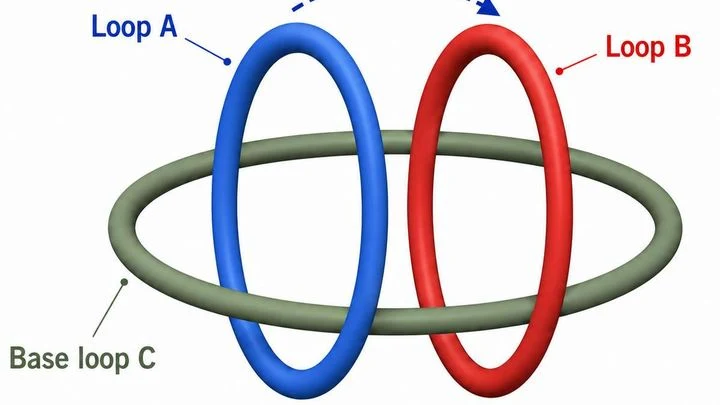
Two threads hang in space. One is looped around the other — physicists call this braiding. For a long time, it was thought that the rules of this dance were rigidly set by the number of dimensions. But the authors of the work found a new maneuver: a special kind of braiding that works in one dimension less than usual.
At temperatures billionths of a degree above absolute zero, a Bose–Einstein condensate emerges — a state where thousands of atoms march in a single quantum key.
A billiard ball strikes another, and the sum of their velocities before and after the collision obeys strict rules. The same happens in the microscopic world: energy, momentum, and charge cannot simply vanish.
Superconductivity and magnetic field are age-old foes: the field barges in like a whirlwind, tearing apart the delicate pairing of Cooper pairs, destroying order.
Quantum technology urgently needs a universal 'translator' between the languages of microwaves and light. Superconducting qubits communicate on centimeter wavelengths, while photons in optical fiber talk at optical frequencies.
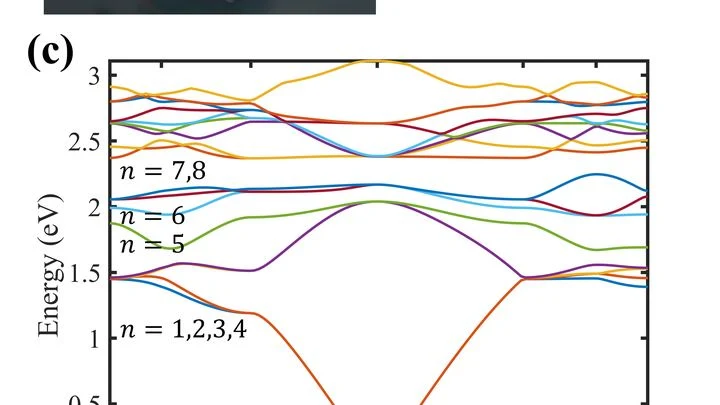
Light gets trapped in a crystal lattice, but not an ordinary one: it's turned inside out, like a honeycomb where instead of wax there's emptiness, and the edges are made of material. That's how an inverted opal is built: a three-dimensional photonic crystal that blocks light of certain colors.
A lone potassium atom enters a dense cloud of sodium atoms cooled to near absolute zero. Such a medium is called a Bose–Einstein condensate — all particles merge into a single quantum wave. One might expect the impurity to simply pick up a single neighbor and form a pair. But the experiment showed something else.
Gravitational-wave observatories are like a keen ear listening for distant rumbles of cosmic catastrophes. To catch the faint whisper of merging black holes, detectors of gravitational waves use specially prepared light — known as squeezed vacuum.
Textbooks divide particles into two camps: bosons love to crowd into the same state, fermions absolutely refuse. But nature allows a third option. Anyons are quasiparticles whose behavior lies somewhere in between. They can 'remember' how they were exchanged and obey a nonstandard exclusion principle.
Picture a pot of boiling soup, but every grain in it is not just a point but a tiny top spinning around its own axis. That's the world of spin-1 particles. For example, some short-lived mesons born in accelerator collisions.
At the center of many galaxies lurks an invisible halo of dark matter: it holds the stars at the edges, keeping them from flying apart. For a long time, it was described as a dilute gas of particles, but new work offers a different view: dark matter might gather into a quantum droplet.
A cloud of rubidium atoms falls into a trap made of light. Lasers and magnetic fields arrange it like a crystal lattice, but the cells here are not fractions of a millimeter: they are fractions of a micrometer.
A pot of water always boils the same way: hit 100 degrees and bubbles start. Quantum fluids are different. When a cloud of atoms is cooled to near absolute zero, it can turn into a single matter wave — a Bose–Einstein condensate. But the transition itself, it turns out, can happen in three different ways.
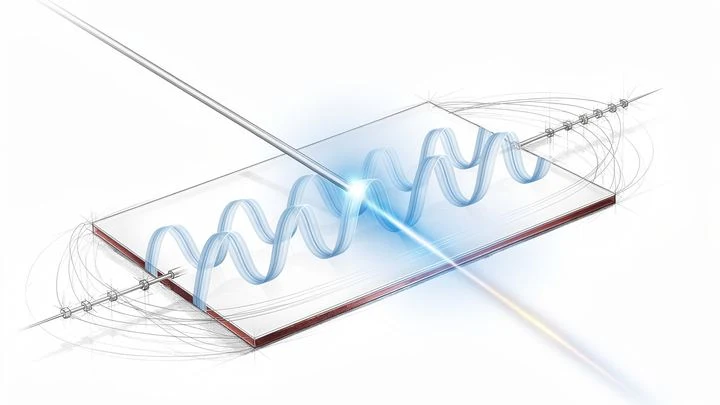
When an electric charge moves with acceleration, it emits electromagnetic radiation, i.e., light — a familiar phenomenon in physics. However, researchers have found that when moving along a specially chosen trajectory, the radiation acquires unusual properties.
Even at absolute rest, atoms emit a faint noise — unavoidable quantum jitter. In the debates between Einstein and Bohr, this noise, like an unceasing whisper, blurs the interference fringes from an atomic slit. Overcoming this limit was considered impossible.
In a football stadium, the crowd's emotions arise from the chatter of individual fans. If mood could be both joyful and sorrowful at once, you'd have a quantum superposition. But the murmur of thousands of voices instantly forces that blend into a single definite state.
The core of a neutron star can be likened to a taut string of super-nuclear density. Sound traveling along it is the oscillation of pressure, whose speed $$c_s$$ betrays the stiffness of matter. New research shows that this cosmic string does not hum monotonically.
A glass chip, threaded with 128 optical waveguides, has been turned into a kind of quantum pinball machine. The role of balls is played by photons — quanta of light, and instead of mechanical flippers, microheaters control the routes, instantly altering the optical paths.
Every isolated quantum system inevitably moves toward thermal equilibrium — a state where all details of the past are erased. It’s like an orchestra: instead of a symphony, it starts playing white noise — random but statistically predictable notes.
A pot of water has just been stirred: the whirlpools and eddies gradually calm down, and the liquid becomes smooth. A similar process, but in the quantum world, occurs in superfluid helium or in a cloud of ultracold atoms.
A cold cloud of atoms is like a swarm of fireflies drawn to one another. The attraction between atoms tries to pack them into a single dense ball. But quantum jitter, the unavoidable motion of particles, keeps the ball from collapsing. When the attraction is strong, the cloud breaks into separate clumps.
A thrown stone falls with acceleration, and from the fall time you can calculate the force of gravity. Scientists repeat this experiment with a cloud of atoms cooled to near absolute zero. Such a cloud falls in a vacuum chamber, and laser pulses split its waves, like light in an interferometer.
An ultracold cloud of atoms trapped in laser light can 'breathe': it rhythmically contracts and expands, much like lungs. Physicists have long been able to observe this breathing, but only now have they realized that its amplitude is not just a pretty picture: it is a precise measure of hidden energy jitters inside the cloud.
In an orchestra where every musician plays the same note, the sound merges into a powerful unison. This is how a Bose–Einstein condensate is born: many boson particles at extremely low temperatures behave as a single entity.
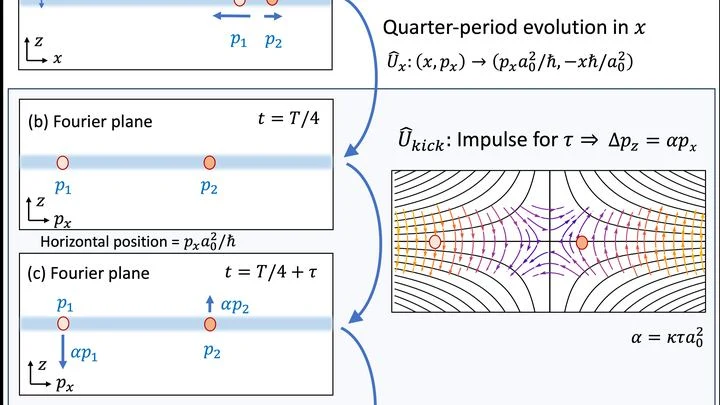
Fireflies flash in a dark forest: you see each flash, but not the flight. A quantum gas microscope can show individual cold atoms, like those fireflies. But until now, it couldn't tell you how fast they're moving.
Now scientists have found a way to fix that.
The light an atom emits is not just a flash. It carries an imprint of the atom's state at the moment of emission. Physicists took a superconducting qubit, an artificial atom the size of a microchip, and made it glow into an open waveguide, like a bulb in a long corridor.
Two particles flying apart in opposite directions behave as a single whole: measuring one instantly determines the state of the other. Such quantum entanglement has long been known for light particles, but now it has been observed for the first time in heavy Z bosons — the carriers of the weak force.
Atoms settled along a chain of traps, like a line of coastal forts. Nearby, a quantum sea: a Bose-Einstein condensate (a substance with zero resistance, where particles move as a single wave).
Magnetic waves in an ultracold gas behave like elastic cords. Two or three such cords can twist into a single knot that breathes: it contracts and expands, but never unravels. For the first time, scientists assembled such knots in the lab and confirmed that their breathing matches calculations exactly.
The gas consisted of two atomic species that do not mix, like oil and water.
In two-dimensional crystals, electrons and holes, quasiparticles corresponding to the absence of an electron and carrying positive charge, attract each other, forming bound pairs called excitons. When cooled strongly, as thermal fluctuations die down, the motions of many excitons can synchronize, like a coordinated dance.
Ordinary tiles form a repeating pattern. But atoms can do more: under certain conditions, they themselves lay out a complex mosaic where the pattern never repeats, like on antique tile panels.