math

knots

A knot is a closed curve in space that cannot be untangled without cutting, often studied in topology and physics.
14 related articles · 1 who worked here

Description

Knot theory classifies embeddings of a circle into three-dimensional space up to isotopy (continuous deformation without self-intersections). The key task is to find invariants that distinguish non-equivalent knots. Among them are the Alexander polynomial (1923) and the Jones polynomial (1984), which brought the author the Fields Medal. Knots naturally arise in physics: as stable field configurations (e.g., magnetic field lines or cosmic strings), and in (2+1)-dimensional systems — as world lines of anyons.

History

The birth of knot theory is associated with the hypothesis of William Thomson (Lord Kelvin) in 1867, who proposed that chemical elements are knots in the ether. Peter Guthrie Tait began compiling tables of knots, classifying all knots up to 7 crossings. With the discovery of the electron and the abandonment of the ether, knot theory receded into the background, but at the beginning of the 20th century, through the efforts of Henri Poincaré and other topologists, it received a rigorous mathematical foundation. In the second half of the 20th century, a renaissance occurred thanks to the discovery of the Jones polynomial (Vaughan Jones, 1984) and connections with quantum physics, the works of Edward Witten and others.

How it works

To classify knots, invariants are used — quantities that do not change under isotopies. The simplest is the number of crossings in a knot diagram. More complex ones include the Alexander polynomial, the Jones polynomial (related to braid group representations and quantum invariants), Vassiliev invariants. The Jones polynomial is computed via skein relations: it is recursively determined through the relationship of knot diagrams that differ only in a small neighborhood of a crossing. In physics, topological knots arise as stable solutions in field theories; for example, in Maxwell's equations there exist electromagnetic knots whose stability is guaranteed by the Hopf topological invariant. World lines of particles in (2+1)-dimensional systems can form knots, leading to fractional statistics.

In practice

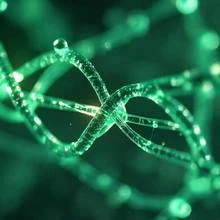
Knots help understand how DNA and proteins are twisted, and can become a basis for super-secure quantum computing.

Fun fact

There exists a knot that cannot be untied, but if you copy its mirror image and join them together, they annihilate like a particle with an antiparticle.
Related articles · 30

Mountain Trails of Quantum Phases
In a mountain range, there are trails that can be contracted to a point if you walk through a flat valley. But there are also loop routes that cannot be shrunk without crossing a ridge.
Mountain Trails of Quantum Phases
In a mountain range, there are trails that can be contracted to a point if you walk through a flat valley. But there are also loop routes that cannot be shrunk without crossing a ridge.
q-bio.QM2026-08-191 minarXiv:2608.18898express
How Collagen Stretches Inside a Tendon
Collagen is the rope from which our tendons, skin, and bones are woven. Each "rope" is a bundle of molecules twisted into a triple helix, like three strands in a cable. Until now, no one had seen what happens to these strands when we pull on the cable.
Quantum Physics2026-08-141 minarXiv:2608.14327express
Quantum snapshots yield a precise angle
A handful of coins drops onto a table — heads and tails land wherever they please. The same goes for an instantaneous snapshot of a quantum chain: in some places a particle is present, in others it is not. But behind the disorder lurks a precise angle. In this work, a chain of particles closed into a ring was considered. It was divided into four arcs: two were measured, two were left untouched.
HEP Phenomenology2026-08-061 minarXiv:2608.05698express
How Light Twists an Electron's Spin
A laser beam is like a swift vortex that briefly captures a passing electron. As the particle moves through the pulse, its spin (the intrinsic rotation, like a tiny top) experiences a weak kick. After leaving the beam, the top no longer points in the same direction; it has turned a little.
Statistical Mech2026-07-281 minarXiv:2607.25625express
How symmetry hides in a spin chain
A quantum chain is like a string of lights, where the bulbs are the spins of particles. Ideally, all bulbs glow in sync, following a common rhythm: that's symmetry. But if you cut off a piece of the string, the rhythm can get out of step: within that segment, symmetry is broken. Physicists study a chain of strongly interacting particles (the XYZ model).
HEP Theory2026-07-242 minarXiv:2607.22938express
How Mass and Charge Swap Roles in a Multidimensional World
A carousel doesn't just spin you around in a circle — with each revolution, it also slightly screws itself into the ground. This corkscrew-like motion is the essence of the NUT charge, a special property of spacetime that physicists have been studying since the mid-20th century.
Strongly Correlated2026-07-071 minarXiv:2607.06279express
How Particle Knots Rewrite the Rules of Statistics
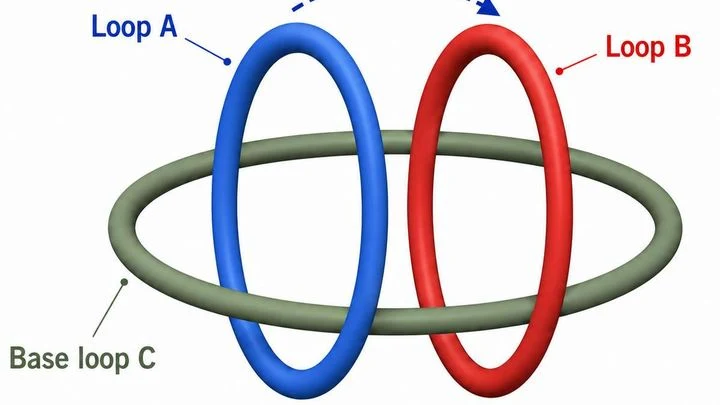
Two threads hang in space. One is looped around the other — physicists call this braiding. For a long time, it was thought that the rules of this dance were rigidly set by the number of dimensions. But the authors of the work found a new maneuver: a special kind of braiding that works in one dimension less than usual.
math.GT2026-07-012 minarXiv:2607.00337
The Loop That Vanishes in Shadow: The Simplicity of Schottky Space
Dim the lights. The stage belongs to a shadow theater, with just r puppeteers, but the screen obeys the laws of hyperbolic geometry. Every wave of the hand births a pattern that mathematicians call a discrete group of isometries.
How Squeezing Rubber Gives Rise to Elusive Angles
A sheet of rubber is squeezed from two sides. At first glance, it's just deformation. But inside, deep within the material, a hidden order awakens. This is not just wrinkles on the surface. It's the birth of special zones where vibrations become trapped, as if in a cage. Previously, it was thought that such effects require intricate lattices and periodic structures.
HEP Phenomenology2026-06-092 minarXiv:2606.10698express
A Narrow Laser for Heavy Integrals
Many cutting-edge physics calculations hit a brick wall — not for lack of ideas, but because of arithmetic. We're talking about integrals that express particle collision probabilities or the shape of gravitational wave bursts.
Atomic Physics2026-06-072 minarXiv:2606.08528express
Quantum Knots from Particle Trajectories
A thrown stone follows a smooth arc: its path is easy to predict. But if the stone skips across water, the trajectory becomes jagged and far more interesting. Quantum particles behave much the same way when their state is not a calm wave with fixed energy but a turbulent mix of several waves at once.
Optics2026-06-062 minarXiv:2606.07991express
Light That Weaves Knots
Light from an ordinary bulb seems utterly chaotic: its waves oscillate out of sync, like a crowd where everyone walks in their own direction. Such light is called incoherent. For a long time, it was believed that elegant topological structures (knots, rings, links) could only be created in coherent laser light, where all waves march in step.
Knots in polymer rings change shape with heat
Take a long thread, close it into a ring, and tie a knot in it. The knot slides along the thread until it hits something. Now imagine the thread is made of two different segments: one stiff and slippery, the other soft and sticky. When heated, the sticky segment softens, and the knot can slide off it, like a sled sliding off a melting hill.
HEP Theory2026-04-242 minarXiv:2604.22918express
How Particle Loops Become Invisible Threads
In the first moments of the universe's existence, space was filled with hot plasma, where particles emerged and disappeared like bubbles in a boiling pot. The traces of these processes, stretched to gigantic sizes by expansion, are preserved in the cosmic microwave background — ancient light that has reached us across billions of years.
How a Cell Makes a Waist
A cell about to divide first marks its waist. Beneath its membrane, in a thin gel of protein filaments, movement begins. The filaments flow like a slow river, and a belt forms in the middle of the cell. This belt tightens more and more until the cell is pinched in half. Scientists built a computer model of this process.
Knot Controls Polymer Swelling
A flexible thread, coiled into a loop, was locked in a tiny box with liquid. It can either absorb water and swell like a sponge, or expel the moisture and shrink into a tight ball. The choice between these states depends on whether the thread has a knot – and which one. The reason lies in entropy, a measure of disorder.
Soft Particles Assemble into Patterns
A drop of water with tiny particles dries on a table. The water evaporates, leaving the particles behind, and they arrange into a pattern, like sand after the tide. But if the particles are soft, the pattern turns out quite different. Researchers studied this process under a microscope, varying only one property of the particles: their elasticity.
Materials2026-02-272 minarXiv:2602.23682express
Magnetic Knot in a Rubber Beam
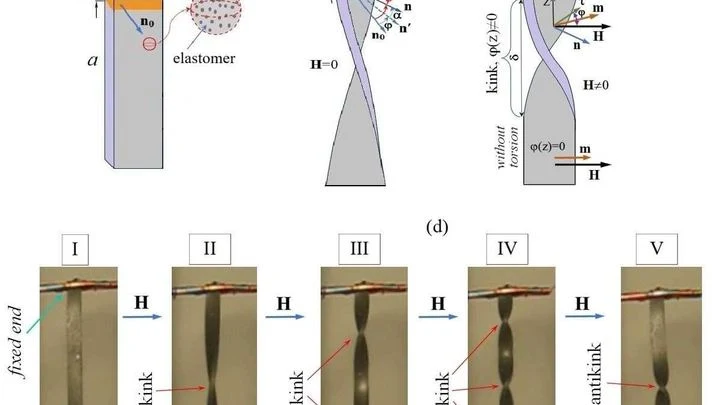
An ordinary rubber strip filled with fine iron filings doesn't just bend in a magnetic field: it ties itself into a stable knot. This effect was predicted and reproduced in experiments by physicists working with magnetoactive elastomers: a silicone base with carbonyl iron particles.
Mesoscale2026-01-251 minarXiv:2601.17790express
Magnetic Knots That Won't Come Undone
Inside a piece of magnetic material, electron spins, tiny magnetic arrows, usually arrange into simple patterns. Sometimes they swirl into vortices, like water down a drain, and these vortices can tie themselves into knots.
The Snapping Arch: How to Control the Click
Snap the bottom of a soda can: it will dent inward and stay that way. Press again: it pops outward. That's bistability: a system with two stable states, like a light switch. An elastic arch is the simplest example. It can curve upward or downward, and to flip it, you need to apply force.
Quantum Gases2026-01-081 minarXiv:2601.04662express
How a Pair of Particles Bounces Off a Wall
Two particles cling to each other like climbers on the same rope and fly toward a wall. When they hit, will they bounce off together, or will the rope snap? What does it depend on? Physicists considered the simplest case: everything happens on a single line, the particles attract only when they occupy the same point, and the wall is perfectly rigid.
Glue and Springs: How to Assemble the Perfect Pattern
A handful of magnetic beads, when shaken, clump together. But add springs that push the beads apart at a distance, and the clumps break up into neat islands. Roughly this is how the particles in the new study behave: they attract at close range but repel from afar. The authors simulated millions of variants of this 'glue with springs' on a computer.
Quantum Physics2025-11-101 minarXiv:2511.06844express
How Light Reveals the Hidden Laws of Open Systems
Open systems exchange energy with their surroundings, like a guitar string fading into the air. Scientists built such a system out of light, twisting the beams into corkscrews and forming an artificial lattice — a maze where losses can be controlled at every step. Light in this maze always moves at the maximum possible speed, but its energy can fade or grow.
Mesoscale2025-11-021 minarXiv:2511.00817express
Particles with Memory: A Step Toward an Invulnerable Quantum Computer
All matter, from stars to humans, is built from particles that in the Standard Model are divided into two families. But there's a third, rare kind — particles that, when swapped, don't just exchange places but tie themselves into a knot, remembering the intertwining rather than the path.
Quantum Physics2025-10-241 minarXiv:2510.21636express
Encounter with a Shutter: How a Photon Creates a Fountain of Probabilities
Light consists of portions — photons. Max Planck was the first to understand that light is emitted in quanta. Today, we can guide single photons. When such a photon encounters a fast shutter, it cannot be sliced — half a photon doesn't exist. Instead, a quantum mixture of states with different photon numbers emerges: zero, one, two, three..
Quantum Crossroads with No Turning Back
In a chain of cold spins stretched along a single line, order and disorder can intertwine into a pattern that defies the usual rules. Two states of matter, two kinds of "order," are separated by a crossroads where the roads do not converge but diverge.
The Knot That Cannot Be Untied: How Interactions Rewrite Charge in a Topological Chain
In 1979, Su, Schrieffer, and Heeger proposed a model that explained the strange electrical properties of polyacetylene, an organic polymer that conducts electricity almost like a metal. Their chain consisted of carbon atoms connected alternately by single and double bonds.
Mesoscale2018-08-272 minarXiv:1808.09043express
Quantum Tangles: How to Spot an Invisible Connection
A stone falls into water, and ripples spread outward. In the quantum world, a magnetic impurity (that pebble) in a metal perturbs the surrounding electrons, and they form a special cloud around it. This is called the Kondo cloud. Like ripples on water in the dark, it long remained elusive.
Strongly Correlated2011-12-252 minarXiv:1112.5783express
The Magnetic Knot That Refuses to Come Undone
A crowd in a square. At first, everyone spins to their own rhythm, but suddenly the music changes, and they all start moving in sync, as one. That's roughly how electrons behave in some metals: they either cling to magnetic impurities or break away and form a collective order.