An elliptic curve is defined by the equation y² = x³ + ax + b. Its graph is a smooth, symmetric curve without self-intersections. On the set of its points (including the point at infinity) one can define an addition operation, turning the curve into a commutative group. This means addition follows the same laws as ordinary numbers: there is a 'zero', an inverse element, and associativity. But the geometry of addition is unusual: to add two points, we draw a secant line through them, find the third intersection with the curve, and reflect it across the x-axis. In cryptography (e.g., the Diffie–Hellman protocol on elliptic curves), security relies on the difficulty of the discrete logarithm problem: given an initial point P and an endpoint Q = n·P, computing the number n is virtually impossible.
History
The study of elliptic curves began with elliptic integrals in the works of Abel and Jacobi in the first half of the 19th century. The term 'elliptic' arose from their connection to computing the arc length of an ellipse. Henri Poincaré contributed to the study of algebraic curves and their groups. In 1985, Neal Koblitz and Victor Miller independently proposed using elliptic curves in cryptography, leading to the widespread ECC systems used today. The link to modular forms, established by Wiles and Taylor, resolved Fermat's Last Theorem.
How it works
The group law on an elliptic curve forms an abelian group. For a curve over a finite field F_p, this group has order about p+1, and the difficulty of the discrete logarithm problem in this group underpins cryptographic security. In protocols like ECDSA, a message is signed using a secret key—a multiplier n—and verified with the public key Q = n·P. Computing n from Q and P is the ECDLP, for which no subexponential algorithms are known in general. Additionally, elliptic curves over the rationals carry a rich structure: by the Mordell–Weil theorem the group of rational points is finitely generated, and its rank and regulator are linked to the L-function of the curve via the Birch and Swinnerton-Dyer conjecture. Thus, the mathematical lock of a smooth curve guards our digital borders.
In practice
HTTPS protocols, cryptocurrency wallets, digital signatures—anywhere a fast and secure digital lock is needed.
Fun fact
Perhaps the most famous elliptic curve is the one connected to Fermat's equation. Andrew Wiles proved Fermat's Last Theorem by establishing a link between elliptic curves and modular forms.
A thrown stone arcs through the air, but a planet around the Sun follows a closed curve. Why an ellipse, and not a circle or a spiral? Kepler's first law provides the answer, but its usual proof requires heavy computation. This work offers a shorter path — through a single simple ratio of velocities.
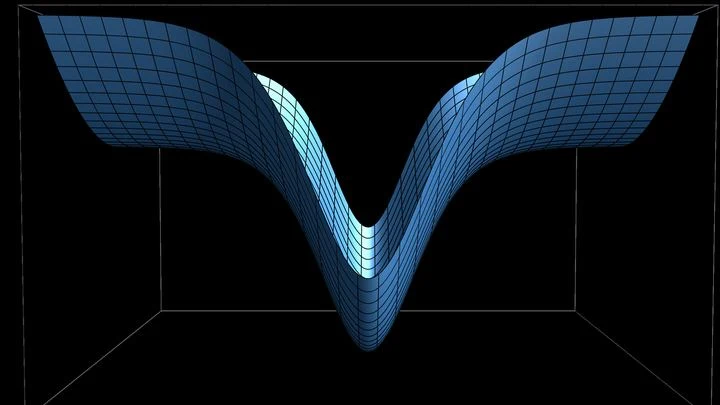
A vortex in a magnetic material is like a whirlpool, but instead of water, the directions of magnetization twist. An electron flying through such a vortex feels not just a magnetic field, but a curvature of space: its path bends as if it were rolling down a funnel with a narrow neck.
In 1998, mathematician David Boyd noticed something strange. He was studying the Mahler measure of polynomials, a quantity that gauges the "complexity" of their roots, and found that for a family of curves, it always equals a special rational number times the derivative of an L-function.
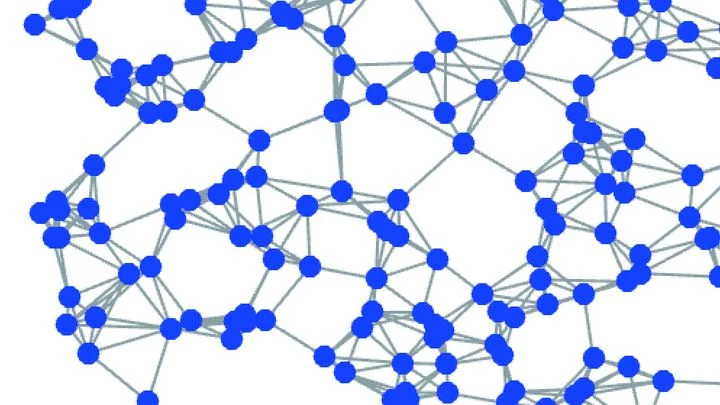
An ordinary road map with traffic is a heap of numbers. Sending them all as is takes too long. But you can reduce the volume without losing the gist. Researchers found a clever solution: first redraw the map so that streets become points, and intersections become bridges between these points.
Forget the flat sheet: embryonic tissue is a dynamic landscape of hills and folds. On convexities, cells stretch; in concavities, they compress, as if performing a dance governed by laws eerily similar to spacetime curvature.
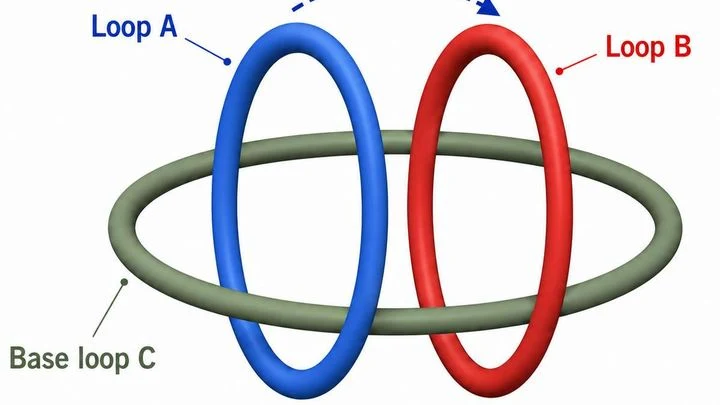
Two threads hang in space. One is looped around the other — physicists call this braiding. For a long time, it was thought that the rules of this dance were rigidly set by the number of dimensions. But the authors of the work found a new maneuver: a special kind of braiding that works in one dimension less than usual.
In the ocean, a whirlpool pulls everything into a closed loop, just as a gravitational wave in empty space twists time into a loop. Gravitational wave — a ripple in the fabric of spacetime, and its special shape can turn the usual flow of events into a closed cycle. In such a zone, an object can return to its own past without violating the laws of physics.
The number −0.000459 is no random guest in the Blasius equation. It's the coefficient of η⁵, defining the boundary layer on a flat plate — a thin whisper of air friction against metal. Standard numerical methods like Runge–Kutta yield only an approximate curve. Physics-informed neural networks (PINNs) try to guess the entire solution. Often — unsuccessfully.
The boundary sets the rules
Quantum gravity is like a theater where spacetime is the stage and fields are the actors. When the stage has an edge, you need to know exactly what happens at the boundary; otherwise, the play falls apart. In 2018, Edward Witten proposed an elegant recipe for such a case.
The night sky sometimes throws up riddles that take your breath away. One of them is a ring of galaxies stretching across a third of the horizon. Astronomers have named it the “Giant Ring on the Sky”: a cluster of galaxies stretched into a thin filament and closed into a circle about 400 megaparsecs in diameter.
A plastic heart rests on the water and doesn't tip over, no matter how you turn it. It freezes in any position, as if the water were holding it by invisible strings. This trick is possible thanks to the Zindler curve — a shape in which all lines that divide the area in half have the same length. The Zindler curve is a closed curve where any chord that bisects the area has the same length.
A diary loses pages, yet the story migrates to the rest. Black holes act similarly: as they shrink (shown by Stephen Hawking), swallowed information shouldn't vanish; it eventually resurfaces. Theory predicts a specific rise-and-fall curve for this escape.
Graphs are considered identical if their 'terrain' matches. Imagine two maps with mountains and valleys: even if drawn differently, the heights and steepness of slopes can be the same.