Non-abelian anyons are quasiparticles that exist only in two-dimensional systems and obey exotic quantum statistics. Unlike ordinary particles (fermions and bosons), swapping two anyons does not just multiply the quantum state by a simple phase factor — the order of swaps matters, and the final state depends on the braiding history. This non-commutative property is the key to their potential use in topological quantum computing, where quantum information is encoded in the braiding patterns of these particles, making it inherently protected from local noise.
History
The concept of anyons was introduced by Frank Wilczek in 1982, and the idea of non-abelian anyons was developed by Gregory Moore and Nicholas Read in 1991, and independently by Xiao-Gang Wen. The theoretical framework was further advanced by Alexei Kitaev in 1997, who proposed concrete physical systems for their realization.
How it works
In two dimensions, the path of a particle around another can be continuously deformed in ways impossible in three dimensions, allowing for anyonic statistics. For non-abelian anyons, the Hilbert space of the system has a degeneracy: multiple distinct quantum states share the same energy. Braiding two anyons performs a unitary transformation within this degenerate subspace, effectively performing a quantum gate. The result of a sequence of braids depends on their order, hence 'non-abelian' — the operations do not commute.
In practice
Non-abelian anyons are the foundation of topological quantum computers, where quantum information is stored in the braiding history of quasiparticles, offering inherent error resistance. They are also studied in fractional quantum Hall systems and in proposals using Majorana fermions in superconducting nanowires.
Fun fact
The braiding of non-abelian anyons is mathematically equivalent to the operation of a quantum computer, meaning that if you can control their braiding, you can perform any quantum computation.
The quantum world is full of surprises: swap two electrons, and their combined wavefunction just changes sign; swap two photons, and nothing happens at all. But there are particles that behave very differently when exchanged, as if they remember being swapped. These particles are called anyons, and they can only exist in a two-dimensional world.
In the world of quantum particles, there are introverts — anyons. They are unlike familiar electrons or protons. If you swap two such introverts, they remember the maneuver, as if leaving an invisible trace.
The quantum world is tricky: sometimes particles confined to a flat layer and pierced by a strong magnetic field start behaving like a liquid made not of whole electrons but of their fractions — fractional charges. This is the fractional quantum Hall effect.
A mosaic of squares and triangles covers the floor without gaps, yet it never settles into a simple repeating pattern. Such a pattern is a quasicrystal — a solid where atoms are arranged not periodically but according to a pattern of several waves of different lengths. These waves are incommensurate with each other, and together they create long-range order.
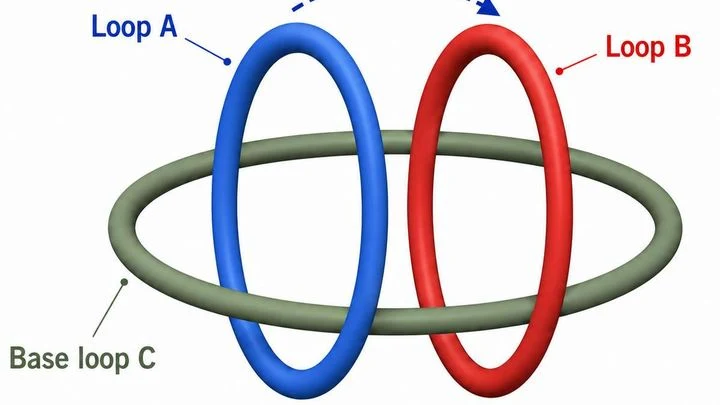
Two threads hang in space. One is looped around the other — physicists call this braiding. For a long time, it was thought that the rules of this dance were rigidly set by the number of dimensions. But the authors of the work found a new maneuver: a special kind of braiding that works in one dimension less than usual.
The hunt for non-Abelian anyons is a quest for a quantum ghost that leaves only one clue: entropy. These particles live in two-dimensional systems at ultralow temperatures. Their exchange doesn't just flip the sign of the wavefunction — it entangles states, creating topological order.
Textbooks divide particles into two camps: bosons love to crowd into the same state, fermions absolutely refuse. But nature allows a third option. Anyons are quasiparticles whose behavior lies somewhere in between. They can 'remember' how they were exchanged and obey a nonstandard exclusion principle.
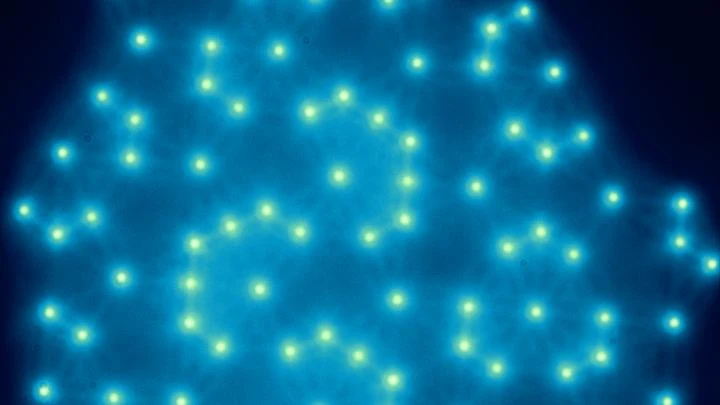
A cloud of rubidium atoms falls into a trap made of light. Lasers and magnetic fields arrange it like a crystal lattice, but the cells here are not fractions of a millimeter: they are fractions of a micrometer.
At the SuperKEKB accelerator, electrons collide with positrons, and among the debris, B-mesons are found. These heavy particles live briefly and break apart into lighter ones. Recently, the Belle II detector recorded a suspiciously high number of cases where a B-meson transforms into a K-meson (kaon) and something invisible—2.7 sigma more than expected.
Tile a floor with identical triangles, and you get a boring repeating pattern. But what if you want the pattern to never repeat, yet use just one tile? For a long time, mathematicians were sure it couldn't be done: you'd need at least two different shapes. The famous Penrose mosaic is a case in point: rhombi with acute and obtuse angles arrange into an infinitely varied but strictly ordered pattern.
The core of a neutron star can be likened to a taut string of super-nuclear density. Sound traveling along it is the oscillation of pressure, whose speed $$c_s$$ betrays the stiffness of matter. New research shows that this cosmic string does not hum monotonically.
An ordinary magnet makes a compass needle turn, but it doesn't stop the needle from moving forward. But if you twist a magnetic field into a knot, it can trap a particle in place, like a snare. This phenomenon is called an 'Aharonov–Bohm cage': the particle's waves cancel each other out at some points and reinforce at others, leaving only tiny 'islands' where it can exist.
A superconducting qubit is a tiny electrical circuit that behaves like an artificial atom. In its normal state, current flows through it without resistance, and the energy levels are evenly spaced, like steps on a staircase. But if a single electron gets stuck in the circuit, everything changes.
Hot water sometimes freezes faster than cold — that's the classic Mpemba effect. In the quantum world, its counterpart is even more astonishing: tiny particles can reach equilibrium many times faster than expected, and what helps them is not forgetfulness, but memory.
Scientists have discovered that on a special triangular lattice, like a tightly woven carpet, particles freeze in place. They don't bump into neighbors or lose energy. Probability waves cancel out like opposing threads in a loom, locking the particle-knots tight.
Atoms, like strands in a braid, follow a strict rule: if one strand is 'charged', its neighbors must stay silent. This phenomenon, Rydberg blockade, allows stable quantum patterns to be woven.
In such patterns, topological order emerges: a structure where the overall weaving pattern matters more than individual loops.
All matter, from stars to humans, is built from particles that in the Standard Model are divided into two families. But there's a third, rare kind — particles that, when swapped, don't just exchange places but tie themselves into a knot, remembering the intertwining rather than the path.
Deep inside a superconductor, electrons pair up into Cooper pairs and glide without resistance. But if a vortex appears in this perfect order, a tiny region where superconductivity vanishes, special excitations emerge there: Bogoliubov quasiparticles.
A stretched string between two quarks doesn't pop instantly like a rubber band. It first vibrates, develops knots, and only then breaks, if it breaks at all. This isn't just a metaphor; it's an accurate description of what physicists call confinement: quarks are permanently locked inside hadrons, and the only way to separate them is to snap the flux tube that binds them.