Braiding is a proposed technique for performing quantum computations in a topologically protected manner, primarily associated with anyons in two-dimensional systems. Unlike ordinary particles, anyons have the exotic property that their quantum state changes when they are exchanged, and this change depends only on the topology of their worldlines, not on the details of the path. By carefully moving quasiparticles around each other in a two-dimensional plane, one can perform a set of operations known as braids, which can be used to encode and manipulate quantum information in a way that is inherently resistant to local errors.
History
The concept of anyons and their braiding statistics was introduced by Frank Wilczek in 1982, and the idea of using them for topological quantum computation was proposed by Alexei Kitaev in 1997 and independently by Michael Freedman and collaborators. The search for non-Abelian anyons in real materials has been a major experimental effort since then.
How it works
The idea relies on the existence of quasiparticles called non-Abelian anyons, such as Majorana zero modes, which are predicted to emerge in certain condensed matter systems. When two such anyons are exchanged, their combined quantum state undergoes a unitary transformation that is determined solely by the braiding operation. By creating a network of anyons and moving them in specific sequences, one can implement a set of quantum gates. The topological nature of the braiding means that small perturbations or local noise do not affect the result, providing a natural form of error correction.
In practice
Braiding is the foundational principle behind topological quantum computers, which are being developed by companies like Microsoft, aiming to create a scalable and fault-tolerant quantum computer using Majorana-based qubits.
Fun fact
In 2020, researchers at Microsoft reported evidence of Majorana zero modes in a nanowire device, but the results were later retracted due to data analysis errors, highlighting the extreme difficulty of experimentally realizing braiding.
On the table lies a layered cake of hexagonal boron nitride flakes, a material similar to graphite but made of boron and nitrogen atoms. One flake is carefully transferred onto another, and at the spot where they overlap, after heating in oxygen, bright single light sources are born.
The quantum world is full of surprises: swap two electrons, and their combined wavefunction just changes sign; swap two photons, and nothing happens at all. But there are particles that behave very differently when exchanged, as if they remember being swapped. These particles are called anyons, and they can only exist in a two-dimensional world.
A quantum computer based on neutral atoms is like a city where couriers, laser tweezers, physically carry packages between addresses. While one courier drags an atom across the entire chip, the others sit idle. This is slow and error-prone.
The new architecture replaces couriers with a shared radio wave.
A quantum annealer is like a smart oven: it searches for the lowest point in an energy landscape to find the answer. But many constrained problems, like "pick exactly three items"—can't be loaded directly into such an oven. They have to be translated into unconstrained quadratic formulas, usually by adding penalties.
A laser beam can do more than heat things up: it can also calm motion. When light enters a mirror trap, it exerts pressure on the mirrors, and if you tune the beam's color just right, that pressure becomes a gentle braking force. This is how tiny mechanical vibrations are cooled to nearly absolute zero.
In a room with a dead corner, sound doesn’t travel. On the wall there’s a smart mirror: it catches the sound and re-reflects it, making the hidden audible. That’s how a reflective surface works in wireless communication. But if the source is right in front of you, the mirror only creates an echo.
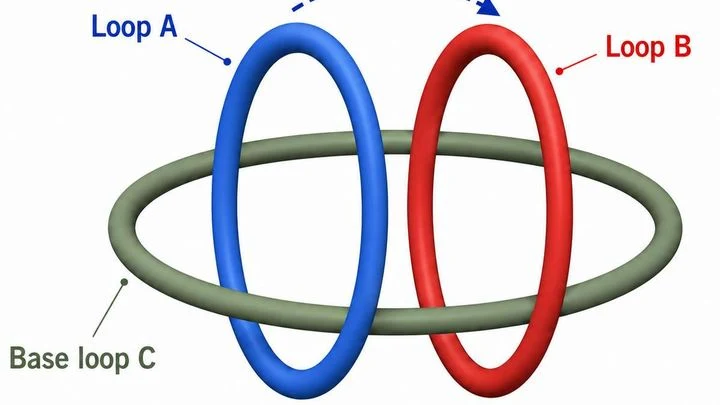
Two threads hang in space. One is looped around the other — physicists call this braiding. For a long time, it was thought that the rules of this dance were rigidly set by the number of dimensions. But the authors of the work found a new maneuver: a special kind of braiding that works in one dimension less than usual.
Training a large neural network across hundreds of compute nodes is like making soup as a team: each 'chef' tastes the dish and tells the others what to adjust.
Textbooks divide particles into two camps: bosons love to crowd into the same state, fermions absolutely refuse. But nature allows a third option. Anyons are quasiparticles whose behavior lies somewhere in between. They can 'remember' how they were exchanged and obey a nonstandard exclusion principle.
A quantum computer is like an orchestra where each musician plays their part, but if one hits a wrong note, the melody falls apart. Errors arise constantly: from thermal jitter, from imperfect instruments. To keep the symphony going, you need a "conductor" who hears the off-key notes and corrects them on the fly.
A bridge of aluminum just a few atoms thick is the heart of many quantum devices. Current flows through such a bridge without resistance, and it can be controlled with a magnetic field. These bridges are called Josephson junctions, after the British physicist who described their behavior.
Gravitational wave detectors work like sensitive microphones, picking up the trembling of space from distant cosmic catastrophes. When two black holes merge into one, the newborn object rings like a bell, and that ringing is a unique 'voice' of gravity.
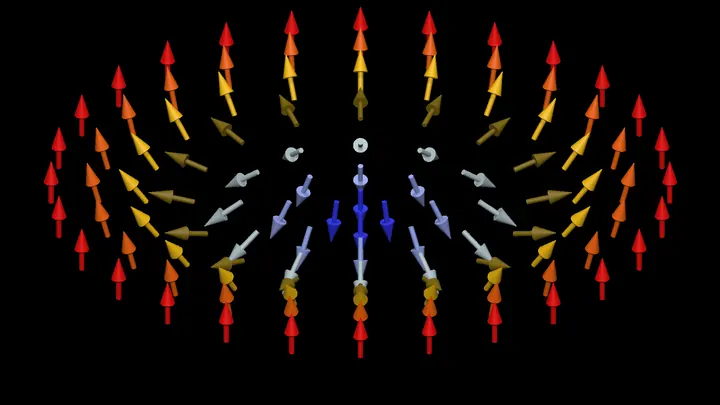
In a field trap, scientists assembled a crystal — 150 ions at ultra-low temperature. Each ion behaves like a tiny magnet, capable of rotating in any direction. By controlling forces that depend on this rotation, physicists made all the magnets swirl into a common vortex called a skyrmion.
In a cold cloud of atoms chilled to near absolute zero, energies can behave like threads that weave into braids. These braids are not just a pretty image: their pattern is tied to topology, the branch of mathematics that studies properties preserved under continuous deformations.
An ice cube in tea melts without a trace. Similarly, quantum systems usually quickly forget their past. But under strong disorder, many-body localization emerges — particles seem to freeze, preserving memory.
The experiment on IBM's 144-qubit processor lasted 5000 cycles.
A quantum computer isn't a monolith: it's more like an orchestra, where each qubit must play its part without drowning out the neighbors. In ion-based machines, two types of qubits are used: some store information, others process it. Previously, each type required its own laser, like separate batons for violins and trumpets.
Imagine two synthetic diamonds, each acting as a high-precision tuning fork. Inside the crystal lattice of each diamond sits a carbon-13 atom: this is a quantum bit, or qubit, the minimal unit of quantum information.
Atoms, like strands in a braid, follow a strict rule: if one strand is 'charged', its neighbors must stay silent. This phenomenon, Rydberg blockade, allows stable quantum patterns to be woven.
In such patterns, topological order emerges: a structure where the overall weaving pattern matters more than individual loops.
All matter, from stars to humans, is built from particles that in the Standard Model are divided into two families. But there's a third, rare kind — particles that, when swapped, don't just exchange places but tie themselves into a knot, remembering the intertwining rather than the path.
Quantum batteries lose energy due to entropy — the tendency toward disorder. Just as parallel wires pick up interference, the battery's contacts with the environment create leakage channels. The solution: braid the giant atoms, which act as both charger and storage, into a braid.
Deep inside a superconductor, electrons pair up into Cooper pairs and glide without resistance. But if a vortex appears in this perfect order, a tiny region where superconductivity vanishes, special excitations emerge there: Bogoliubov quasiparticles.
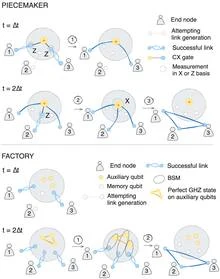
Assembling a puzzle as pieces arrive, rather than waiting for the complete set, is the philosophy behind a new protocol for distributing quantum entanglement. In quantum networks, where nodes exchange Bell pairs, the traditional approach resembles a patient assembler who waits until all pieces are on the table before starting.
Four cesium atoms hang in vacuum, held by laser tweezers like beads on an invisible thread. Around them is a ring resonator, a closed loop of mirrors where light circulates without obstacles. When a probe beam strikes this tiny chain, something strange happens: the atoms scatter light not uniformly in all directions, but predominantly in one direction.
Inside a diamond, you sometimes find tiny flaws — a spot where a carbon atom is replaced by nitrogen, with a vacancy right next to it. Physicists call this an NV center (a nitrogen-vacancy defect). Such a defect acts like a magnetic needle that can store information in its spin.
A supercomputer simulating laser plasma is like a kitchen where hundreds of chefs are preparing a single dish. If ten people crowd around one stove while another stands empty, the work grinds to a halt. The same happens in simulations: plasma particles bunch up in certain regions of space, leaving others nearly empty.