Quantum statistics is the set of rules that govern how identical particles behave when they are crowded together at the quantum level. Unlike classical statistics, where particles are treated as distinguishable billiard balls, quantum statistics recognizes that particles of the same type are fundamentally indistinguishable. This leads to two dramatically different behaviors: fermions (like electrons and protons) obey the Pauli exclusion principle, meaning no two can occupy the same quantum state, while bosons (like photons and gluons) can pile into the same state without limit. These rules are the foundation for understanding everything from the structure of atoms to the behavior of neutron stars.
History
The distinction was first formalized by Enrico Fermi and Paul Dirac in 1926 for fermions, and by Satyendra Nath Bose and Albert Einstein in 1924–25 for bosons, building on earlier work by Wolfgang Pauli.
How it works
The distinction arises from the symmetry of the quantum wavefunction. When two identical fermions are swapped, the wavefunction changes sign (antisymmetric), which forces the probability of them being in the same state to zero. For bosons, the wavefunction stays the same (symmetric), so they can all crowd into the lowest energy state, creating phenomena like Bose-Einstein condensates. This is encoded in the spin-statistics theorem, which links a particle's intrinsic spin (half-integer for fermions, integer for bosons) to its statistical behavior.
In practice
Quantum statistics underpins the design of semiconductors and transistors, where electron behavior is governed by Fermi-Dirac statistics, and is also essential for understanding superfluidity and superconductivity.
Fun fact
The Pauli exclusion principle, a direct consequence of fermionic statistics, is the reason white dwarf stars don't collapse under their own gravity.
The quantum world is full of surprises: swap two electrons, and their combined wavefunction just changes sign; swap two photons, and nothing happens at all. But there are particles that behave very differently when exchanged, as if they remember being swapped. These particles are called anyons, and they can only exist in a two-dimensional world.
On the wall: light and dark fringes. That’s what light looks like when it cancels itself out.
Way back in the 17th century, Christiaan Huygens suggested that light is a wave.
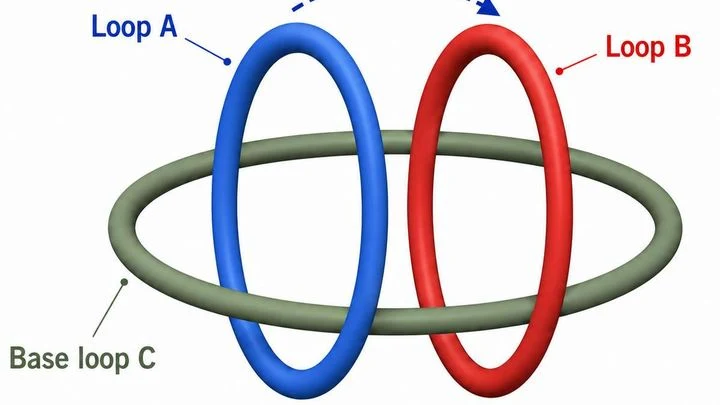
Two threads hang in space. One is looped around the other — physicists call this braiding. For a long time, it was thought that the rules of this dance were rigidly set by the number of dimensions. But the authors of the work found a new maneuver: a special kind of braiding that works in one dimension less than usual.
Twins enter a room from different doors. Each gets a box with a button, and each time they press it, either a red or a green light flashes. If the twins are perfectly identical, you'd expect their lights to follow the same internal rules. But what if the rules differ even though the twins are exact copies?
That's precisely the scenario the authors explored.
Textbooks divide particles into two camps: bosons love to crowd into the same state, fermions absolutely refuse. But nature allows a third option. Anyons are quasiparticles whose behavior lies somewhere in between. They can 'remember' how they were exchanged and obey a nonstandard exclusion principle.
A cloud of rubidium atoms falls into a trap made of light. Lasers and magnetic fields arrange it like a crystal lattice, but the cells here are not fractions of a millimeter: they are fractions of a micrometer.
In a football stadium, the crowd's emotions arise from the chatter of individual fans. If mood could be both joyful and sorrowful at once, you'd have a quantum superposition. But the murmur of thousands of voices instantly forces that blend into a single definite state.
If you squeeze a handful of sand in your fist, it first compacts, but then starts to resist — the grains have nowhere left to go. In the depths of a neutron star, something similar happens, except instead of sand grains, you have elementary particles, and instead of your hand, you have monstrous gravity.
The light an atom emits is not just a flash. It carries an imprint of the atom's state at the moment of emission. Physicists took a superconducting qubit, an artificial atom the size of a microchip, and made it glow into an open waveguide, like a bulb in a long corridor.
In the 19th century, James Clerk Maxwell imagined a tiny demon. It knows the speed of every gas molecule and opens a door: fast ones to the left, slow ones to the right. This creates a temperature difference without expending energy, seemingly violating the laws of physics.
A random fiber laser is a thin glass thread through which light travels, but instead of reflecting off mirrors, it reflects off the tiniest irregularities in the fiber itself. Such a laser doesn't produce a steady beam: its light flickers and flares like a candle flame in a draft.
The law discovered by Wolfgang Pauli forbids identical particles from occupying the same spot. Hence, in cold matter, a Fermi sea is born: particles, like water, fill energy levels from bottom to top. The shape of the sea's surface — including 'islands' of emptiness — dictates the properties of the whole system.