Knock, knock, who's there? Majorana express
An interpreter gets distracted by every rustle in the hall, and a one-hour meeting stretches into two. That's roughly how scientists have spent years searching for special states in tiny electrical chains: they watched the total current but missed how the signal was corrupted by noise. Now a method has been proposed that listens not to the interpreter but to how synchronously people at opposite ends of the table nod their heads.
Three quantum dots (artificial atoms where an electron is trapped as if in a pit) are arranged in a line. If everything is tuned perfectly, two smeared blobs appear at the ends of the chain — the so-called Majorana modes. They behave like halves of an electron: each sits at both ends at once, and together they form a whole particle. The trouble is that a conventional current measurement through the chain cannot distinguish such a smeared pair from a simple electron stuck to one end.
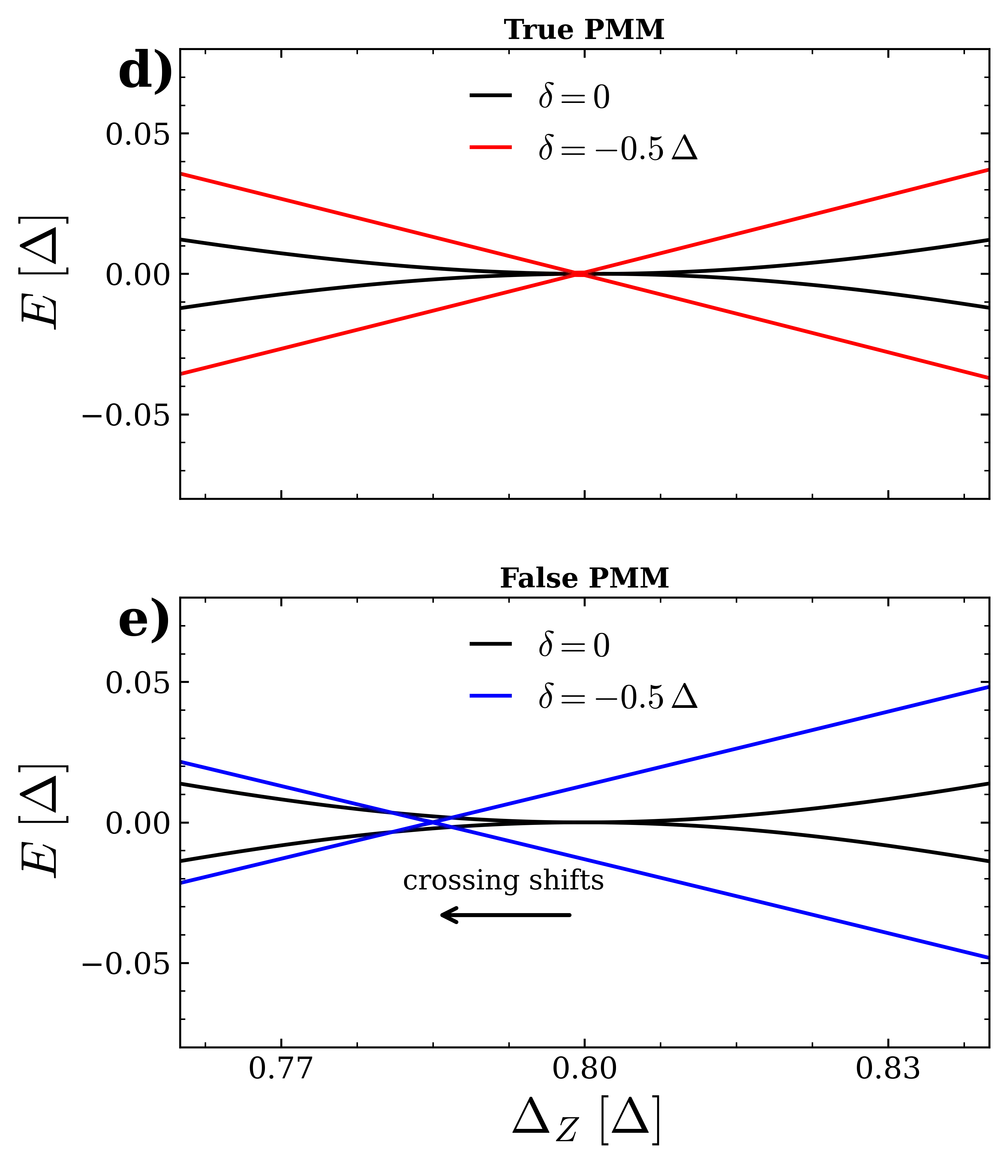
The authors propose measuring not just the current but its cross-correlation noise — how strongly the current at one end of the chain fluctuates when the current at the other end fluctuates. If the modes are real and spread over the ends, these fluctuations become large and stable. Interestingly, even if you slightly detune the outermost dot, the noise hardly changes, as if the system maintains its own balance.
This approach is not just another tool but a way to finally say with confidence: yes, we have caught that very smeared pair. For quantum computers, this is critical: Majorana modes promise to store information in a way that a random jolt won't erase, and now there is a way to verify that the protection actually works.
Original abstract
as written by the authors arXiv:2607.23498
The minimal Kitaev chain that emulates a topological superconductor with three quantum dots offers a tunable platform for potentially hosting poor man's Majorana (PMM) modes. Asserting the need to go beyond differential conductance spectroscopy, we introduce current-current correlations as a viable framework for verifying their true non-locality. The robustness of the PMM modes, specifically with respect to delocalization as the system is tuned away from sweet spots, we show, is embedded in the relative magnitudes of the nonlocal transport processes. This aspect is adeptly captured by current cross-correlations, whose features show remarkable stability around the PMM sweet spot, specifically with respect to the detuning of an outer dot. We establish this as a prominent feature and a diagnostic for true PMMs even in the short chain limit. Our results accentuate the need for current cross-correlation measurements as a diagnostic framework for unambiguously verifying true non-locality of entangled states as well as topologically protected states.
Majorana modes are named after the Italian physicist Ettore Majorana, who predicted particles that are their own antiparticles and then mysteriously disappeared in 1938.
In the series "The Expanse," the mysterious protomolecule uses quantum effects reminiscent of nonlocal connections between particles to transmit information instantly across vast distances.