An artificial atom is a deliberately engineered quantum system that reproduces the key property of a natural atom: discrete, quantized energy levels. Unlike real atoms, which are fixed by nature, artificial atoms are built in the lab from solid-state materials or superconducting circuits, and their energy spacing can be tuned by design. This makes them ideal building blocks for quantum computers, where each artificial atom serves as a qubit — the quantum analogue of a classical bit.
History
The concept emerged in the 1990s with the development of quantum dots and superconducting qubits, notably by researchers such as Daniel Loss, David DiVincenzo, and the groups of Yasunobu Nakamura and Yuri Pashkin, who demonstrated the first superconducting qubit in 1999.
How it works
The discrete energy levels arise because the system confines electrons or other quantum excitations in a small region, forcing them into standing-wave patterns with specific allowed energies. In a superconducting artificial atom, for example, the 'atom' is a tiny circuit with a Josephson junction; the quantized states are the collective motion of Cooper pairs. By applying microwave pulses, one can drive transitions between these levels, exactly as light drives transitions in a real atom, and read out the state via the circuit's response.
In practice
Artificial atoms are the core of most current quantum processors, including those made by IBM and Google, and are also used in quantum memory and quantum communication experiments.
Fun fact
In a superconducting artificial atom, the 'atom' is about a micrometer across — roughly 10,000 times larger than a real atom — yet it still obeys the same quantum rules.
A quantum computer isn't just a bunch of qubits: it's a whole city, where each resident is one of the machine's possible states. Residents get to know each other through weak interactions between qubits: if one state can transition to another, a thread of acquaintance is drawn between them.
An empty resonator isn't truly empty. Even in an absolute vacuum, where not a single photon exists, quantum fluctuations persist. They resemble ripples on water in a dead calm: the surface appears smooth, but molecules keep jittering. Physicists have learned to turn this jitter into real waves.
Once Richard Feynman saw in quantum systems a challenge for classical computers. Now we face the inverse problem: understanding what exactly the quantum processor has simulated. Among the states it births are veritable 'black boxes'—topological phases of matter.
In 1905, Einstein showed that the chaotic motion of pollen in water results from the jostling of invisible molecules. A century later, physicists have learned not only to observe but also to control motion at the quantum level.
In the quantum world, particles can merge into a single liquid that flows without friction. One of its most mysterious forms is the fractional quantum Hall liquid. In it, electrons or atoms move as a single vortex, and their charge splits into fractions, like a pie cut into perfectly equal slices.
In the world of atoms and particles, everything tends toward rest: particles lose energy, just as a swing slows down due to energy loss (friction). But many devices — from hydrogen masers to atomic clocks — live by repetitive cycles.
Computational studies of material behavior have long suffered from two extremes: either fast but inaccurate models, or accurate but slow physical calculations. Modern programs, trained on data, have nearly resolved this dilemma — now the bottleneck is not computing power, but human routine: setting up simulations and checking results.
Paimon works like an autonomous chef.
An invisible trap made of laser light held 11,000 atoms — a record for quantum engineering. Previously, physicists wrestled with a few dozen of these particles; now the count runs into the thousands. Each atom becomes a qubit — a quantum bit that is both zero and one at once, like a spinning coin balanced on its edge.
The atomic nucleus is a natural spring of colossal power. When the protons and neutrons inside it rearrange, it enters a special long-lived state — a nuclear isomer. It stores energy like a spring compressed to its limit.
A time crystal resembles an eternal clock: its atoms spontaneously perform rhythmic movements. In ordinary clocks, a pendulum is driven by a spring or battery, but here the motion arises without an energy supply — the system simply returns to its initial state at regular intervals. This idea was proposed by Frank Wilczek in 2012.
If you carry a cup of coffee slowly and steadily around a room and then return to the same spot, nothing happens to the drink. But in the quantum world, things are different: a particle that makes such a loop comes back not quite the same. It picks up an elusive 'extra'—the geometric phase, which physicists call the Berry phase.
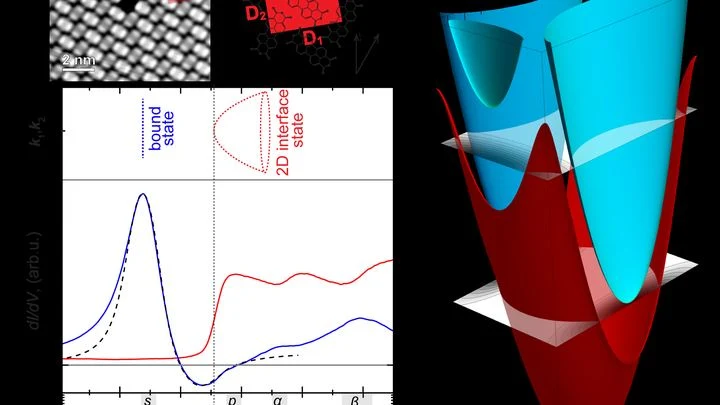
A wafer-thin film of organic molecules was grown on a silicon substrate. In this film, as if on a sheet of graph paper, tiny "pens"—artificial atoms — were laid out with the tip of a scanning tunneling microscope.
Inside an exploding star, neutrinos race so densely that they start to influence each other. Their quantum states become entangled, like threads in a tight ball where you can no longer tell which is which. Ordinary computers struggle with this task, as the number of possible states grows avalanche-like.
An amoeba turns left. For a long time, this was considered the result of a rigid chain of causes, like dominoes. But at the core of matter, there's a gap for freedom. The 'Agent Choice via Quantum Flux' model shows: each decision corresponds not to one, but to many quantum histories.
A regular laser is a light amplifier in which atoms, after receiving energy, collectively emit waves of a single frequency. A maser does the same thing, but for microwaves — the invisible radiation that heats food in a microwave oven and carries signals in phones.
Magnetic monopoles are like halves of a magnet that cannot exist alone in ordinary materials. But in spin ice, they appear in pairs connected by an invisible thread — a Dirac string. Previously, such monopoles were only seen in artificial systems at room temperature, but their quantum motion remained a mystery.
Instead of millions of rigidly fixed particles — 10,000 atoms, working as beads on a quantum abacus. Each bead can be both zero and one at the same time. But the key is: if an error creeps into the calculation, the atoms can be physically moved: as if you could rearrange the abacus on the fly so that the glitch doesn't ruin the result.
Imagine reality as an undeveloped photograph: until the moment of measurement, it exists only as a cloud of probabilities — a superposition of all possible states. Only the act of observation, like developing film, forces a particle to acquire definite properties.
A chef tastes the soup after every pinch of salt and instantly decides what to add next. That's roughly how the new setup for growing thin crystalline films works — except instead of taste, it uses an image from an electron microscope, and instead of a chef, a computer program.
An ordinary magnet makes a compass needle turn, but it doesn't stop the needle from moving forward. But if you twist a magnetic field into a knot, it can trap a particle in place, like a snare. This phenomenon is called an 'Aharonov–Bohm cage': the particle's waves cancel each other out at some points and reinforce at others, leaving only tiny 'islands' where it can exist.
Ordinary messages can be intercepted without anyone noticing. Physicists have come up with a way to create a shared secret that instantly breaks if someone so much as glances at it. Instead of paper, they use single particles of light. This quantum communication exploits a rule: any measurement changes a quantum object.
Light and matter in the tiny world obey laws that are hard to compute even on a supercomputer. Physicists build special "quantum simulators"—setups where cold atoms play the roles of particles and fields. But until now, such simulators could only depict the field in its simplest form: as if it were either present or absent.
Quantum computers have gained a built-in self-repair mechanism. The new two-dimensional scheme works like living tissue: each qubit-cell interacts with neighbors by local rules, automatically suppressing random disorder — entropy. Unlike previous methods, it doesn't require constant measurements, which themselves generate errors.
A quantum computer is like an orchestra where each musician plays their own part. With few instruments, the conductor can manage each one separately. But when there are thousands of musicians, individual commands become overwhelming.
A grain-of-sand-sized device: a tiny mirror-dish holds a single rubidium atom and collects the glow it emits under a laser beam. The trapped light particles are sent into an optical fiber — the whole setup is precise and stays aligned even when shaken.
A quantum bit, or qubit, is like a coin spinning on a table, able to be both heads and tails at once. For the computer to know what came up, you have to stop the coin and look. Previously, this stopping was done with a delay: data was read out, taken to a regular computer for processing, and only then was the result known.
Inside a tiny crystal, sound is trapped like light in a mirrored room. It bounces off the walls and forms standing waves — a multitude of harmonic oscillations, each with its own frequency. Physicists have learned to use these oscillations as qubits — the basic units of quantum information.
A quantum computer is like an orchestra, where each qubit is a musician and the control signals are the conductor. If the conductor waves the baton imprecisely, the musicians fall out of sync. In a real device, signals pass through power amplifiers, like loudspeakers that add noise and distortion.
There's always a risk that someone will peek at your ballot during an election. Physicists have come up with a solution: anonymous voting safeguarded not by people, but by the laws of nature.
Their 'magic ballot box' operates with light particles — photons.
Modern encryption is unthinkable without truly random numbers. But a standard source can be unreliable or even deliberately corrupted. The solution came from experimenters who built a 98-ion quantum processor: it works like a high-speed filter, turning a 'dirty' signal into one that's crystal-clear and unpredictable.
Quantum batteries lose energy due to entropy — the tendency toward disorder. Just as parallel wires pick up interference, the battery's contacts with the environment create leakage channels. The solution: braid the giant atoms, which act as both charger and storage, into a braid.
Intelligent action begins with a plan. Just as an architect needs blueprints to evaluate options, any agent with will needs to repeatedly copy data about reality.
On an ordinary optical table, amid lasers and mirrors, a cloud of a hundred strontium-87 atoms begins to live by the laws of curved spacetime. Half a second later, its quantum interference fades: gravitational time dilation destroys the superposition.
A chess game where pieces move only for castling, and all strikes are delivered from a standstill. That's the strategy physicists at Infleqtion chose for their 114-qubit quantum processor Sqale. Instead of shuttling neutral atoms to a dedicated zone before every operation, they learned to entangle them right on the spot using fine optical tweezers.
In a dark room, a resonator catches light the way a spiderweb catches dew drops. A laser pulse bursts in, and the mechanical membrane starts to vibrate in sync, leaving a trace in the very fabric of the system. That is how memory is born: not in a silicon cell, but in the dance of photons and phonons.
At the hilltop of classical physics, a particle is frozen in unstable equilibrium. The slightest nudge — and it rolls down with increasing speed. In the quantum universe, no nudge is needed: the uncertainty principle itself acts as an all-pervading wind, blowing the particle off the peak.