Majorana modes are exotic quasiparticles that emerge at the boundaries of certain superconductors, behaving as if they were half of an electron. They are their own antiparticles, meaning a Majorana particle is identical to its antiparticle. These modes are of intense interest for topological quantum computing because they can store quantum information non-locally, making it robust against local noise.
History
The concept was proposed by Ettore Majorana in 1937 as a real solution to the Dirac equation. In condensed matter, Alexei Kitaev introduced a toy model in 2001 showing how Majorana modes could appear in a 1D chain. Experimental evidence has been reported since 2012, but definitive proof remains debated.
How it works
In a superconductor, electrons pair up into Cooper pairs. Under specific conditions (e.g., proximity to a topological insulator or a magnetic field), unpaired electrons can form Majorana bound states at the ends of a nanowire. These states have zero energy and are protected by topology, meaning they cannot be easily destroyed by local perturbations. Braiding these modes—exchanging their positions—performs quantum gates that are inherently error-resistant.
In practice
The primary application is topological quantum computing, where Majorana modes serve as qubits that are protected from decoherence. They are also studied for potential use in fault-tolerant quantum memory.
Fun fact
Because Majorana modes are their own antiparticles, two of them can 'annihilate' each other, but if they are braided, the quantum state changes in a way that is topologically protected.
In a superconductor, where electrons move in pairs without resistance, special waves can run along the edges, like ripples along the edge of a carpet. The number of such waves is an important characteristic of the material, but measuring it directly is difficult.
An interpreter gets distracted by every rustle in the hall, and a one-hour meeting stretches into two. That's roughly how scientists have spent years searching for special states in tiny electrical chains: they watched the total current but missed how the signal was corrupted by noise.
Graphene, a sheet of carbon one atom thick, behaves like a calm water surface, until superconductivity appears. Then, unusual waves ripple across it, like the circles from a thrown stone: pairs of electrons move without friction.
After a hit, a black hole rings like a bell. But instead of sound, it emits gravitational waves whose frequency rapidly decays: these are called quasinormal modes. From such a 'ring,' you can infer the hole's mass, spin, and other properties.
A black hole's horizon is not a wall but rather a one-way membrane. Anything that crosses it disappears forever. Stephen Hawking showed that this boundary should glow faintly, emitting particles. But catching such radiation from a real black hole is impossible: it's too far and too dim.
Physicists have found a workaround: build a "toy" black hole out of magnetic atoms.
A mosaic of squares and triangles covers the floor without gaps, yet it never settles into a simple repeating pattern. Such a pattern is a quasicrystal — a solid where atoms are arranged not periodically but according to a pattern of several waves of different lengths. These waves are incommensurate with each other, and together they create long-range order.
In 1984, the world of crystallography was turned upside down: sharp diffraction peaks with fivefold symmetry were discovered in an alloy of aluminum and manganese – as if nature had mocked the strict theorems forbidding repeating patterns from having axes of order 5, 8, 10, or 12.
The quantum many-body world is a jazz ensemble, where each electron improvises, continuously listening to all the others, and the overall wave function is born from this tense dialogue.
Building a quantum computer capable of solving problems beyond classical machines requires reliable qubits. One of the most elegant ideas is to use Majorana zero modes as qubits: ghostly excitations that remember their entangled paths and aren't thrown off by thermal noise.
A black hole is not a dead object. After a disturbance, such as merging with another hole, it rings like a bell. This ring is not just a sound but a complex set of damped oscillations called quasinormal modes. Their frequency and damping rate depend on the hole itself: its mass, charge, and spin.
Imagine a skyscraper assembled not from individual bricks but from entire studio apartments. That's exactly how the Au₆Te₁₂Se₈ crystal is built: its nodes are not atoms but superatomic clusters of gold and chalcogens that behave as single quantum objects.
Two pendulums hang from the same crossbar. A push, and they start swinging, gradually falling into and out of sync. In a topological qubit, Majorana particles, special excitations that can store quantum information, play the role of these pendulums.
You're looking for a quiet room for an important conversation. You step into a space, and hear silence. But upon closer inspection, you find that in one corner the ventilation is simply broken, and in another there's a hole in the floor that absorbs sound.
Drop a pebble into a pond, and ripples spread across the water. Strike a bell, and it rings at its own frequency. When a black hole collides with another, it too 'rings'—except instead of sound, it's the trembling of space itself.
A drop of ink falls into a glass of water, and within a minute you can't tell where it landed. In the quantum world, it's even more dramatic: information about a local event spreads across the entire system so quickly that any point-like sensor soon stops feeling anything. This is called delocalization, and for quantum sensors, it sounds like a death sentence.
A fabric that stretches lengthwise but not crosswise. That's roughly how a semi-Dirac material works: electrons can move freely in one direction but barely budge in the other. Because of this unusual anisotropy, special tracks, one-dimensional channels, emerge at the edges of the two-dimensional crystal. Electrons race along them only along the perimeter, like water in a trough.
In a thin film of superconductor, bursts of electric current appear from time to time. They look like fingerprints, but whose — not immediately clear. Some are left by mysterious particles that could become the basis of a reliable quantum computer. Others are just bumps in the material, duds.
A nanowire is like a tiny cable: inside is a magnetic core, outside is an aluminum shell that can conduct current without resistance. But they don't get along easily: a strong magnetic field destroys superconductivity, like noise drowns out a quiet melody.
A material just one atom thick and of record purity — only one foreign atom per million — becomes the setting for a remarkable phenomenon. When cooled to near absolute zero, the electrons inside, like musicians in an orchestra, freeze into a strict order, forming a crystal. This state, predicted by Eugene Wigner nearly a century ago, has now been observed in detail.
Hot water sometimes freezes faster than cold — that's the classic Mpemba effect. In the quantum world, its counterpart is even more astonishing: tiny particles can reach equilibrium many times faster than expected, and what helps them is not forgetfulness, but memory.
All matter, from stars to humans, is built from particles that in the Standard Model are divided into two families. But there's a third, rare kind — particles that, when swapped, don't just exchange places but tie themselves into a knot, remembering the intertwining rather than the path.
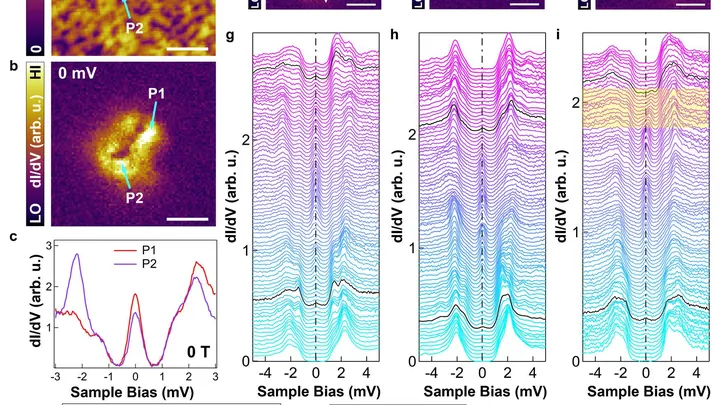
Deep inside a superconductor, electrons pair up into Cooper pairs and glide without resistance. But if a vortex appears in this perfect order, a tiny region where superconductivity vanishes, special excitations emerge there: Bogoliubov quasiparticles.