A quantum dot is a semiconductor nanocrystal typically 2 to 10 nm in size, in which the motion of charge carriers (electrons and holes) is confined in all three dimensions, leading to quantization of the energy spectrum. Due to spatial confinement, energy levels become discrete, like atomic ones, and depend on the dot's size. Optical transitions between these levels yield narrow luminescence bands. The emission color can be continuously tuned by changing the nanocrystal diameter.
History
In 1981, Alexey Ekimov, while studying CuCl nanocrystals in silicate glass, noticed a blue shift of the absorption edge upon decreasing crystal size. In 1983-84, Louis Brus theoretically substantiated the quantum size effect in semiconductor nanocrystals, demonstrating the relationship between transition energy and particle radius. In 1993, Moungi Bawendi and colleagues developed a method for high-temperature synthesis of monodisperse CdSe quantum dots, paving the way for practical use. Subsequent research led to the creation of cadmium-free dots and applications in bioimaging and optoelectronics.
How it works
Quantum confinement: when the crystal size becomes smaller than the exciton Bohr radius, the motion of charge carriers is quantized. The Schrödinger equation for a particle in a three-dimensional potential well yields discrete energy levels, with spacing increasing as size decreases. Absorption of a photon creates an exciton, which then recombines radiatively. Due to the size dependence of the transition energy, quantum dots of the same composition can emit across the entire visible range. Spectral homogeneity is limited by the size dispersion of the ensemble, and blinking is associated with Auger ionization processes.
In practice
Quantum dots are used in QLED displays for bright and pure colors, and also in biomedicine as luminous markers for tracking cells.
Fun fact
Quantum dots are so bright and stable that they are used to create TVs with record color gamut, and in biology to track the movement of a single molecule inside a living cell.
A tiny trap for single charges, a quantum dot, can hold a single hole. But the moment a charge at the material interface twitches, the hole in the trap starts to tremble. Engineers have found a way to calm this jittery charge by replacing a steep staircase with a gentle ramp.
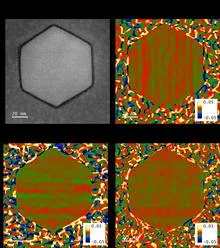
A taut string sounds higher, a slack one lower. In quantum dots, the crystal lattice plays the role of the string: compression or stretching changes the color of the emitted light. The trouble is that during nanowire growth, each dot ends up with its own random strain, so their "strings" sound out of tune.
A taut string sounds higher, a slack one lower. In quantum dots, the crystal lattice plays the role of the string: compression or stretching changes the color of the emitted light. The trouble is that during nanowire growth, each dot ends up with its own random strain, so their "strings" sound out of tune.
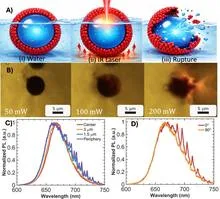
A tiny capsule, like a soap bubble but with a shell of glowing crystals, behaves like a laser. While its wall is intact, light circulates, amplifies, and escapes as a narrow, bright beam. Once the wall bursts, the beam turns into a dim spot. Such a capsule is a colloidosome, and it can change its glow on command.
In a quiet room with no magnets anywhere, two electrons in a silicon trap still feel a faint trembling. It comes from the nuclei of silicon and germanium atoms, which spin randomly like the needles of broken compasses. This trembling was once considered noise, but now it has become a measuring instrument itself.
A tiny capsule, like a soap bubble but with a shell of glowing crystals, behaves like a laser. While its wall is intact, light circulates, amplifies, and escapes as a narrow, bright beam. Once the wall bursts, the beam turns into a dim spot. Such a capsule is a colloidosome, and it can change its glow on command.
In a dark room, a spark jumps between two wires, and for an instant, there is light. Physicists have done something similar, but a million times smaller: at the boundary of two transparent crystals, they drew a conducting path and left a break just a few atoms wide. When a direct voltage was applied across this tiny gap, it began to glow.
Light passing by a tiny structure changes direction. If the structure is smaller than the wavelength of the light, it acts like a lens and focuses the light into a spot smaller than the wave itself.
The laser beam in an optical tweezer is not just a spot of light but a force bag. A particle caught in it usually rolls toward the brightest point, like a ball into a dimple.
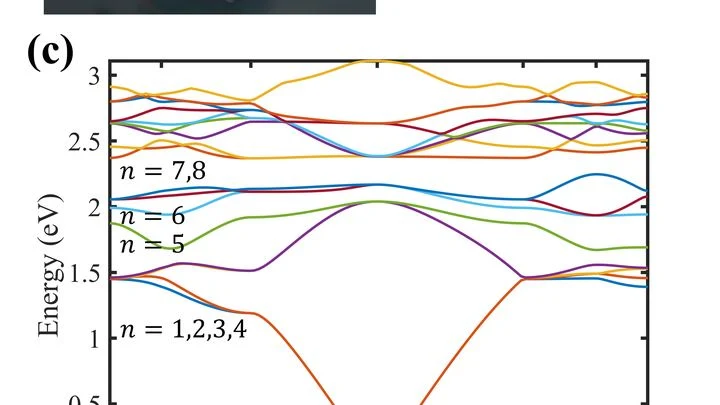
Imagine a ladder whose rungs are tiny magnets. If neighboring magnets point in opposite directions, the ladder is "calm." But if you make them all point the same way, the whole structure becomes magnetized and "stubborn."
Scientists built such a ladder from germanium atoms — a semiconductor used to make transistors.
A short flash of light is like a musical phrase: you can distinguish individual notes if you listen very carefully. But in the quantum world, these 'notes'—temporal modes — are squeezed down to picoseconds, and ordinary optics can barely tell them apart.
A camera looks at two distant sparks. They're so close together that they merge into a single fuzzy blob. It seems impossible to tell them apart — the classic limit of optical microscopy has been reached.
But quantum mechanics hints that the light field still holds a secret about where each spark sits.
A thin silver thread nearly as long as a hair's width, and inside it, pristine quantum laws hold sway. Physicists built a conductor where electrons can only move forward or backward, like on a perfectly straight single-lane road with no shoulders. On such a road, any pothole or pebble would normally destroy the fragile quantum state.
Electric charge is a slippery thing. You can measure how much there is in the entire universe or in a single particle, but try to point your finger and say, 'Right here, in this cubic centimeter, there is exactly this much charge right now,' and you hit a fundamental wall.
The issue is that total charge, which physicists denote by the letter Q, is nonlocal.
After a hit, a black hole rings like a bell. But instead of sound, it emits gravitational waves whose frequency rapidly decays: these are called quasinormal modes. From such a 'ring,' you can infer the hole's mass, spin, and other properties.
Electrons in a solid usually either run freely (metal) or are locked in place (insulator). But sometimes strong mutual repulsion locks them into a halfway state: charges stand still, while spins, tiny magnetic arrows, continue to live their own life. This is called a Mott insulator.
A spotlight blazes straight into your eyes, and a few steps away a tiny firefly flickers. That's roughly what it's like hunting for an Earth-like planet around a neighboring star: the planet is a hundred million to ten billion times fainter than its star, and in the sky they almost merge into a single point.
A living cell constantly emits faint magnetic signals, as if whispering. Scientists eavesdrop on this whisper with two microscopic 'microphones'—magnetic field sensors.
Light gets trapped in a crystal lattice, but not an ordinary one: it's turned inside out, like a honeycomb where instead of wax there's emptiness, and the edges are made of material. That's how an inverted opal is built: a three-dimensional photonic crystal that blocks light of certain colors.
Two pendulums hang from the same crossbar. A push, and they start swinging, gradually falling into and out of sync. In a topological qubit, Majorana particles, special excitations that can store quantum information, play the role of these pendulums.
Toss a handful of phosphorus into silicon, and at a certain impurity concentration the material suddenly starts conducting electricity. This is a metal-insulator phase transition, and it happens abruptly. But what exactly changes in the electron wave functions when an insulator becomes a metal?
Twins enter a room from different doors. Each gets a box with a button, and each time they press it, either a red or a green light flashes. If the twins are perfectly identical, you'd expect their lights to follow the same internal rules. But what if the rules differ even though the twins are exact copies?
That's precisely the scenario the authors explored.
A tiny defect in a boron nitride crystal behaves like a microscopic indicator bulb. Shine light on it, and it glows, with the shade shifting with temperature: the warmer it gets, the redder the glow.
Three guitar strings on the same instrument, but each tuning peg turns with a different resistance: one gives way immediately, another is stiff, and the third is completely stuck.
In a water supply system, water sometimes flows not as a continuous stream but in separate identical portions, as if the tap opens and closes, letting through exactly one drop each time. This is roughly how electric current behaves in superconducting contacts called Josephson junctions.
In a boron nitride crystal, the perfect atomic lattice is sometimes disrupted: an atom is missing here, or replaced by a foreign one there. Under a powerful microscope, these tiny imperfections appear as traps for electrons: they capture particles and start to emit light, and they also respond to magnetic fields.
The quantum world is usually drawn with points, but real instruments only see blurry spots. Heisenberg and von Neumann long suspected: precision is unattainable.
A quantum computer is like an orchestra where every musician-qubit must play in perfect silence. But when you have many such orchestras that want to perform together, they need a reliable conductor-communicator.
Ordinary batteries lose charge like tea cools down. A quantum battery works differently: its heart is a tiny cavity with darting photons. If you illuminate it with special photon pairs, energy flows into a chain of qubit cells instantaneously — much like a swing gets a boost from strong pushes.
A quantum bit (qubit) is a delicate thing. Even a little heat destroys it, like a random nudge topples a crystal wine glass. To protect this fragile information, physicists have built a three-dimensional quantum structure resembling a Russian doll.
A heat engine doesn't have to be made of iron. In the microworld, a single electron can play the role of a piston, and the measurement process itself can serve as fuel. Two neighboring 'pockets' for electrons are connected by a narrow bridge.
A pendulum swings not in a single plane but in five dimensions at once. Its motion is described by a complex mathematical model, and the pendulum itself is an electron in a graphene sheet interacting with five different "flavors" of its environment.
Three craftsmen work in the same workshop. The first tries to figure out whether tiny hourglasses are built into nature's own machinery. The second attaches a laser pointer to a microscope to see details invisible to the naked eye. The third, conversely, takes living threads and carefully weaves them into fragile quantum circuits.
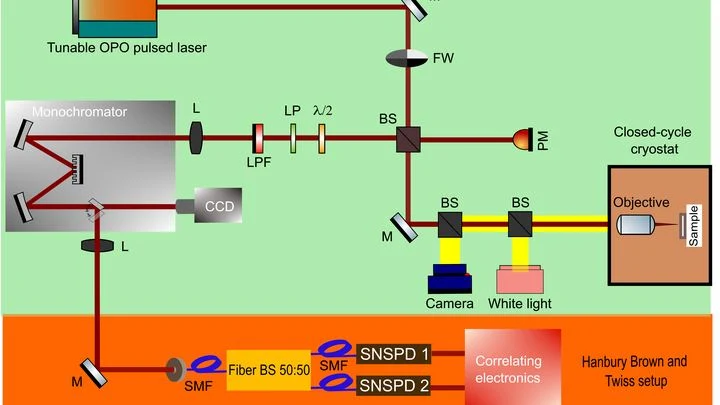
Two musicians in separate rooms play the same note. The sound must be so identical that a listener can't tell who is playing. In the quantum world, these musicians are single-photon sources — particles of light that must be indistinguishable from one another.
Tiny semiconductor islands grown right on silicon fire off single photons, like a machine gun that shoots exactly one bullet at a time. These islands are called quantum dots. They can emit light in discrete packets, which is needed for secure information in quantum networks.
A quantum memory node is a tiny diamond with a defect that can store and emit single photons. But its light has a wavelength of 637 nanometers, the same red as a ruby, and is almost completely absorbed after just a few meters of standard optical fiber.
A light bulb that shines not in a steady stream but in individual drops — photons. Such 'droplet' sources are called single-photon emitters. They are needed for quantum communication, where each photon carries a bit of information, and for ultra-precise measurements.
Two nearly identical locks are opened by the same pick. They look alike on the outside, but inside the mechanisms differ. Much the same can be said for the two main types of non-small cell lung cancer — adenocarcinoma and squamous cell carcinoma. Under a microscope, they can be confused, yet they require different treatments. That's where the quantum "magnifier" comes in.
A quantum computer is like an orchestra where every musician must play their part perfectly, or the melody falls apart. Previously, controlling qubits — the quantum 'musicians'—required a room full of equipment, and every extra wire added noise.