Asymmetry from Familiar Quarks express
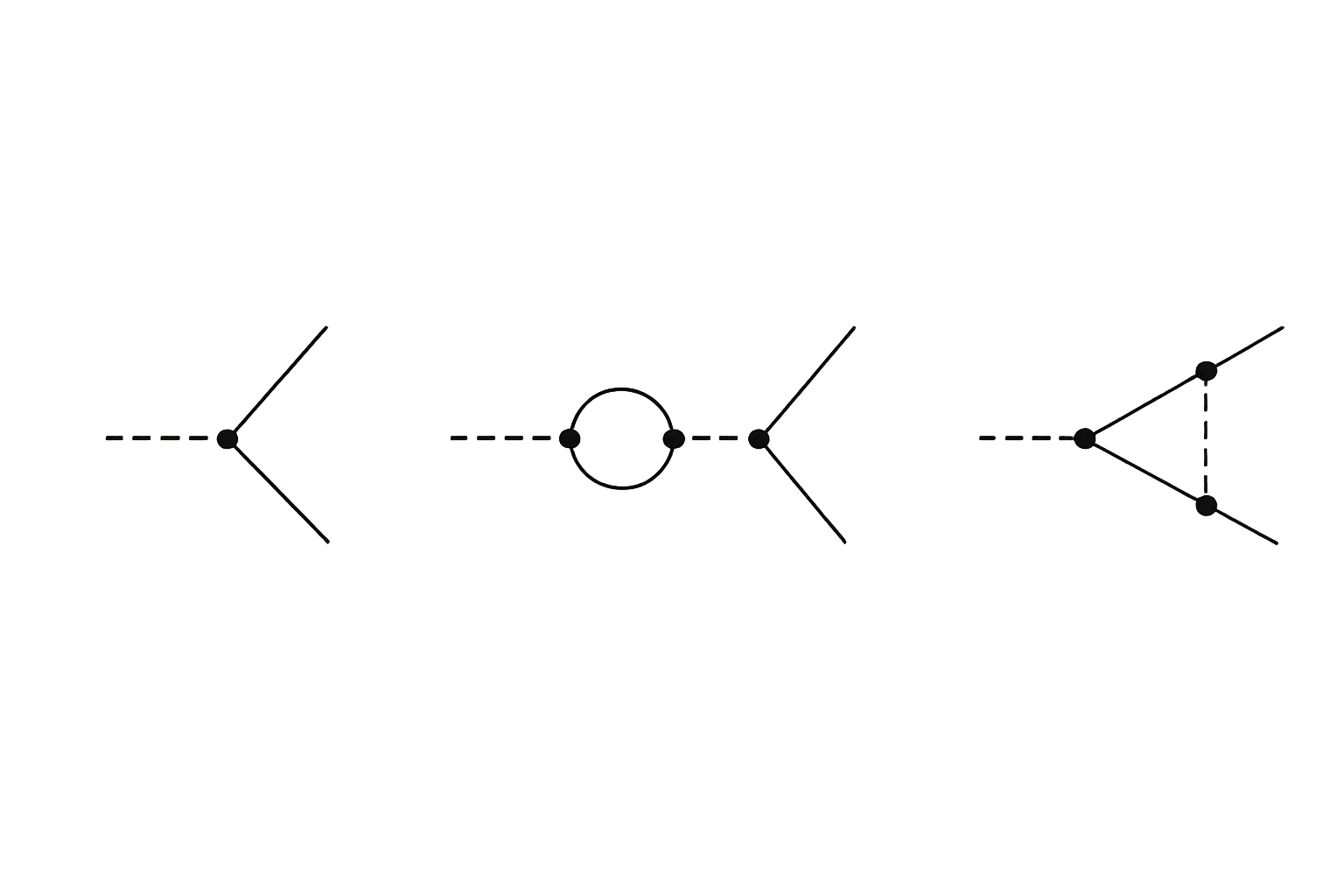
In the first moments after the Big Bang, matter and antimatter were almost equally abundant. But something tipped the balance, leaving only a tiny excess of ordinary particles — the very excess that makes up stars, planets, and ourselves. For a long time, it was thought that the known CP violation (the difference in behavior between particles and their mirror counterparts) in the Standard Model was insufficient to explain this. New work shows it is sufficient — if you add a leptoquark.
A leptoquark is a hypothetical particle that can convert quarks into leptons and vice versa. In the proposed scenario, its interactions are arranged so that all CP violation comes from the already familiar Cabibbo–Kobayashi–Maskawa matrix (which describes how quarks transform into each other). No additional sources of asymmetry are required. At the high temperatures of the early Universe, leptoquark decays proceeded slightly more often in one direction than the other, and this tiny difference accumulated into the observed amount of baryons, protons and neutrons, today.
This is like a scale where one pan is initially heavier by a hair. At first, the difference is imperceptible, but after almost everything annihilates, the remaining imbalance becomes all visible matter. The scenario requires no fine-tuning or exotic fields — only one new 'player' with already familiar rules of the game.
If matter and antimatter had annihilated perfectly symmetrically in the early Universe, for every billion antimatter particles there would have been a billion matter particles, and after their encounter nothing would remain — only radiation. The observed excess is about one particle per billion.
In Dan Brown's novel 'Angels & Demons', antimatter is used as a weapon; in reality, its disappearance in the first moments is the reason for our existence.