Matter–antimatterasymmetry is the observed fact that the universe contains vastly more matter than antimatter, despite the expectation that the Big Bang should have produced equal amounts of both. If matter and antimatter had been created symmetrically, they would have annihilated each other completely, leaving a universe filled with radiation and no stars, planets, or life. The fact that we exist means that for every billion or so particle–antiparticle pairs, one extra particle of matter survived. This asymmetry is one of the biggest unsolved problems in physics, as the Standard Model of particle physics does not provide a sufficient explanation for it.
History
The problem was first articulated by Andrei Sakharov in 1967, who laid out three conditions necessary for baryogenesis (the generation of matter–antimatterasymmetry): baryon number violation, C and CP violation, and departure from thermal equilibrium. Since then, no single theory has fully satisfied all conditions within the Standard Model.
How it works
The asymmetry is thought to arise from processes that violate certain symmetries, specifically charge conjugation (C) and charge-parity (CP) symmetry. In the early universe, conditions were extreme enough for such violations to occur, possibly through interactions involving heavy particles or through the dynamics of the electroweak phase transition. These processes would have produced a slight excess of quarks over antiquarks, which then led to the matter-dominated universe we see today. The exact mechanism, however, remains unknown, and experiments are searching for new sources of CP violation and for processes like proton decay that could shed light on it.
If the asymmetry were even slightly different, the universe would be either empty or filled with antimatter, making our existence extraordinarily fine-tuned.
A tightly stretched membrane, squeezed into a narrow case, decides on its own where to burst. So does a cell: when it is cramped, the point of division shifts from the middle, and the two halves come out unequal. Previously, it was thought that such asymmetry is predetermined by chemical labels, but the new work shows that mechanics alone is enough.
In the first moments after the Big Bang, matter and antimatter should have been created in equal amounts. But today, everything around us is ordinary matter, and antimatter is almost nowhere to be found. Where did it all go? The standard answer: a tiny imbalance in favor of matter wiped out almost all antimatter.
The early Universe was not just a hot soup of particles. In the first fractions of a second, mirror symmetry could have been broken: the world and its reflection would not be quite identical. If so, the large-scale cosmic web of galaxies would retain a barely noticeable 'curl'—as if all matter were slightly twisted in one direction.
Boiling water in a pot is a good place to start. Bubbles of steam rise, pop, and the surface settles down. Something similar might have happened in the first moments of the universe's life with a special field filling space: bubbles of a new phase inflated and collided, like islands of steam in liquid.
The quantum world loves balance. When a massive particle is forced to split, to go down two paths at once, something must give way in response. That "something" turns out to be the very apparatus that split the particle.
Twins enter a room from different doors. Each gets a box with a button, and each time they press it, either a red or a green light flashes. If the twins are perfectly identical, you'd expect their lights to follow the same internal rules. But what if the rules differ even though the twins are exact copies?
That's precisely the scenario the authors explored.
On one side of the scale lies all the matter in the Universe; on the other, all the antimatter. According to the laws of physics, at the moment of the Universe's birth, the pans should have been balanced. But we see one pan tipping: around us are stars, planets, people, and almost no antimatter. This imbalance is one of the greatest mysteries.
In the first moments after the Big Bang, matter and antimatter should have been created in equal amounts. But today we see only matter — stars, planets, ourselves. Where did the antimatter go? One clue hides in nearly elusive particles: right-handed neutrinos. The usual story is that their decays create a slight bias in favor of matter.
After the Big Bang, the Universe resembled a tightly inflated balloon: pressure prevented matter from clumping together. But hypothetical superheavy particles — sort of ‘heavyweights’ of the microcosm — momentarily made the balloon less stiff. Matter easily clumped, giving birth to black holes with masses from a billion to a billion billion tons.
In the quantum world, there are rules that seem to be broken. One of them is the conservation law: if in classical physics symmetry guarantees the conservation of charge, then in the quantum description this guarantee can disappear. This phenomenon is called a quantum anomaly.
The universe wasn't born alone — alongside it came a mirror twin where everything is reversed: left and right are swapped and time flows from future to past. After the Big Bang, the world, according to Alan Guth's idea of superfast inflation, should have contained equal amounts of matter and antimatter.
Schrödinger's cat, according to quantum rules, can be both alive and dead at once. But a table can't pull that off. When a massive object tries to be in two places, its mass curves spacetime so drastically that instead of two points, a single deep depression forms, and the object rolls into it.
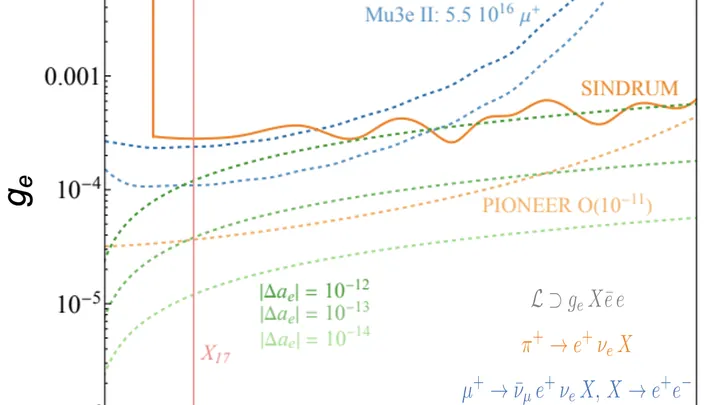
In nuclear transitions of beryllium-8, helium-4, and carbon-12, physicists from the ATOMKI collaboration have been seeing extra events since 2020—as if, when an excited nucleus decays, something else is sometimes born besides the usual photons. The energy of this "something" is always the same: about 17 million electron-volts.
In one hospital ward it's +40°C, in another +10°C, and on average it's +25°C. If temperature affected something nonlinearly (say, the rate of bacterial growth) the average would give a wrong prediction. The same problem arises when cosmologists describe a universe where galaxies are packed into clusters and voids yawn between them.
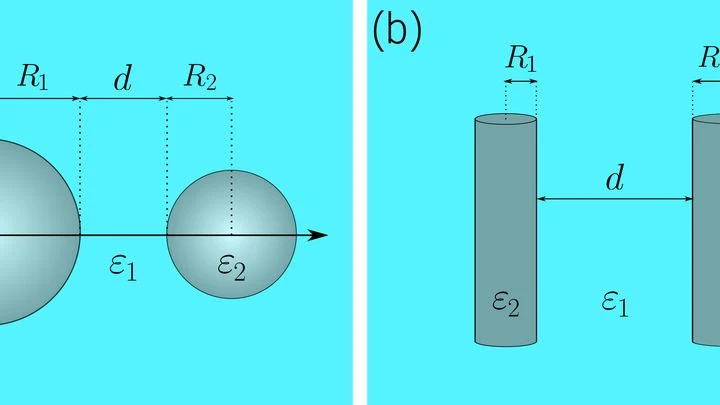
In a glass of salty water, even if it sits perfectly still, something is always happening. Tiny salt particles, ions, float and collide, sending ripples through the water. These ripples are invisible, but they create a force that attracts or repels nearby objects.
Previously, it was thought that this force only acts over very short distances, as if it quickly fades out.