Lepton flavor violation refers to processes in which a charged lepton (electron, muon, or tau) changes into another type, or 'flavor', without involving neutrinos. In the Standard Model of particle physics, such transitions are essentially forbidden—they can only occur through tiny quantum corrections involving neutrinos, making them vanishingly rare. The observation of a clear signal would be a major discovery, pointing to physics beyond the Standard Model, such as new particles or forces that treat lepton flavors differently.
History
The concept of lepton flavor violation was first considered in the 1950s, but it gained prominence after the discovery of neutrino oscillations in 1998, which showed that lepton flavor is not absolutely conserved. Since then, experiments like MEG and Mu2e have been searching for charged lepton flavor violation, with no positive results so far.
How it works
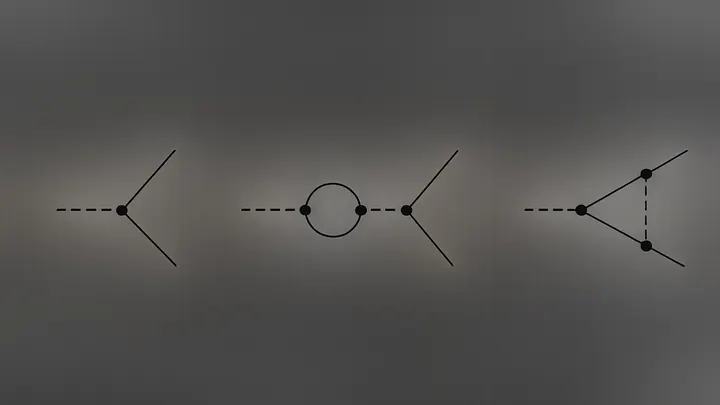
In the Standard Model, lepton flavor is conserved in charged lepton interactions. However, because neutrinos oscillate (change flavor), the model allows for extremely rare charged lepton flavor violation (cLFV) through loop diagrams with neutrinos. The predicted rates are so small (branching ratios below 10^-50) that any observed event would be a clear sign of new physics. Experiments search for specific signatures, such as a muon decaying into an electron and a photon, or a muon converting to an electron in a nucleus, with no neutrinos in the final state.
In practice
Searches for lepton flavor violation are used to probe new physics at energy scales beyond the reach of colliders, providing constraints on models like supersymmetry, leptoquarks, and heavy neutral leptons.
Fun fact
The tau lepton, being much heavier than the muon, has more possible decay channels for flavor violation, making it a unique probe—but its short lifetime makes it harder to study.
Neutrinos are tiny particles that pass through our bodies by the billions every second without touching a single atom. They have a mysterious property: on their way from the Sun or an accelerator, they can change their type, or 'flavor'—for example, turning from an electron neutrino into a muon neutrino.
Ultra-sensitive scales try to detect the difference between two nearly identical grains of sand. One is a perfect mirror reflection of the other. In the world of elementary particles, such mirror reflection is called P-parity, and its violation is one of the great mysteries of physics.
In the first moments after the Big Bang, matter and antimatter were almost equally abundant. But something tipped the balance, leaving only a tiny excess of ordinary particles — the very excess that makes up stars, planets, and ourselves.
The early Universe resembles a boiling cauldron, where particles and antiparticles are born and die in equal numbers. But today, all around us is only matter — stars, planets, ourselves. How did a tiny excess of one part in a billion emerge from the initial equality? One answer hides in the oscillations of a heavy field, like a rock that the tide alternately submerges and exposes.
A massive star exhausts its fuel, and its core collapses in a fraction of a second. A supernova is born, along with a brief but powerful shower of neutrinos. These particles barely interact with matter, so they fly away freely, carrying information about the catastrophe.
A scale capable of weighing the invisible: that's exactly how the ratio of decays of light mesons (pion and kaon) into electrons and muons works. If nature follows the same rules for all generations of particles, the pans of this scale show a strictly defined number. But if an unknown force lurks somewhere, the needle will waver.
Neutrinos are like invisible dancers who change masks mid-flight. The three types (electron, muon, and tau neutrinos) constantly morph into each other. This dance is described by a complex mixing matrix, and physicists have long tried to break it down into simple moves.
The authors of the new work reassembled one such decomposition, TM1, using the 'flavor spin' formalism.
In 2021, the LHAASO observatory registered gamma quanta with energies above a petaelectronvolt from sources like the Crab Nebula — a supernova remnant with a pulsating neutron star at its heart.
In the depths of a neutron star, the remnant of an exploded star, matter is compressed so tightly that a teaspoon would weigh billions of tons. Within this superdense material, a special kind of force might be at work, one that affects only muon and tau neutrinos.
Electrons and muons are tiny magnets. Their magnetism is slightly more than two (in special units), and this 'excess fraction' (anomalous magnetic moment) arises from constant ripples in the vacuum: particle pairs momentarily pop into existence and vanish.
The Universe doesn't just expand — it resonates. After the Big Bang, stretched strings remained in its fabric — thin as a proton, yet heavy as a mountain range. Their oscillations give birth to gravitational waves, and in this radiation, like in a musical score, the history of fundamental symmetries is encoded.
On one side of the scale lies all the matter in the Universe; on the other, all the antimatter. According to the laws of physics, at the moment of the Universe's birth, the pans should have been balanced. But we see one pan tipping: around us are stars, planets, people, and almost no antimatter. This imbalance is one of the greatest mysteries.
In the first moments after the Big Bang, matter and antimatter should have been created in equal amounts. But today we see only matter — stars, planets, ourselves. Where did the antimatter go? One clue hides in nearly elusive particles: right-handed neutrinos. The usual story is that their decays create a slight bias in favor of matter.
A magnet with only one pole — north, but no south. Split it in half, and instead of two ordinary magnets, you get two more one-pole magnets. In our world, no such particle has been found, although many theories predict their existence. These hypothetical objects are called magnetic monopoles.
The authors of the study noticed a curious connection.
Two nearly identical pendulums are set in motion at the same time. One decays quickly, the other swings for a long time. At some point, their motions overlap, and in the combined picture, a subtle shift appears that would be invisible if you looked at each pendulum separately.
The speed of light in a vacuum is physics' metronome: it sets the rhythm for all processes. If it falters, the familiar harmony collapses. Neutrinos, ubiquitous but almost intangible particles from space, can check if this rhythm ever stumbles under extreme conditions.
When a massive star dies, its core collapses, and a neutrino storm is born. These ghostly particles fly outward, changing their flavor along the way, like a chameleon changes color. This dance of flavors can either boost the explosion or, conversely, dampen it.
But this dance has a choreographer — the density gradients of matter.
The tau lepton is a heavy cousin of the electron, living less than a trillionth of a second. It usually decays into lighter particles, but never directly into three muons: such a transition is forbidden by known laws of particle physics. If it did happen, it would mean unknown forces are at play.
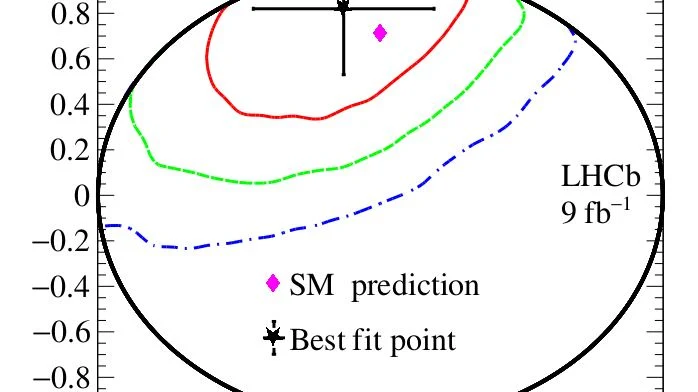
In the LHCb detector, like in a giant camera with billions of 'snapshots,' rare events are captured: how short-lived particles, B mesons, fall apart into lighter ones. One such decay, where a B meson turns into a kaon and a pair of muons, is particularly interesting. In it, as in a mirror, the difference between matter and antimatter may show up.
Two teams of radio telescopes pointed their antennas at two gas clouds: one at the very center of the Milky Way, the other in its quiet outskirts. Both clouds contain methanol molecules — an alcohol that acts as a tiny pendulum in space: it absorbs and emits radio waves at strictly defined frequencies.
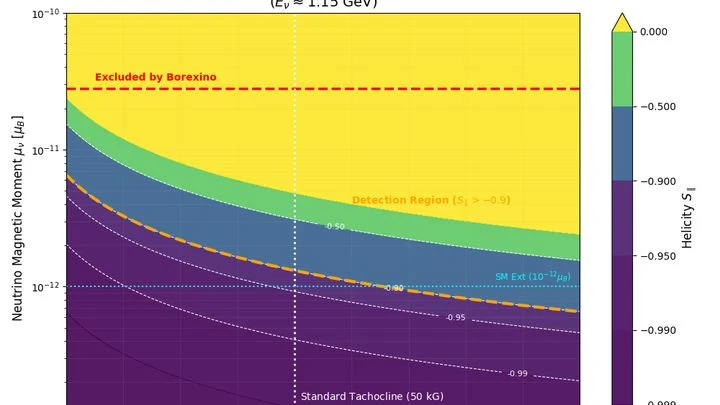
The Sun doesn't just shine: it continuously emits streams of tiny particles, neutrinos. They are born in thermonuclear reactions in the core and pass through the star almost unhindered. But inside the Sun, there are magnetic fields that can influence these particles, like invisible corridors that slightly bend their path.
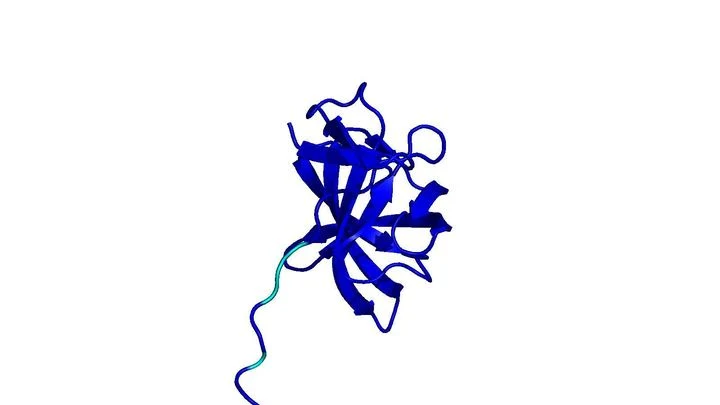
A protein language model is like a chef who learned from thousands of recipes and now invents new dishes. Sometimes he gets carried away and salts every dish because one good cookbook used a lot of salt. In proteins, such repetition isn't just ugly: identical stretches in the chain make the protein fragile, it can't fold into the right shape, and it doesn't work.
The muon is a heavy cousin of the electron that lives for just two millionths of a second. In a magnetic field, it spins like a top, but slightly faster than formulas predict. Twenty years ago, this 'slightly faster' was noticed at Brookhaven, and physicists have been arguing ever since: either the instruments were wrong, or unknown particles are hiding in the vacuum.
The cosmos is filled with invisible dark matter, which betrays itself only through gravity. Its existence was suspected by Fritz Zwicky and confirmed by Vera Rubin.
Our Sun emits streams of neutrinos — particles that barely interact with matter. Passing through the dense solar material, they change their type — scientists call this 'flavor.' It's like a voice that changes as it moves through a crowd: the thicker the crowd, the more it gets distorted.
Predicted by Wolfgang Pauli and named by Enrico Fermi, neutrinos are nearly elusive particles. Inside dying supernova giants and merging neutron stars, an immense number are born. Each particle has a flavor that can change.
In 2016, the LHCb detector at the Large Hadron Collider recorded millions of proton-proton collisions. Among the debris of these collisions, neutral B mesons were born—particles that can spontaneously transform into their antiparticles and back.