CP violation is the observed asymmetry in the behavior of matter and antimatter under the combined operations of charge conjugation (C) and parity inversion (P). It is one of the essential conditions proposed by Andrei Sakharov to explain why the universe contains vastly more matter than antimatter. While the Standard Model of particle physics includes CP violation through the Cabibbo–Kobayashi–Maskawa matrix, the observed asymmetry in the universe is far larger than this mechanism can account for, suggesting new physics beyond the Standard Model.
History
CP violation was first observed in 1964 by James Cronin and Val Fitch in the decays of neutral kaons, a discovery that earned them the Nobel Prize in Physics in 1980.
How it works
CP symmetry states that the laws of physics should be the same if a particle is replaced by its antiparticle and spatial coordinates are inverted. CP violation occurs when this symmetry is broken, leading to different decay rates or oscillation patterns between particles and antiparticles. In the Standard Model, this arises from a complex phase in the quark mixing matrix, which allows certain weak interaction processes to proceed at different rates for matter and antimatter. The effect is small, typically observed as tiny differences in decay probabilities or in the oscillation of neutral mesons.
In practice
CP violation is studied in particle physics experiments like LHCb and Belle II to search for deviations from the Standard Model, which could explain the matter–antimatter asymmetry of the universe.
Fun fact
The observed CP violation in the Standard Model is far too small to explain the universe's matter dominance, meaning there must be undiscovered sources of CP violation in nature.
Two dancers on the same stage mirror each other's moves even when a curtain separates them. In the quantum world, such pairs are called entangled, and physicists have spent half a century probing how far this connection reaches. Until now, all tests with massive particles concerned their internal properties, such as spin, but not their motion itself.
Neutrinos are tiny particles that pass through our bodies by the billions every second without touching a single atom. They have a mysterious property: on their way from the Sun or an accelerator, they can change their type, or 'flavor'—for example, turning from an electron neutrino into a muon neutrino.
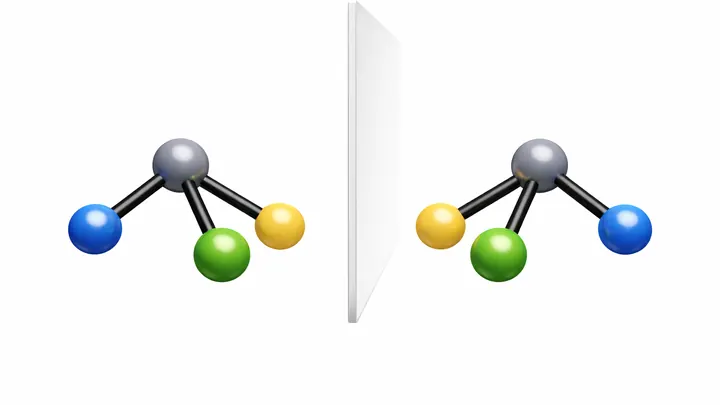
An ordinary mirror swaps left and right. Many laws of physics don't notice the swap: they are mirror-symmetric. But some phenomena, like the weak interaction, break this symmetry. Until now, it was thought that gravity and light each break mirror symmetry in their own independent way.
The hot broth of the early universe seethed with particles and antiparticles. They were born and died in pairs, and by all laws of symmetry should have annihilated each other completely. But something went wrong, and a tiny excess of matter survived. From it, stars, planets, and we ourselves later assembled.
Physicists call this imbalance baryon asymmetry.
Ultra-sensitive scales try to detect the difference between two nearly identical grains of sand. One is a perfect mirror reflection of the other. In the world of elementary particles, such mirror reflection is called P-parity, and its violation is one of the great mysteries of physics.
In the first moments after the Big Bang, matter and antimatter were almost equally abundant. But something tipped the balance, leaving only a tiny excess of ordinary particles — the very excess that makes up stars, planets, and ourselves.
The early Universe was not just a hot soup of particles. In the first fractions of a second, mirror symmetry could have been broken: the world and its reflection would not be quite identical. If so, the large-scale cosmic web of galaxies would retain a barely noticeable 'curl'—as if all matter were slightly twisted in one direction.
A quantum chain is like a string of lights, where the bulbs are the spins of particles. Ideally, all bulbs glow in sync, following a common rhythm: that's symmetry. But if you cut off a piece of the string, the rhythm can get out of step: within that segment, symmetry is broken.
Physicists study a chain of strongly interacting particles (the XYZ model).
Neutrinos are like invisible dancers who change masks mid-flight. The three types (electron, muon, and tau neutrinos) constantly morph into each other. This dance is described by a complex mixing matrix, and physicists have long tried to break it down into simple moves.
The authors of the new work reassembled one such decomposition, TM1, using the 'flavor spin' formalism.
Quantum chromodynamics is the theory that describes how quarks and gluons assemble into protons and neutrons. In its equations, there is a strange angle, the parameter θ (theta).
An electron flying through a heavy nucleus behaves like a tennis ball sent through a picket fence. If the pickets are unevenly spaced (denser here, sparser there) the ball will deflect differently.
Imagine a perfectly tuned orchestra, where every instrument is adjusted with flawless precision, trying to play in a noisy hall. That noise is quantum gravity — the microscopic ripples of spacetime. It constantly threatens to throw the musicians off.
Many molecules, like gloves, come in left- and right-handed versions. Their energy difference, caused by the weak interaction, is minute, like a whisper in a noisy room. Physicists have figured out how to turn that whisper into a chorus. A mixture of precursor molecules in an ultracold gas yields mirror-image pairs.
On one side of the scale lies all the matter in the Universe; on the other, all the antimatter. According to the laws of physics, at the moment of the Universe's birth, the pans should have been balanced. But we see one pan tipping: around us are stars, planets, people, and almost no antimatter. This imbalance is one of the greatest mysteries.
In the first moments after the Big Bang, matter and antimatter should have been created in equal amounts. But today we see only matter — stars, planets, ourselves. Where did the antimatter go? One clue hides in nearly elusive particles: right-handed neutrinos. The usual story is that their decays create a slight bias in favor of matter.
Battery aging is like metal fatigue: a crack grows inside long before the part breaks. Usually, you only learn about the problem when capacity drops below 80%—but by then, the damage is irreversible.
A superconductor is like a perfect electron dance: electrons move in pairs without losing energy, like dancers who never miss a beat. But add a few magnetic impurities, and strangers crash into the dance, disrupting the synchronized motion. The temperature at which this dance begins drops.
The weak equivalence principle, silently tested since the time of Galileo and laid at the foundation of general relativity, states: all bodies fall equally, regardless of their internal composition.
A huge orchestra is tuning up before a concert. Each instrument makes its own noise, and in the general hubbub it's hard to pick out individual sounds. But if the conductor gives a special flick of the baton for a second, all the violins will simultaneously hit one high note, and that pure tone will cut through the cacophony.
In a packed hall where couples are spinning, a wave sometimes ripples through: some pairs break apart, others form, and the motion sweeps everyone along. A dense neutrino cloud behaves similarly: these are the tiniest particles that barely interact with matter.
Neutrinos are the most abundant massive particles in the universe. Trillions of them pass through us every second, yet they leave barely a trace. Their collective gravity, though tiny, can influence the motion of entire galaxies. Think of two people approaching each other on a busy street; invisible passersby alter their speed.
Vacuum is not silent emptiness, but a boiling cauldron of quantum fluctuations, born from nothing and vanishing in billionths of a second. This invisible symphony acts like a constant wind, pressing an atom against a wall — as if a powerful bass note pushes a light ball.
Drop a stone into a pond — the ripples spread evenly and then fade. Gravitational waves born from black hole mergers behave differently: even after the main wave passes, a faint 'tail' remains. It's as if, after the ripples on the water, a tremor persists for a long time, caused not by the stone itself but by how the water 'remembers' the impact.
In the quantum world, there are rules that seem to be broken. One of them is the conservation law: if in classical physics symmetry guarantees the conservation of charge, then in the quantum description this guarantee can disappear. This phenomenon is called a quantum anomaly.
The universe wasn't born alone — alongside it came a mirror twin where everything is reversed: left and right are swapped and time flows from future to past. After the Big Bang, the world, according to Alan Guth's idea of superfast inflation, should have contained equal amounts of matter and antimatter.
Light travels across a room, bouncing off mirrors and walls. The emptiness in between seems perfectly neutral: it doesn't hinder the beam or curve its path. But what if, at the deepest foundations of the world, emptiness is more complex? Physicists have long suspected that the symmetry of space might break at tiny scales, and then light would behave differently.
A crystal of calcium ions in a trap, illuminated by a laser, is a tiny model of the matter inside a white dwarf. There, in the depths of a dying star, atomic nuclei arrange into a rigid lattice as the temperature drops.
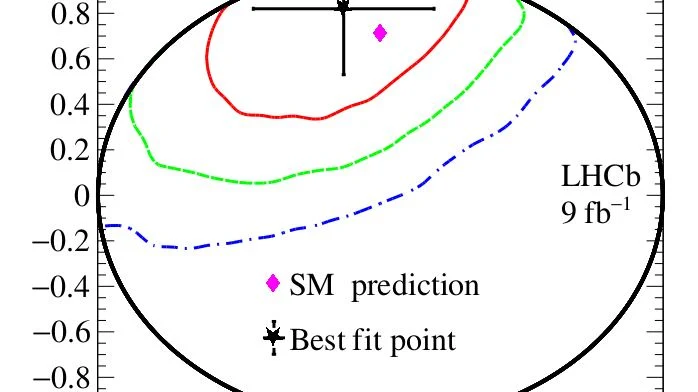
In the LHCb detector, like in a giant camera with billions of 'snapshots,' rare events are captured: how short-lived particles, B mesons, fall apart into lighter ones. One such decay, where a B meson turns into a kaon and a pair of muons, is particularly interesting. In it, as in a mirror, the difference between matter and antimatter may show up.
A drop of metal on a semiconductor is like an island in the sea. For an electron to reach that island, it must pay a "toll": overcome a barrier that arises because the island is tiny, and each extra charge significantly changes its energy. This phenomenon is called Coulomb blockade. It underpins single-electron transistors, where current flows one electron at a time.
When an electron and a positron collide at the BESIII collider, they produce a short-lived particle — the charmed baryon Λc+. Inside it, like in an overstuffed box, another particle quickly emerges: the Λ hyperon. This hyperon has its own rotation, its spin, and physicists have for the first time been able to measure how much that rotation is aligned with the particle's direction of motion.
Two twins look identical, but one is left-handed and the other right-handed. In the world of elementary particles, there are similar pairs: Ξ- and its antiparticle Ξ+. They are born together in the decay of the J/ψ particle and, like entangled twins, maintain a connection even at a distance.
A compass needle points north, but what if space itself has a hidden axis? Physicists have used Earth's magnetic field to test whether the universe's structure is truly the same in all directions.
An ordinary laser amplifies light into a bright beam. Run the process in reverse, and you get an anti-laser — a device that sucks in light without a trace. But such a machine is finicky: even a slight disorder can ruin the absorption.
Physicists have found a way to make the anti-laser invulnerable.
In the LHCb detector at the Large Hadron Collider, protons collide, and for a fleeting moment, particles that don't exist in ordinary matter are born. One of them is the neutral B meson. It lives for less than a billionth of a second and decays into two other particles: the narrow resonance J/ψ and the broader ρ(770).
In every cell lives a tireless scribe — an enzyme that copies the long thread of DNA. It moves along it like a read head over a tape, building a new strand alongside. It picks letters by strict rule: opposite A it always places T, opposite G it places C. But sometimes, very rarely, its hand trembles, and a different letter slips in.
According to the Big Bang theory, developed by Georges Lemaître, the Universe began from a hot dense point and then rapidly expanded — an inflation proposed by Alan Guth. Echoes of that time reach us as a faint glow — the ancient light.
The universe is a pie baked from a single recipe, but the teaspoon and the kitchen scale stubbornly show different amounts of sugar. That’s how it is with the expansion of the universe: measurements from nearby stars (the spoon) give one number, while those from the ancient light of the Big Bang (the scale) give a completely different one.
In the familiar world, we have three spatial dimensions. However, theoretical physics allows for additional, hidden directions — compactified, that is, curled up to microscopic sizes.