Asymmetry refers to the absence of symmetry in a physical system, where certain properties or behaviors differ when the system is reflected, rotated, or otherwise transformed. In physics, asymmetry is often a clue: it can reveal hidden dynamics, broken symmetries, or the direction of time. For example, the imbalance between matter and antimatter in the universe is a profound asymmetry that allowed our existence, and the asymmetry in the cosmic microwave background seeded the formation of galaxies.
Asymmetry arises when the laws or conditions of a system do not remain invariant under a transformation. This can happen spontaneously, as when a symmetricstate becomes unstable and settles into a less symmetric one — like a ball rolling off the top of a perfectly symmetric hill. It can also be induced by external influences, such as magnetic fields or rotation, which break the symmetry of a material's response to light or other stimuli.
In practice
Asymmetry is exploited in technologies like optical isolators and lasers, where breaking the symmetry of light propagation allows for one-way transmission or directional emission.
Fun fact
The fact that the universe contains more matter than antimatter is a type of asymmetry called CP violation, and without it, all matter would have annihilated with antimatter shortly after the Big Bang, leaving a universe with only photons.
A tightly stretched membrane, squeezed into a narrow case, decides on its own where to burst. So does a cell: when it is cramped, the point of division shifts from the middle, and the two halves come out unequal. Previously, it was thought that such asymmetry is predetermined by chemical labels, but the new work shows that mechanics alone is enough.
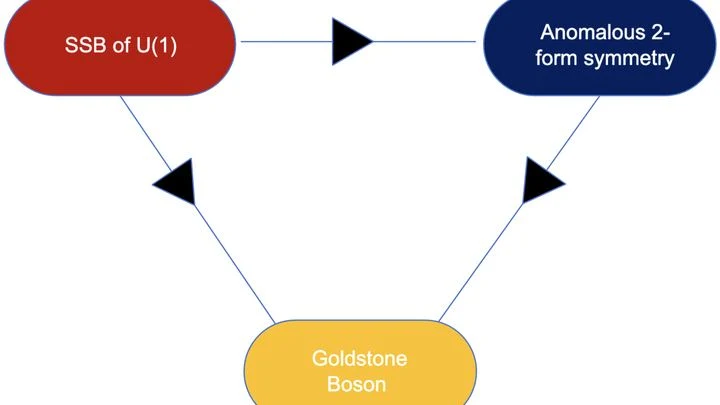
In some quantum theories, symmetries intertwine in an unusual way, as if a lock had two keys, but turning one slightly shifted the other. Such intertwined symmetries are called 2-groups. One is an ordinary symmetry acting on point particles (0-form), and the other is a 'linear' symmetry (1-form) governing extended objects like strings or lines.
The early Universe was not just a hot soup of particles. In the first fractions of a second, mirror symmetry could have been broken: the world and its reflection would not be quite identical. If so, the large-scale cosmic web of galaxies would retain a barely noticeable 'curl'—as if all matter were slightly twisted in one direction.
A quantum chain is like a string of lights, where the bulbs are the spins of particles. Ideally, all bulbs glow in sync, following a common rhythm: that's symmetry. But if you cut off a piece of the string, the rhythm can get out of step: within that segment, symmetry is broken.
Physicists study a chain of strongly interacting particles (the XYZ model).
An infinite chain of atoms spaced at equal intervals. Shift the entire chain by one step, and the picture doesn't change. That's translational symmetry: the world looks the same wherever you look. You'd think such a simple rule would give rise to simple states, like a crystal lattice assembled from identical building blocks.
But the authors counted those blocks anew.
Place two identical alarm clocks on a table and set them off at the same time. If one is on a slippery surface and starts to slowly slide, its timing will be thrown off, and within a minute they'll ring out of sync. That's roughly how the new method proposed by astrophysicists for supermassive black holes works.
Light usually behaves like a pedestrian on a two-way street: the path from a streetlamp to a camera matches the reverse path. But near a rotating black hole with broken spatial symmetry, this street becomes one-way. Swap the light source and observer, and the hole's shadow changes shape: from an oval resembling a rugby ball, it turns into a teardrop.
In an orchestra where every musician plays the same note, the sound merges into a powerful unison. This is how a Bose–Einstein condensate is born: many boson particles at extremely low temperatures behave as a single entity.
The universe wasn't born alone — alongside it came a mirror twin where everything is reversed: left and right are swapped and time flows from future to past. After the Big Bang, the world, according to Alan Guth's idea of superfast inflation, should have contained equal amounts of matter and antimatter.
Normally, current flows equally well in both directions if there's no magnet. A magnetic field or magnetic material breaks that symmetry: electrons start to prefer one direction. But in a new study, physicists found a way to do without magnets.
In a crystal, atoms may not sit perfectly ordered but with some disorder.
Normally, electric current is the same in both directions, like water in a straight pipe. But at the boundary between a normal metal and a superconductor, this rule breaks down. Two waves on water, going around a wide obstacle from different sides, can arrive with different delays and meet ‘out of step’.
You can edit a cell perfectly, and it still turns out useless. The gene is fixed exactly as planned, yet the cell behaves unpredictably: it drifts, changes fate, loses safety. It's like fixing one gear in a watch, but the watch still runs wrong because the whole mechanism is out of sync.
Previously, a cell was viewed as a list of independent parts.
Two metal plates in a perfect vacuum attract each other. Even Richard Feynman compared emptiness to a boiling foam: particle pairs are born and immediately vanish, creating the Casimir effect. If the plates are asymmetric, they also start to twist — that's a vacuum motor.
But rotation doesn't require oddly shaped parts.
In the nearly empty regions of space, galaxies spin in unison, like dancers in the same troupe. This dance creates a difference in light from opposite sides: on one side stretching, on the other compression. This optical shift has become a probe of the first moments after the Big Bang.
Two beams of light, red and blue, enter a tiny ring made of silicon nitride. The ring is smaller than the thickness of a human hair. At the input, both beams are equally bright. But inside the ring, one of them suddenly starts to outshine the other, like two equally matched people in a debate where one unexpectedly gains the upper hand.
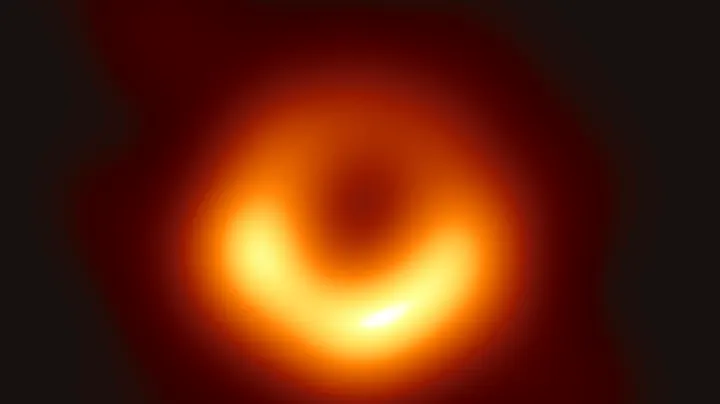
In 2019, astronomers unveiled the first-ever image of a black hole's shadow — a dark void encircled by a lopsided orange ring. This is the supermassive black hole at the heart of galaxy M87, 55 million light-years away. The ring isn't just glowing: one side is noticeably brighter than the other, like a campfire burning unevenly, with flames leaping higher on one side.
In the familiar world, we have three spatial dimensions. However, theoretical physics allows for additional, hidden directions — compactified, that is, curled up to microscopic sizes.
Matter is like a house. In some rooms, there is the strict order of a crystal, where every atom is in its place. In others, the chaos of superfluid helium, where atoms forget about their neighbors.