Leptons are tiny building blocks of matter that do not feel the strong nuclear force. The most familiar is the electron, which runs around the nucleus in atoms. There are also elusive neutrinos, which fly through the Earth almost without noticing it.
History
J.J. Thomson identified the electron as a particle in 1897 by measuring its e/m ratio. The muon was discovered in 1936 in cosmic rays and was first confused with Yukawa's meson. The tau lepton was detected by Martin Perl's group in 1975. The existence of neutrinos was postulated by Wolfgang Pauli in 1930 to save the energy conservation law in beta decay; neutrinos were first captured by Reines and Cowan in 1956.
How it works
Leptons interact through the weak interaction (exchange of W±, Z bosons), and charged ones also electromagnetically (photon). The Dirac equation describes free charged leptons. Neutrino oscillations require nonzero mass and mixing, described by the Pontecorvo-Maki-Nakagawa-Sakata matrix. Charged leptons are stable (electron) or decay via the weak interaction (muon, tau). The Pauli principle forbids two identical leptons from occupying the same quantum state, which determines the structure of atoms and neutron stars.
Fun fact
About 10¹¹ neutrinos from the Sun pass through your fingernail every day, but you feel nothing — so ghostly are leptons.
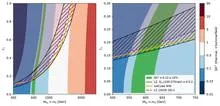
In an underground laboratory in South Dakota, the LUX-ZEPLIN detector, filled with liquid xenon, waits for rare collisions. Usually, dark matter particles pass through it without a trace, but one day a xenon nucleus was displaced with an energy of 248 keV.
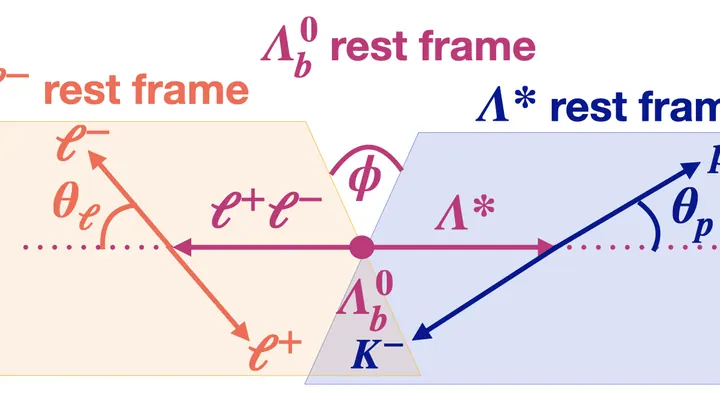
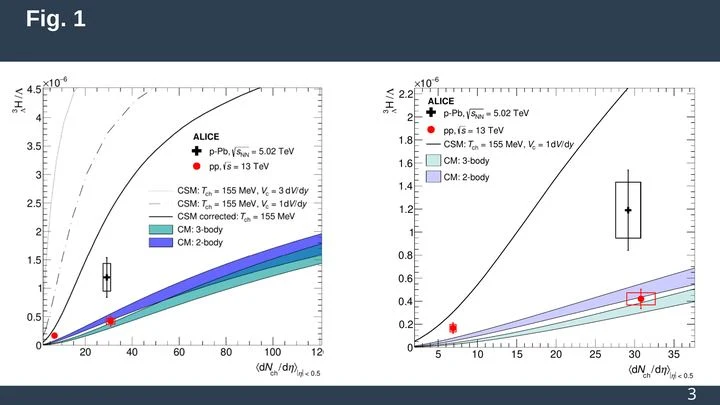
At the Large Hadron Collider, protons are smashed together, and among the debris, a heavyweight particle, the lambda baryon, sometimes appears. It lives for a tiny fraction of a second before decaying into other particles.
Neutrinos are nearly elusive particles that pass through Earth without noticing it. But sometimes one slams into an atomic nucleus in water, and a whole shower of particles is born: muons, protons, pions. Catching that moment is like photographing a bullet hitting an apple from a kilometer away.
An invisible stream of particles passes through your body every second. These are neutrinos — tiny messengers from distant stars and earthly reactors. Catching them is nearly impossible: they fly through matter like a bullet through fog. But physicists have learned to set traps for them.
In nuclear physics, a puzzle has long been nagging: why among elements lighter than bismuth, only technetium (No. 43) and promethium (No. 61) have no stable isotope at all? All their neighbors in the periodic table can boast at least one long-lived variant, but these two seem to fall out of the general pattern.
High in the mountains, where the air is clear and still, physicists are preparing to catch elusive visitors from space — neutrinos. These particles, like ghosts, pass straight through the Earth, leaving almost no trace. But occasionally a neutrino does slam into an atom, producing a shower of particles that can be seen.
Solar neutrinos are tiny particles born in the Sun's core by the trillions every second. They pass through Earth almost without noticing it, and for a long time they were considered absolutely stable. But perhaps they too can "age"—decaying imperceptibly, vanishing on their way to us.
A scale capable of weighing the invisible: that's exactly how the ratio of decays of light mesons (pion and kaon) into electrons and muons works. If nature follows the same rules for all generations of particles, the pans of this scale show a strictly defined number. But if an unknown force lurks somewhere, the needle will waver.
Neutrinos are like invisible dancers who change masks mid-flight. The three types (electron, muon, and tau neutrinos) constantly morph into each other. This dance is described by a complex mixing matrix, and physicists have long tried to break it down into simple moves.
The authors of the new work reassembled one such decomposition, TM1, using the 'flavor spin' formalism.
The Moon is an airless sphere of dense rocky grit called regolith. When fast particles from space slam into it, muons are born in the soil — unstable relatives of electrons, but two hundred times heavier. Most fly downward and fade away in the depths. But those that pop upward into the vacuum can travel tens of kilometers before decaying.
The tau lepton is a short-lived particle, a heavy cousin of the electron. When it decays, quarks inside it exchange gluons, like players in a closed room tossing a ball back and forth. You can't see the throws themselves, only the final score: two pions flying off at certain angles.
Electrons and muons are tiny magnets. Their magnetism is slightly more than two (in special units), and this 'excess fraction' (anomalous magnetic moment) arises from constant ripples in the vacuum: particle pairs momentarily pop into existence and vanish.
On one side of the scale lies all the matter in the Universe; on the other, all the antimatter. According to the laws of physics, at the moment of the Universe's birth, the pans should have been balanced. But we see one pan tipping: around us are stars, planets, people, and almost no antimatter. This imbalance is one of the greatest mysteries.
Atomic nuclei are wrapped in fluffy electron coats — in such attire, they can't get close enough to embrace. But swap the light coat for a heavy one: a muon, a particle from the standard model, shrinks the cloud by nearly 200 times.
In the world of elementary particles, there's a long-standing puzzle: why are the masses of the electron, muon, and tau particle so vastly different? And why are quarks, the building blocks of protons and neutrons, also split into three generations with sharp jumps in mass?
A noisy train station at rush hour. Thousands of people hurry past, voices merging into a dull roar. Somewhere in the crowd, two people try to shake hands with a special, barely visible gesture. Spotting such a handshake is nearly impossible.
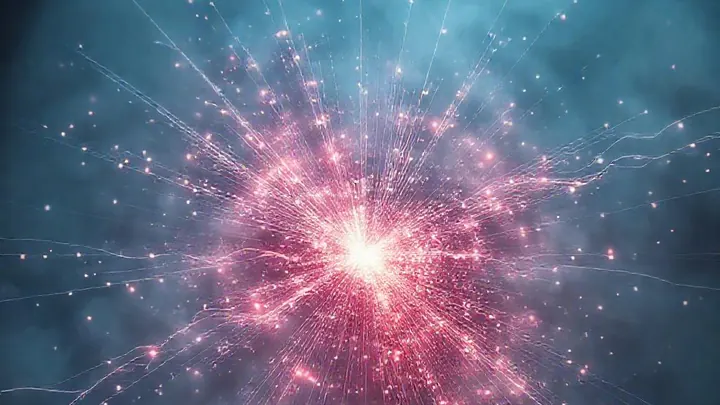
A firework bursts, and one point explodes into four sparks at once. That's how the Z boson, the particle that carries the weak force, behaves when it decays into four charged leptons (electrons or muons). The process is extremely rare: for every million Z bosons produced, only about five decay this way.
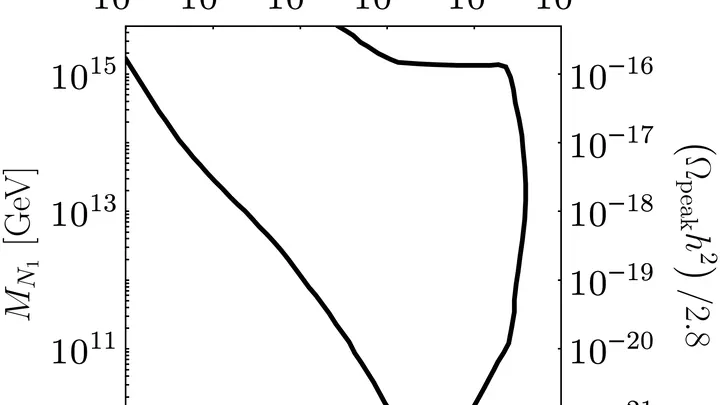
In the first moments after the Big Bang, matter and antimatter should have been created in equal amounts. But today we see only matter — stars, planets, ourselves. Where did the antimatter go? One clue hides in nearly elusive particles: right-handed neutrinos. The usual story is that their decays create a slight bias in favor of matter.
In the very beginning, moments after the Big Bang, the universe was ridiculously symmetric: particles and antiparticles in equal measure. But a tiny imbalance occurred, like one extra grain of sugar in a kilogram, and the entire familiar world, stars, planets, people, arose from that surplus. How nature created this imbalance remains a mystery.
In the Standard Model, our most complete description of the subatomic world, electric charge is always a multiple of the electron's charge: nature works in whole units, like a builder using bricks of a strictly defined size. Yet the equations allow for particles with double charge — bileptons.
Three oddly shaped weights sit on a table. Their exact masses are unknown, but place them on a balance scale in a certain combination, and the needle always points to the same magic number. That is roughly the puzzle physicists call the Koide relation for the three charged leptons: the electron, the muon, and the tau.
Two tiny spinning tops fly apart after a collision. Their rotation is not predetermined: it becomes definite only at the moment of measurement. This is quantum entanglement: the state of one top instantly responds to the state of the other, no matter how far apart they are.
To uncover the proton's true size, physicists swapped the electron in a hydrogen atom for its heavy copy — the muon. Acting like a magnifying glass with thousandfold power, the muon gets right up against the nucleus and 'probes' the proton with unprecedented precision.
A giant sphere filled with liquid flashes when an elusive particle, a neutrino, flies through it. Inside the sphere, like fireflies on a Christmas tree, hang thousands of tubes that catch these flashes. To pinpoint exactly where the flash occurred and how much energy arrived, you need to know the position of each tube to within a millimeter.
The proton looks like a solid ball, but inside it's a hive of activity: quarks exchange gluons — the particles that bind them together. Gluons pop in and out of existence, and their distribution within the proton is not just a curious detail but a key to predictions at the Large Hadron Collider.
If an atomic nucleus is a family, then in an ordinary helium house live two protons and two neutrons, holding hands tightly. Now imagine that one family member is an oddball who loves to wander far from home.
The muon resembles the electron but is 200 times heavier and lives for two millionths of a second. Its magnetic moment, how the particle responds to a magnetic field, has been measured with fantastic precision. Yet the measured value is slightly larger than theory predicts.
Deep beneath the Apennine Mountains, in a tank holding three tons of liquid xenon, something gives a barely perceptible shudder every few days. It's a solar neutrino, a ghostly particle born in the Sun's thermonuclear furnace, that has traveled 150 million kilometers through empty space and solid rock to finally collide with a xenon nucleus.
A ring road around the Sun, where the traffic is not cars but clumps of matter. The diameter of this road is measured in light-years: it encircles our planetary system at its outer edge, in the Oort Cloud, where the star's weak gravity still holds sway.
In an accelerator near Beijing, electrons collide with positrons, and for an instant, particles are born that you wouldn't find in ordinary matter. One of them is lambda-c-plus: inside it sits a heavy charmed quark, like a stone in a slingshot. Now physicists have for the first time seen this particle break apart into a neutron, a positive pion, and an eta meson.
When a neutron or proton enters an atomic nucleus, it behaves like a ball hitting a rough wall: it can bounce off in different ways, depending on where it hits.
In the first instants after the big bang, the universe was a quantum vacuum where pairs of particles and antiparticles, virtual "guests" from physical nothingness, spontaneously appeared and almost immediately annihilated.
The tau lepton is a heavy cousin of the electron, living less than a trillionth of a second. It usually decays into lighter particles, but never directly into three muons: such a transition is forbidden by known laws of particle physics. If it did happen, it would mean unknown forces are at play.
Neutrinos are tiny particles that zip through Earth, barely noticing it. In the MicroBooNE experiment, they are caught in a tank of liquid argon. When a neutrino strikes an argon nucleus, it produces an electron and protons, like splashes from a stone thrown into water.
In the accelerator, an electron and a positron collide, and for an instant, a particle is born that lives for less than a billionth of a second. Its decay resembles the explosion of a tiny firecracker: fragments scatter in all directions, and physicists reconstruct what was inside from their trajectories.
The proton is not a solid ball. Inside, it's a seething mix of quarks and gluons. Gluons are the particles that glue quarks together, much like wood glue binds pieces of wood. The question is: how much of the proton's "weight" comes from this glue? Physicists have calculated this on a computer by discretizing space and time into a fine grid.
Inside the accelerator, particles collide, and for a fleeting moment a B meson is born — a heavy particle that lives for less than a billionth of a second. Usually, it decays into a shower of debris, but sometimes it transforms into just two particles: a muon and a neutrino. This rare path is like a lottery where the winning ticket appears once in every two million draws.
In a particle accelerator, the anti-lambda particle is a rare guest. It is born on the fly, lives for a tiny fraction of a second, and usually decays on its own. But sometimes it manages to collide with an ordinary proton, and then a whole shower of light particles is born: kaons, pions.
The top quark is the heaviest known building block of matter, but theory predicts a stealthy twin, the T-quark, which could be several times heavier. To coax it into the open, physicists collide protons with muons — the electron's unstable relatives.
A magnesium oxide crystal is like a row of soldiers: atoms stand in neat lines, and an electron runs along them. But if the electron lingers, the nearest atoms shift slightly from their positions, like neighbors in a rank turning their heads. The electron finds itself in a dip made of displaced atoms and can no longer move freely.