Movement Alters Decisions express
A person flips a coin to make a decision. They stand still — the coin lands heads. They take a few steps, and flip again. It would seem walking shouldn't affect the coin. But what if the walk itself changes how often they decide to simply repeat the previous toss?
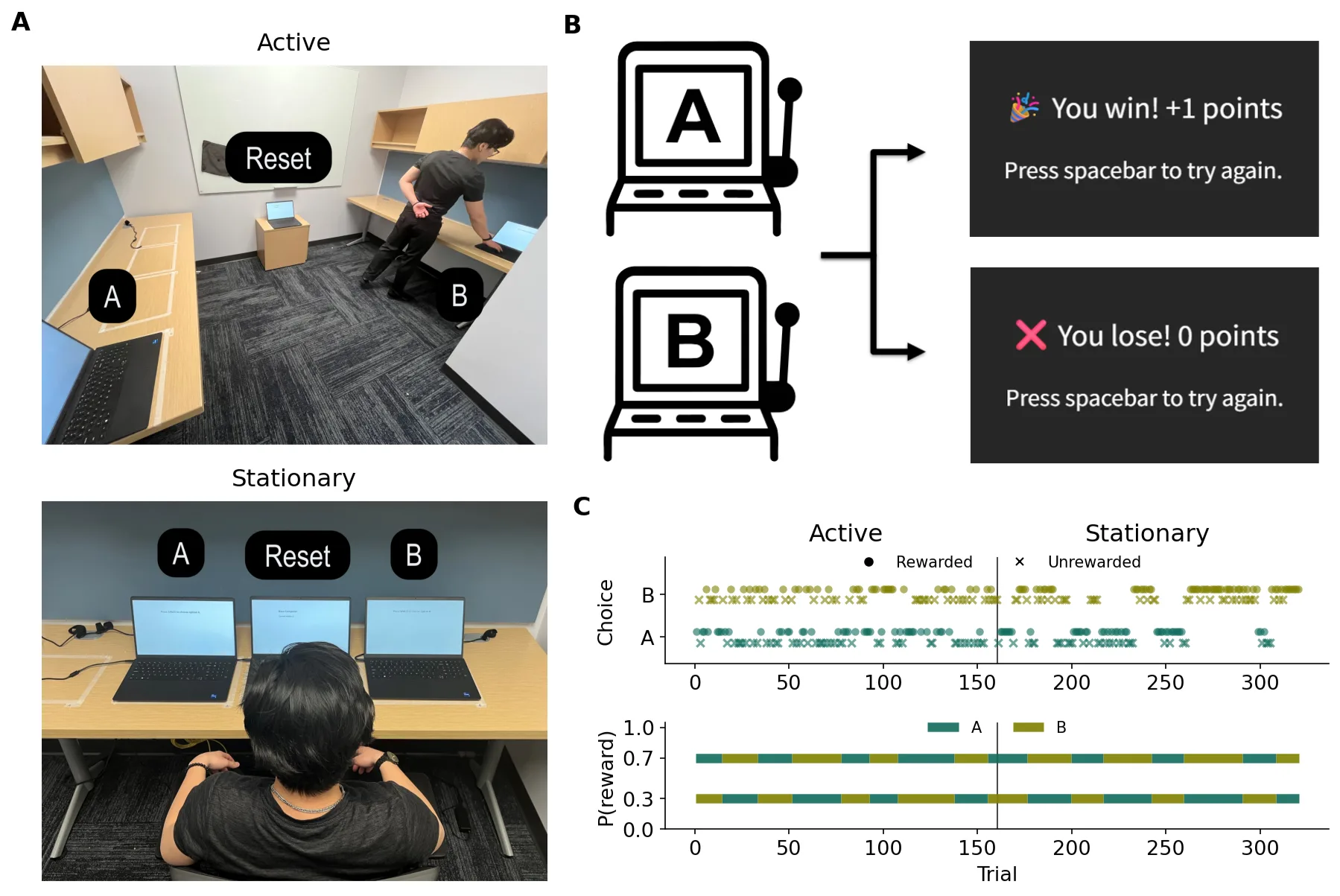
That's exactly what researchers tested. They asked 90 people to play a computer game: they had to guess which of two buttons more often yielded a win. The rules changed subtly, and players learned to adapt. Half the participants played only while sitting: their hand moved from key to key. The other half walked between two tables to press a button at each. Then the groups switched.
It's like a trace left by the body. The brain, accustomed to movement, after stopping seems to switch on a "repeater"—as if the echo of steps turns into an echo of decisions. At the same time, the game skill itself didn't suffer: people with good intuition remained the same, just their "ruler" shifted slightly.
Why does this matter? In psychiatry, such games are being considered as tests — to diagnose based on behavior at a computer. But if a simple change in posture subtly shifts the metrics, you could mistakenly label a healthy person as ill. Before implementing such methods in the clinic, we need to understand and account for all these "hidden springs."
Original abstract
as written by the authors arXiv:2608.08206v1
In computational psychiatry, task-irrelevant factors such as a task's perceptual and motor features are typically assumed not to bias decision behavior, but at most to add noise. Yet growing evidence links sensorimotor processing to decision-making through multiple pathways, challenging this assumption. We tested this directly using a two-choice probabilistic reversal learning task completed by 90 participants under two sensorimotor conditions: a stationary condition requiring only arm movements to respond, and an active condition requiring participants to walk between physically separated computers. Task performance, measured as the propensity to choose the more probable rewarding option, did not differ between conditions. However, stay rate (the tendency to repeat the previous choice) was significantly elevated in the stationary condition, but only among participants who completed the active condition first; those who completed the stationary condition first showed no such difference. Logistic regression weights capturing the influence of recent win history on choice showed the same pattern, with stationary-condition elevation restricted to the active-first group. Cross-condition correlations for both measures were strong, indicating that this order-dependent effect shifted absolute measurements without disrupting individual difference structure. Prior sensorimotor history therefore does not compromise the task's ability to extract stable cognitive variables, but does bias the values it yields - a non-random source of variance that, if it generalizes beyond this experiment, could shift patients across diagnostic thresholds in proposed clinical applications. The finding adds to a growing list of potential methodological contaminants in computational psychiatry's cognitive-task paradigms that must be characterized and mitigated before clinical translation.
The effect depended on order: only those who moved first and then sat began to repeat choices more often. Those who sat from the start showed no change in style, as if the body remembered the first experience and carried it into the new setting.
In Peter Watts's novel Blindsight, aliens don't distinguish consciousness from movement — for them, thought and action are one. This experiment shows that even in humans, the boundary between motor control and choice is far thinner than commonly assumed.