A random variable is a mathematical function that assigns a numerical value to each outcome of a random experiment. It is a fundamental concept in probability theory and statistics, bridging the gap between abstract outcomes (like coin flips or dice rolls) and measurable quantities. Random variables can be discrete, taking on a countable set of values (e.g., number of heads in 10 flips), or continuous, taking on any value in an interval (e.g., the exact height of a randomly chosen person).
History
The formal concept of a random variable was developed in the early 20th century, with key contributions from Andrey Kolmogorov in the 1930s, who placed probability on a rigorous measure-theoretic foundation.
How it works
Formally, a random variable X maps from a sample space Ω to the real numbers. The probability that X takes a particular value or falls in a range is determined by its probability distribution. For discrete variables, this is a probability mass function; for continuous variables, a probability density function. The expected value and variance summarize the distribution's center and spread. Random variables allow us to apply calculus and algebra to randomness, enabling predictions and inference.
In practice
Random variables are used everywhere in science and engineering: in risk assessment, financial modeling, quality control, machine learning, and physics (e.g., quantum measurement outcomes). They are the building blocks of statistical inference and simulation.
Fun fact
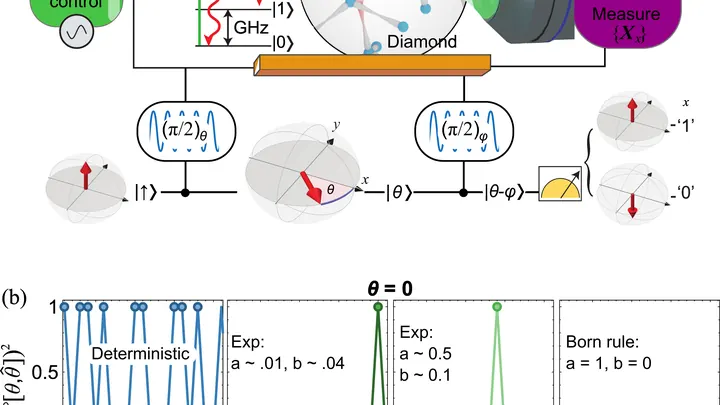
In quantum mechanics, the outcome of a measurement is a random variable, but its distribution is determined by the wavefunction—so randomness is intrinsic, not just a lack of information.
Every one of us has wondered at least once how many years we'll live. In 1996, nearly two and a half thousand Japanese people over sixty answered that question in a national survey. Their answers became a kind of mirror reflecting hopes, fears, and habits of thought. Twenty-eight years later, researchers compared those forecasts with actual dates of death and found that the mirror was warped, but not useless.
A person flips a coin to make a decision. They stand still — the coin lands heads. They take a few steps, and flip again. It would seem walking shouldn't affect the coin. But what if the walk itself changes how often they decide to simply repeat the previous toss?
That's exactly what researchers tested.
It is commonly believed that a black hole is a merciless cosmic vacuum cleaner, sucking in everything indiscriminately. But new research flips the picture: right at the horizon, curvature transforms from a trap into a trampoline.
For a long time, biologists argued: if a herd of animals stably maintains a mix of aggressive and peaceful individuals, does each one alternately change behavior, or do some always fight while others always yield? In classical equations, these options are indistinguishable.
Imagine a ball in an unfamiliar hall: two guests start from opposite corners. Their movements are not a smooth waltz but chaotic improvisation in search of rare treasures. Contrary to intuition, the outcome hinges not on tempo but on the geometry of the floor.
A quantum computer is like a finicky musical instrument: the slightest change in temperature, humidity, or string tuning, and the melody sounds different.
A candle flame in a draft dances: now it flares up, now it almost goes out. Quasars behave much the same way — supermassive black holes in the centers of distant galaxies, surrounded by a scorching disk of infalling matter. Only they flicker not over seconds, but over months and years.
Every morning you pick up the same mug, but the coffee tastes either bitter or just right. It's not about the coffee, and not about your character. Inside us, an invisible panel with dozens of sliders is constantly shifting: fatigue, hunger, anxiety, hormone levels.
A typical recipe explains how to cook a dish: step by step, from the initial ingredients to the finished result. The new approach flips the logic: imagine that the future pie itself dictates how much flour to add now. In the quantum world, researchers suggest, a particle receives signals from the future measurement outcome.
Neurons in the brain and nodes in artificial neural networks don't just fire with simple yes/no signals; they also handle smoothly varying quantities, like where an object is and how big it is. But neural responses are finicky: the same stimulus triggers slightly different bursts of activity each time.
A coin toss seems random, but in reality, physics decides everything: the force of the throw, air resistance, the surface's elasticity. If you knew all the details, you could predict the outcome. True randomness lives deeper — in the quantum world.
A pot of water heated from below is a simple example of turbulence. Hot fluid rises, cold fluid sinks, and the flow spontaneously breaks into rotating cells that look like horizontal rolls. In a new study, physicists took a wide rectangular container (ten times longer than its height) and tracked how many such rolls appear.
At night, the brain doesn't switch off. Instead, it sorts through the day's events like a librarian arranging books on shelves. But where do those strange, sometimes nonsensical dream images come from? Many have assumed they're just random noise with no meaning.
A new computer model shows that randomness doesn't hinder: it helps.
In the ocean, sometimes a huge solitary wave appears out of nowhere and then vanishes. Such rogue waves are rare but dangerous. Similar rare and intense spikes occur in other systems, from financial markets to lasers. The problem is that they are hard to predict, let alone trigger on demand.
Before an important conversation, a person reaches for their phone but doesn't dial. Several possible phrases already exist inside, but none has been chosen. This state, when options exist but none has won, the authors call 'rogue variables.'
To describe this mathematically, they build a graph: nodes are images, words, memories, and the links between them show how close they are.