Hypothesis testing is a formal procedure in statistics for deciding whether a proposed explanation about a population is supported by sample data. You start with a null hypothesis (often 'no effect' or 'no difference') and an alternative hypothesis (what you suspect is true). The goal is to assess how likely the observed data would be if the null hypothesis were true, and then either reject or fail to reject the null based on that probability.
History
The framework was developed by Ronald Fisher in the 1920s, with later contributions from Jerzy Neyman and Egon Pearson formalizing decision rules and error rates.
How it works
You compute a test statistic from the data, such as a t-value or chi-square value, and compare it to a distribution expected under the null hypothesis. The p-value is the probability of obtaining a result at least as extreme as the observed one, assuming the null is true. If the p-value is below a pre-chosen significance level (commonly 0.05), you reject the null, concluding the evidence favors the alternative. The procedure balances two types of errors: false positives (Type I) and false negatives (Type II).
In practice
It is used across science to validate experimental results — from clinical trials testing drug efficacy to particle physics searches for new particles, where a 5-sigmathreshold corresponds to a tiny p-value.
Fun fact
In particle physics, the standard for claiming a discovery is a p-value of about 3×10⁻⁷, corresponding to a 5-sigma effect, far stricter than the usual 0.05 used in many other fields.
A person flips a coin to make a decision. They stand still — the coin lands heads. They take a few steps, and flip again. It would seem walking shouldn't affect the coin. But what if the walk itself changes how often they decide to simply repeat the previous toss?
That's exactly what researchers tested.
Drop an ice cube into a glass of water — within a minute it melts, and the temperature evens out. That's thermal equilibrium in action: energy spreads evenly, and the system "forgets" its past.
A glucose meter that doesn't prick your finger but just looks at your wrist: that's the dream for millions of people with diabetes. It's the promise of algorithms that extract glucose levels from the ordinary pulse signal, the photoplethysmogram (the same one that measures heart rate in smartwatches).
Ordinary models assume that infection is like a steady flow of water that washes over everyone equally. In reality, the stream from a sick person fluctuates: right after infection it barely trickles, then turns into a raging downpour, and later subsides. The chance of catching the virus depends on the strength of this flow at the moment of contact.
A driver on a slippery road doesn't know exactly how the car will respond to the steering wheel, and learns on the go, leaving room for error. A smart control algorithm behaves in a similar way.
The 120 residents of Montelago are not people but digital characters. Each, besides a name and biography, has three hidden coordinates: trust in municipal authorities, assessment of source credibility, perceived adequacy of information. These numbers are known to the creators but not to the system itself.
We're used to thinking that noticing only confirmations of our guesses is a mistake. But recent calculations, inspired by wave behavior, flip that view. It turns out that the habit of seeking the familiar is the best way to reduce information noise (scientists call it entropy).
Two particles behave like a pair of unusual dice: thrown at opposite ends of the universe, they always land on the same face. Physicist John Stewart Bell calculated: if the dice had hidden rules, the frequency of matches would have a strict limit.
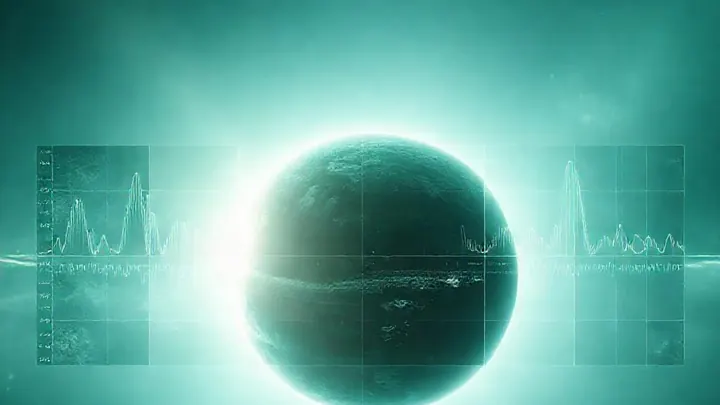
The hunt for life on distant planets is like diagnosing a rare disease with a test of unknown accuracy. A single positive result means nothing: maybe it's a glitch? We search the atmospheres of exoplanets (worlds around other stars) for traces of water and other compounds, but any signal could be a false alarm.
Your hand rests on the table, and two short vibrations arrive at your wrist — one after the other. You need to say which is stronger. The task seems simple, but the answer depends on which vibration came first. If the first is weak and the second is strong, the difference feels larger than when they are swapped.
Hot tea cools down, and its temperature is the same throughout the cup. But in many systems (for example, in the rarefied gas between stars or in plasma) temperature is not uniform: in one place particles are faster, in another slower. Physicists call such systems "superstatistical": it's as if the tea consisted of many small regions, each with its own temperature.
Comparing two scents is easy even without knowing their ingredients, just tell if they're alike. This everyday principle became the foundation for a new class of Bell inequalities, reimagining tests of the spooky connection between particles. Previously, you had to measure precise properties, like spin direction, but the authors showed that simply comparing outcomes is enough.
The universe is expanding, but at what rate is a question that has been troubling astronomers for decades. Two methods of measurement give different answers, and this discrepancy is called the Hubble tension. Some look at the early universe through the cosmic microwave background, others at nearby supernovae and Cepheid variables.
Genetic diagnostics is like comparing two photos taken with different cameras. If one camera slightly shifts the colors, the image will show "defects" that don't exist in reality.
All bodies fall the same: this was first observed by Galileo. Einstein elevated the observation to the equivalence principle: gravity and acceleration are indistinguishable, giving birth to curved spacetime.
In the quantum world, particles do not have precise properties until they are measured. The official model refuses to explain what lies behind this uncertainty. But the idea that invisible 'pilots' control particles has been around since the 1920s.