Movement Alters Decisions express
A person flips a coin to make a decision. They stand still — the coin lands heads. They take a few steps, and flip again. It would seem walking shouldn't affect the coin. But what if the walk itself changes how often they decide to simply repeat the previous toss?
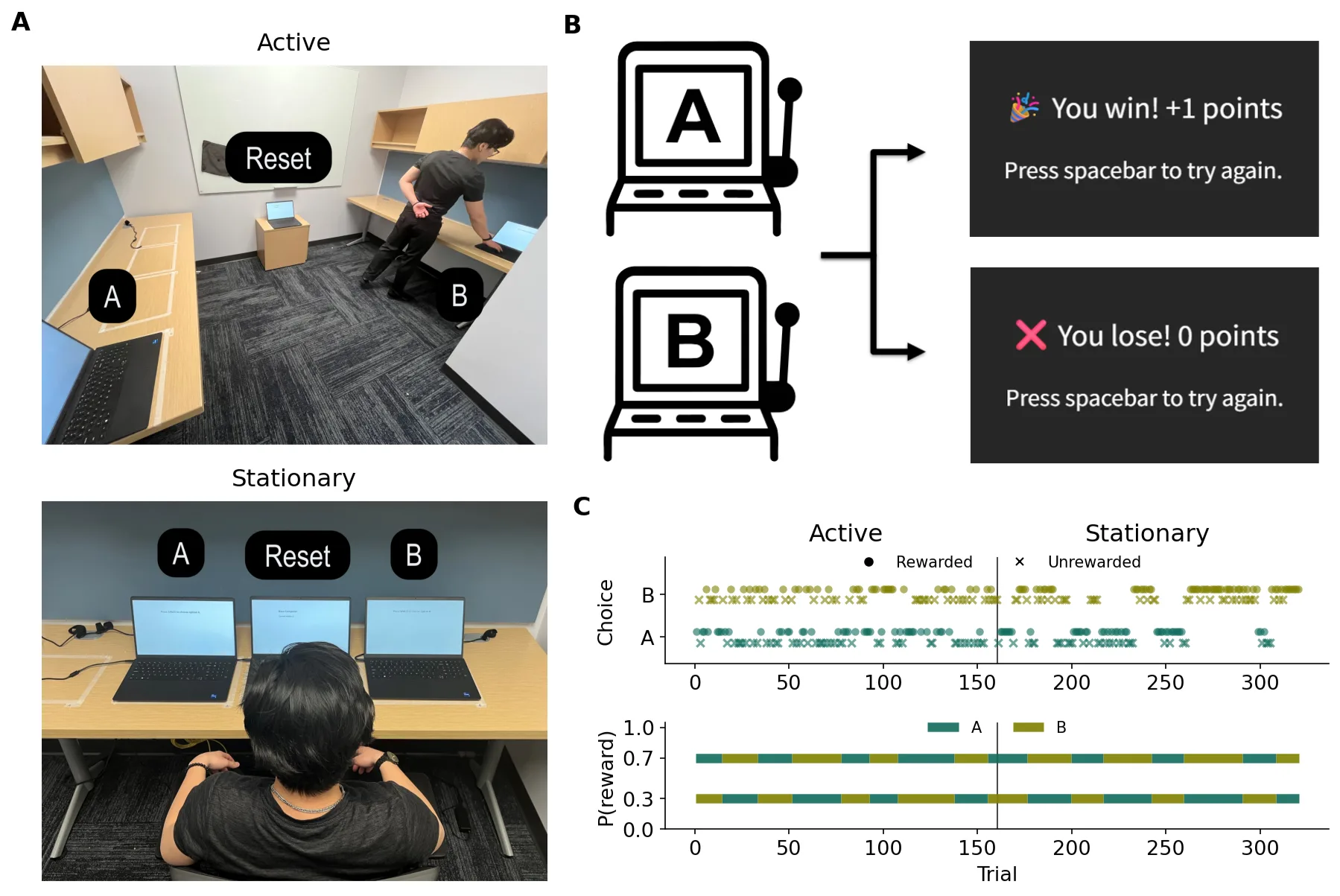
That's exactly what researchers tested. They asked 90 people to play a computer game: they had to guess which of two buttons more often yielded a win. The rules changed subtly, and players learned to adapt. Half the participants played only while sitting: their hand moved from key to key. The other half walked between two tables to press a button at each. Then the groups switched.
It's like a trace left by the body. The brain, accustomed to movement, after stopping seems to switch on a "repeater"—as if the echo of steps turns into an echo of decisions. At the same time, the game skill itself didn't suffer: people with good intuition remained the same, just their "ruler" shifted slightly.
Why does this matter? In psychiatry, such games are being considered as tests — to diagnose based on behavior at a computer. But if a simple change in posture subtly shifts the metrics, you could mistakenly label a healthy person as ill. Before implementing such methods in the clinic, we need to understand and account for all these "hidden springs."
The effect depended on order: only those who moved first and then sat began to repeat choices more often. Those who sat from the start showed no change in style, as if the body remembered the first experience and carried it into the new setting.
In Peter Watts's novel Blindsight, aliens don't distinguish consciousness from movement — for them, thought and action are one. This experiment shows that even in humans, the boundary between motor control and choice is far thinner than commonly assumed.