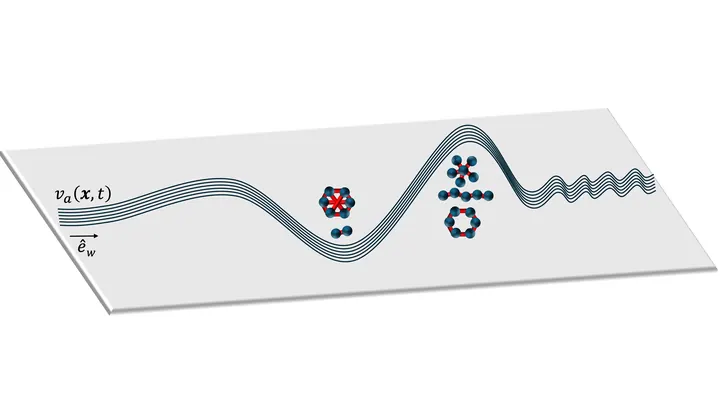
A stimulus is any external signal or change in the environment that triggers a response in a biological or physical system. It is the fundamental input that drives adaptation, learning, and dynamic behavior — from a neuron firing to a chemical wave propagating. In physics and complex systems science, stimuli are studied not just as triggers, but as perturbations that can push a system into new regimes, such as tipping it into instability or prompting self-organization.
History
The concept of stimulus-response was formalized in physiology in the 19th century, notably by Ivan Pavlov and later behaviorists, but its application to physical systems is more recent, emerging with complexity science in the late 20th century.
How it works
The mechanism depends on the system. In neural or biological contexts, a stimulus crosses a threshold to initiate an action potential or behavioral change. In physical systems, a stimulus (like a sudden force or temperature change) alters the energy landscape, causing the system to transition between states. Repeated stimuli can lead to habituation, where the response diminishes, or to resonance, where the system amplifies the input.
In practice
Stimuli are central to designing sensors, adaptive materials, and neural interfaces, as well as in understanding how systems respond to perturbations in engineering and climate science.
Fun fact
In some chemical systems, a single stimulus can trigger a traveling wave that persists long after the stimulus is removed, as seen in the Belousov–Zhabotinsky reaction.
The skin of an older person is like an orchestra where the musicians are all in place, the instruments are tuned, but the conductor walks onstage later than he should. Infection with Staphylococcus aureus sets off an elaborate concert of immune cells in the skin, and it used to seem that with age the orchestra simply plays more quietly.
A banknote taped to the finish line makes your hand fly faster. In the lab, that banknote was replaced with a 50-pence coin, and the finish line with a target on a screen. The researchers recruited 28 young people and 28 older adults, seated them at a robot handle, and asked them to steer a cursor toward the target. Sometimes they were paid for speed and accuracy, sometimes not.
A person flips a coin to make a decision. They stand still — the coin lands heads. They take a few steps, and flip again. It would seem walking shouldn't affect the coin. But what if the walk itself changes how often they decide to simply repeat the previous toss?
That's exactly what researchers tested.
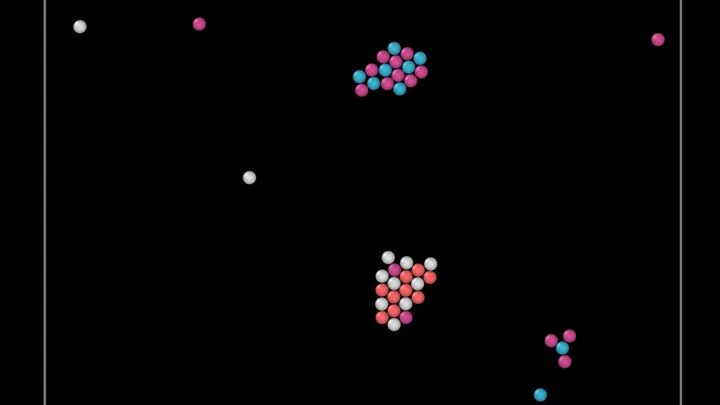
A drop of water on glass trembles and shimmers: it seems to have a life of its own. Similar behavior can now be observed in the world of colloids: tiny particles suspended in a liquid. Researchers simulated particles that emit chemical signals. These signals, like scents in the air, spread around and cause neighbors to either draw closer or move apart.
A stadium packed with fans hears the announcer’s voice for the first time, and instantly the whole place erupts. The message sounds again and again. Only a handful of people in nearby rows respond. That’s roughly how neural networks behave in brain organoids — tiny lab-grown replicas of the brain.
A jazz ensemble: at first, a cacophony of random notes. Then — a catchy riff that plays over and over. Such is the riddle of the origin of life — only in the language of chemistry.
A bacterium swims toward food. A chemical signal guides it forward, but with each movement the signal changes. A loop emerges: sensation, action, new sensation. The authors turned this loop into a measurable quantity.
In a glass of water, oil gathers into droplets: that's equilibrium separation dictated by chemistry. But there are systems where order arises not from rest but from a constant flow of energy.
Two gardeners haggle over water from a magical well. One proposes how many buckets to take, the other can agree or refuse. If the deal goes through, the water decreases; if not, the well gradually refills. This haggling repeats hundreds of times, and the gardeners' habits sometimes change randomly, as if they're trying new tactics.
A desert where every step reshapes the terrain. Dunes settle, new slopes emerge, and the next step is dictated by what you've just trampled. That's roughly how "sandscapes" work — a mathematical model inspired by living systems.
A neuron is like a complex musical instrument. To understand how it responds to a touch, you used to have to connect to each string directly — a delicate, slow procedure that only works for individual cells.
A runner loses on both a smooth track and sticky sand. Seems hopeless. But if the surface underfoot starts changing every few seconds (track, then sand) the runner suddenly stops falling behind. He doesn't get faster; the environment just doesn't get a chance to 'crush' his weakness.
That's exactly what the authors found when studying a simple predator–prey model.
In embryonic development, a cell resembles a musician in a vast orchestra: it must play its part, following a conductor — the gradient of signaling molecules. But the conductor is unreliable: morphogen concentrations constantly fluctuate. How then does a cellist not veer into a violin melody?
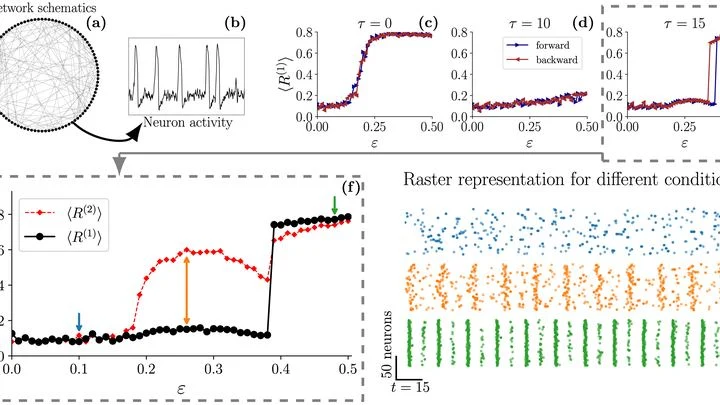
A neuron sends a signal to its neighbor. The neighbor doesn't respond immediately — the impulse travels along the process at a finite speed, like a letter delayed in transit. Usually, such a delay is considered a nuisance, but in this new work, it becomes the conductor.
When two excitable neurons are connected with a delay, a rhythm spontaneously emerges between them.
A city is a living system: it consumes resources, produces waste, and its 'circulatory system'—the road network — delivers people and goods to their destinations. But while engineers design transport arteries as rigid geometry of straight lines, nature has spent millions of years perfecting ideal distribution networks.
An orchestra plays without a conductor. Each musician has a score: that's the genes. But the volume and tempo depend on the acoustics of the hall, the mood, and the neighbors on stage. That's roughly how heredity and daily life together shape a teenager's behavior.
The brain constantly juggles tasks: it reacts to a sharp sound, solves an equation, or drifts into daydreams. Scientists have long suspected that switches between different "scenarios" of neural network activity underlie this, but extracting them from the chaos of electrical signals was difficult.
The brain is like a multi-story building: lower floors process simple signals, while upper floors assemble them into complex perceptions. Scientists have long suspected that this order is tied to how neurons work together. But exactly how has remained a puzzle.
Show the same photo of a cat to two different neural networks, and they often reach a similar conclusion: "cat." But ask them for more detail, and their answers may diverge. One model focuses on the whiskers, another on the coat color, a third on the pose. So even within the "visual" world of neural networks, there's no complete unity.
Your hand rests on the table, and two short vibrations arrive at your wrist — one after the other. You need to say which is stronger. The task seems simple, but the answer depends on which vibration came first. If the first is weak and the second is strong, the difference feels larger than when they are swapped.
A Network That Decides When to Stop
A crowd grows: each new person joins the group with a probability that depends on how large the group already is. If the group is small, joining is easy; if it is huge, people start to hesitate, and growth slows down. This mechanism, called feedback, changes the entire behavior of the network.
A quiet tube with a heated grid inside. The voltage on the grid is suddenly raised, and the tube starts to hum, sustaining itself. This is not a malfunction but a transition to another stable state, like a ball rolling over a hill into a neighboring hollow.
Polymers are long threads of carbon and hydrogen atoms. In living cells, they encounter streams of chemical signals that pulse like the surf. Long chains and closed rings behave like skilled surfers: they catch the wave and glide with it. Short fragments and tight coils, counterintuitively, move strictly against it.
A bacterium in a drop of water is looking for food. Around it, there's a chemical gradient: more food molecules on one side, fewer on the other. How should it move to reach the tasty spot fastest? It could steer smoothly, like a cyclist dodging a puddle. Or, like a bacterium, it could periodically stop, tumble, and swim off in a random direction.
Every hour, when the hands of a clock align at twelve, something happens in Earth's magnetosphere. It's as if an invisible conductor raises a baton, and waves race along magnetic field lines toward the surface. They're called pearls: on recordings, they look like a string of beads strung along time.
A density of four people per square meter is the threshold beyond which a crowd ceases to be a sum of individual pedestrians and becomes something else. In Pamplona's Plaza Consistorial during the San Fermín festival, local density reached nine people per square meter.
An old aviation instrument sometimes sticks: the needle catches on the scale and doesn't move, even though the plane is already changing altitude. Engineers found a simple solution: add a slight vibration. The shaking doesn't hinder; on the contrary, it helps the needle break free and show the truth.