How Jet Speeds of Distant Black Holes Were Measured express
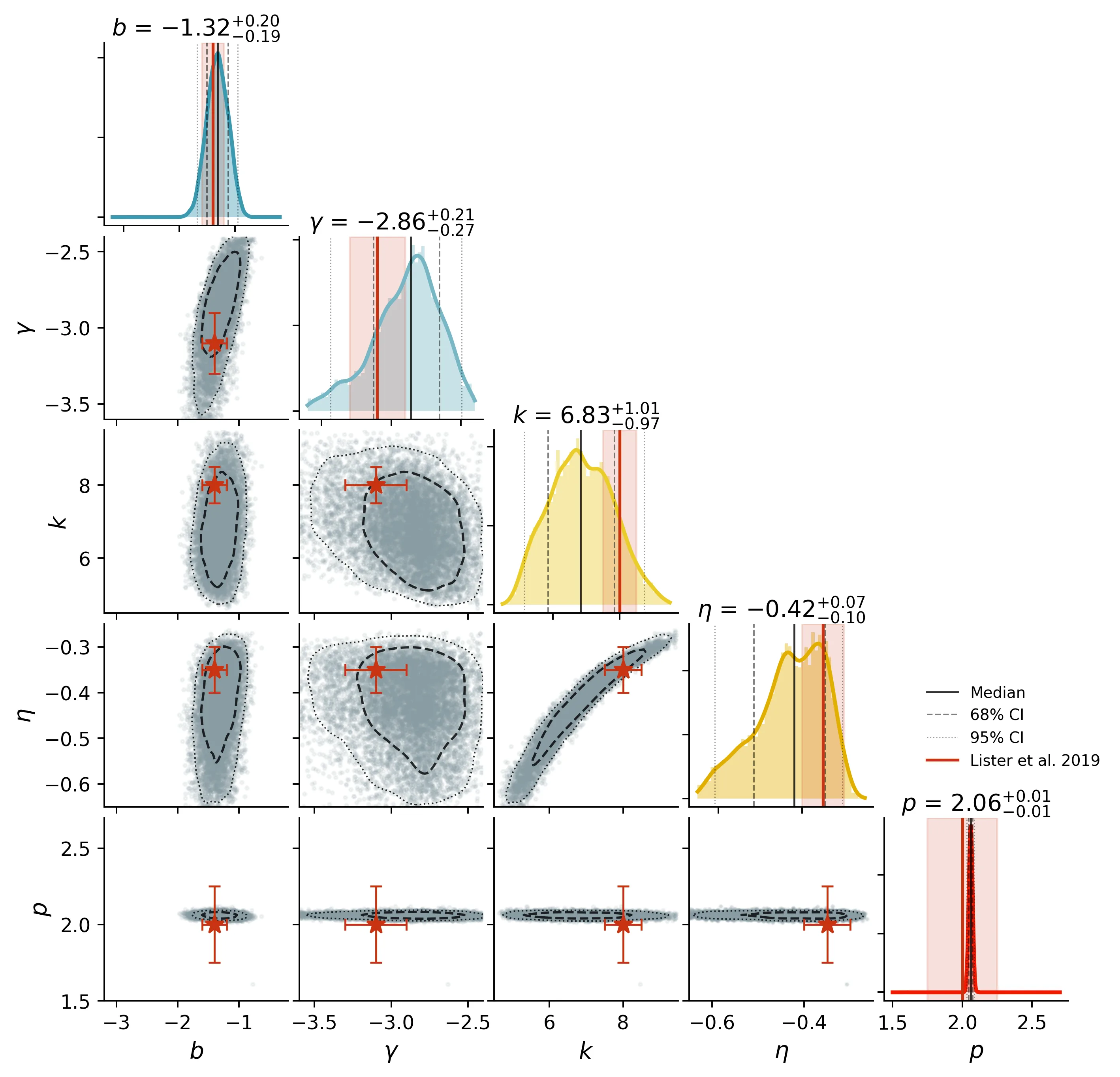
Supermassive black holes at the centers of galaxies sometimes eject narrow streams of matter — jets that travel at nearly the speed of light. For a long time, astronomers could not say precisely how fast these jets are for different black holes. In the new work, scientists collected data on hundreds of such jets and applied a method previously used in other fields of science.
The method is called "likelihood-free inference." Instead of trying to compute the probability of each scenario directly, the computer learns from many simulated examples and then compares them to real observations. This allowed accounting for distortions introduced by brightness limitations: faint jets are simply not visible, and if this is not considered, speed estimates are biased. The new approach showed that previous errors were greatly underestimated, and the speed distribution does not resemble a simple curve.
The result: most jets have speeds close to 99% of the speed of light, but there are also slower ones. The speed distribution turned out to be similar to that observed for stellar-mass black holes: those that form from the explosions of massive stars. This suggests that the mechanism for launching jets may be the same for black holes of any mass.
Original abstract
as written by the authors arXiv:2608.08733v1
We present the most complete modelling of the MOJAVE 1.5 Jansky Quarter Century active galactic nuclei (AGN) jet population, using likelihood-free simulation-based inference. Due to the complex impact of a flux-limit on observed AGN data sets, careful modelling of the parent population is required. In particular, when observing and fitting to multiple data distributions likelihoods become non-intuitive. Parameter degeneracies further complicate the problem and make it suitable for likelihood-free, simulation-based inference. This method relies on a normalising flow learning the likelihood surface or posteriors directly. We extensively validate the flow to show that previous parameter estimates for the AGN jet speed distributions underestimated parameter errors significantly and do not capture the non-gaussianity of the parameter posteriors. The new results enable a better statistical comparison to other AGN population studies, but also a more accurate comparison of supermassive black hole jets with their lower mass counterparts, X-ray binaries (XRB). We find that the AGN follow a Lorentz factor distribution of the shape $$N(\Gamma) \propto \Gamma^b$$ with $$b= -1.32_{-0.19}^{+0.20}$$. This slope is consistent with the XRB Lorentz factor distribution at $$2\sigma$$. Simulation-based inference as a method is generally well-suited to many astrophysical problems, and this paper shows the convenient applicability of this methodology to parent population studies of jetted AGN with multiple observables specifically.
Jets from supermassive black holes can be longer than the distance from Earth to a neighboring galaxy.