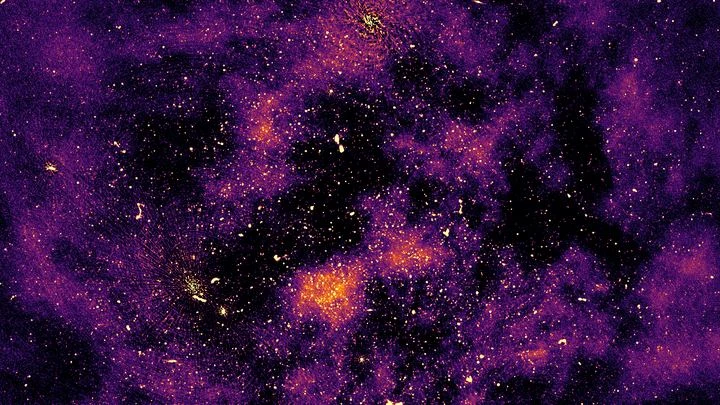
Relativistic jets are narrow, powerful outflows of plasmaejected from the vicinity of black holes and neutron stars at speeds close to the speed of light. They can extend for thousands of light-years, emitting radio, optical, and X-ray radiation as particles accelerate and interact with magnetic fields. These jets play a crucial role in transporting energy from the central object to the surrounding galaxy, influencing star formation and the intergalactic medium.
History
Jets were first observed in the galaxy M87 in 1918, but their relativistic nature was recognized only in the 1970s with the advent of very long baseline interferometry. The theoretical framework was developed by Roger Blandford and Roman Znajek in 1977.
How it works
The jet is powered by the extraction of rotational energy from the spinning black hole or accretion disk, a process described by the Blandford-Znajek mechanism. Magnetic field lines anchored in the disk or horizon twist and accelerate plasma outward. The particles within the jet are accelerated to relativistic energies, producing synchrotron radiation and inverse Compton scattering, which generate the observed high-energy emission.
In practice
They are natural particle accelerators, and studying them helps understand cosmic ray origins and the feedback mechanisms that regulate galaxy evolution.
Fun fact
The jet in M87 was the first astrophysical object to be imaged with event-horizon-scale resolution, revealing a bright ring around the black hole's shadow.
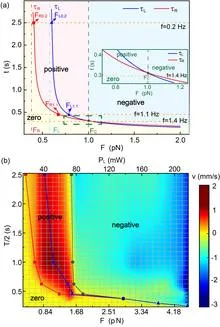
A swing that rocks on a sawtooth hill behaves strangely: without kicks, it gets stuck in the first dip, but with rhythmic pushes it can move uphill, downhill, or stay frozen in place. That is exactly what physicists saw when they placed a single dust grain in a trap with a sawtooth bottom and started pushing it alternately with laser beams.
A lighthouse that blinks not every second but once every few minutes or even hours. That is exactly how long-period radio transients behave — cosmic sources discovered only recently.
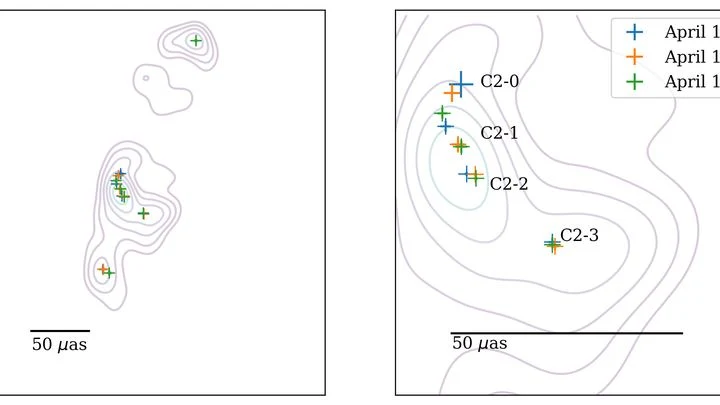
In April 2021, the antennas of the Event Horizon Telescope (EHT)—a global network of millimeter-wave radio telescopes — zeroed in on a tiny spot in the constellation Virgo.
At the center of a galaxy, a huge black hole is shrouded in an invisible cloud — a swarm of ultralight particles that it itself spawned. Into this cloud dives another black hole, about the size of a star, and begins a long spiral dance. The approach takes millions of years, but the most dramatic events unfold right at the horizon.
In 2022, astronomers began discovering strange cosmic beacons — long-period radio transients. Unlike fast pulsars, discovered by Jocelyn Bell Burnell in 1967, these objects flared with periods of tens of minutes and hours.
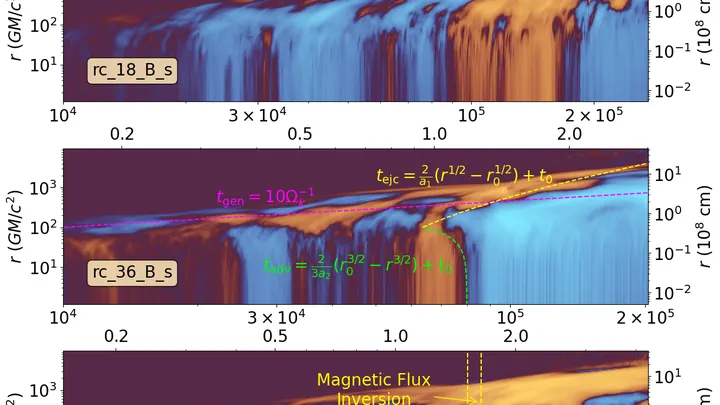
A massive star collapses, and a black hole is born, surrounded by a disk of incandescent plasma. For narrow jets to burst out of this disk, an ordered magnetic field is needed. But inside the star, it's tangled.
The Fermi telescope spent 17 years recording gamma rays from the active nuclei of galaxies with giant black holes at their centers. The glow of their jets resembles a chaotic cacophony: it constantly changes.
In the binary system Cygnus X-3, right here in our Galaxy, a black hole and a giant star whirl so tightly together that the star loses matter: it's swept away by a powerful wind. Jets blast out from near the black hole; recently, a telescope caught photons from them, each carrying the energy of a flying mosquito.
Massive stars end their lives in a colossal explosion, which Fritz Zwicky called a supernova. The core crushes down into a black hole or a neutron star.
A stream of water from a hose hitting a wall splashes sideways. Astrophysical jets behave similarly — narrow plasma flows ejected from the vicinity of black holes or young stars. When such a flow encounters resistance from surrounding gas, a shock wave forms inside it, akin to a standing wave in a fast-flowing river.
From the center of a galaxy, where a black hole lurks, narrow jets of hot gas shoot out in opposite directions. They shine across vast distances, sometimes longer than the galaxy itself.
A laser beam usually travels straight, like a jet of water from a hose. But what if you twist that jet like the thread of a corkscrew? You get a light spring — a beam that, as it moves, also spins around its own axis. At every point in space, its brightness traces a spiral, and if you place a flat screen in its path, you'll see a rotating spot of light.
When two protons collide at enormous speed, a narrow beam of particles (a jet, like the spray from a stone thrown into water) shoots out from the point of impact. In collisions of heavy lead nuclei, things are more complicated: a hot cloud forms inside, which interferes with the jet's straight flight.
At the heart of nearly every large galaxy lurks a supermassive black hole. As it devours gas, it blasts powerful outflows back into space, like a dragon that can't swallow all its prey and breathes fire. These 'winds' accelerate to thousands of kilometers per second and can sweep away the gas reservoirs from which stars are born.
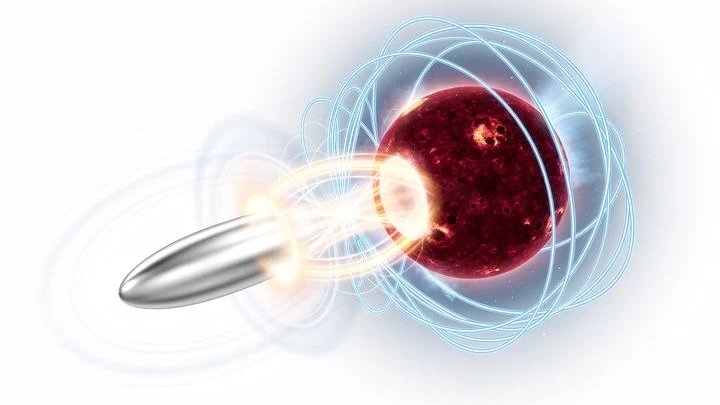
The neutron star PSR J1101-6101 is tearing through space at a breathtaking speed. It leaves behind a trail of charged particles, like a speedboat carving through water and dragging a foamy wake.
The black hole in the binary system V4641 Sagittarii behaves like a giant blender. It sucks in matter from its companion star and flings it back into space in two narrow jets. These jets slam into the surrounding gas like a water jet hitting sand, gradually carving out a huge cavity around the hole.