constant

speed of light

The speed of light in vacuum is a universal constant, approximately 299,792,458 meters per second.
Value
\(c = 299792458\)metre per second
10 related articles · 6 formulas · 2 who worked here

Description

Light travels at an incredible but constant speed — faster than anything we know. Imagine it as the fastest arrow that nothing can outrun. Light from the Moon to Earth takes less time than the blink of an eye!

History

The first estimates of the speed of light were made by Rømer (1676) from the eclipses of Jupiter's moons. In 1849, Fizeau conducted the first terrestrial measurement using a rotating toothed wheel. In 1865, Maxwell derived the speed of light from his equations of electromagnetism. The Michelson-Morley experiment (1887) demonstrated the independence of the speed of light from the motion of the ether, leading to the principle of the constancy of the speed of light. The works of Lorentz and Poincaré paved the way for Einstein's special relativity (1905), where the constancy of the speed of light became a postulate.

How it works

According to special relativity, the speed of light in a vacuum is the same in all inertial frames of reference. This leads to relativistic effects — time dilation and length contraction. Formally, this is described by the Lorentz transformations. In quantum field theory, the speed of light determines the scale of the causal structure of spacetime. In general relativity, locally the speed of light is constant, but globally it can change in a gravitational field (Shapiro effect). The principle of the constancy of the speed of light underlies all modern physics.

Fun fact

If you could travel at the speed of light, you would circle Earth's equator 7 times in one second.

Concept graph →

Formulas

$$c_{\text{coord}} = c \sqrt{-g_{tt}/g_{rr}}$$
Speed of light in curved spacetime coordinates.
What is in the formula
c_coordvariableCoordinate speed of light — speed metre per second
cvariableSpeed of light in vacuum — speed of light metre per second
g_ttvariableTime-time component of metric tensor — metric tensor component
g_rrvariableRadial-radial component of metric tensor — metric tensor component
√operatorSquare root operation — square root operator
c_{{coord}}=c(1-\frac{r_s}{r}) · 2605.09783
$$P \sim e^{-\frac{2\pi M c^2}{\hbar a}}$$
Particle detection probability decays exponentially with mass and acceleration.
What is in the formula
PvariableDetection probability of a particle — probability
MvariableMass of the particle — mass kilogram
avariableProper acceleration of the detector — acceleration metre per second squared
cconstantSpeed of light in vacuum — speed of light = 299792458 metre per second
ħconstantReduced Planck constant — reduced planck constant = 1.054571817e-34 joule second
$$a_0 = \frac{c^2}{\ell}$$
Characteristic acceleration scale in modified gravity.
What is in the formula
a_0variableCharacteristic acceleration scale — acceleration metre per second squared
cconstantSpeed of light in vacuum — speed of light = 299792458 metre per second
\ellconstantA characteristic length scale of the modified gravity theory — length scale metre
$$T = \frac{\hbar c^3}{8\pi G M k_B}$$
Black hole temperature is inversely proportional to its mass.
What is in the formula
TvariableHawking temperature of the black hole — temperature kelvin
MvariableMass of the black hole — mass kilogram
\hbarconstantReduced Planck constant, fundamental quantum of action — reduced planck constant = 1.054571817e-34 joule second
cconstantSpeed of light in vacuum, universal speed limit — speed of light = 299792458 metre per second
GconstantNewtonian constant of gravitation, sets strength of gravity — gravitational constant = 6.67430e-11 cubic metre per kilogram per second squared
k_BconstantBoltzmann constant, relates temperature to energy — boltzmann constant = 1.380649e-23 joule per kelvin
$$E = m c^2$$
Energy equals mass times the speed of light squared.
What is in the formula
EvariableEnergy — energy joule
mvariableMass — mass kilogram
cconstantUniversal constant representing the maximum speed at which information and energy can travel — speed of light = 299792458 metre per second
$$K > (\gamma - 1) m c^2$$
Particle kinetic energy exceeds rest mass energy threshold.
What is in the formula
Kvariablekinetic energy — kinetic energy joule
γvariableLorentz factor — lorentz factor
mvariablerest mass — mass kilogram
cvariablespeed of light — speed of light metre per second
cconstantThe speed of light in vacuum, a fundamental constant of nature. — speed of light = 299792458 metre per second

Related articles · 55

Light Flows Without Friction: Three Ways to Measure the Limit
In a Paris laboratory, light was made to flow around an obstacle the way water flows around a rock in a stream. But this water is special: it feels no friction.
Optics2026-08-212 minarXiv:2608.21282express
Light Bounces Off a Mirror Flying Faster Than a Bullet
The mirror races along at nearly forty thousand kilometers per second. Light that strikes it bounces back, but changed, like a ball volleyed by a racket in mid-swing. That's exactly the kind of mirror scientists have built inside an ultra-thin glass thread filled with hydrogen. First, a powerful laser pulse is sent down the fiber.
Exoplanets2026-08-121 minarXiv:2608.11622express
Do Meteors Really Slow Down?
A stone thrown into water quickly loses speed. A meteor entering the atmosphere should behave the same way: air slows it down, and friction burns up its material. But cameras of the Global Fireball Observatory network have captured hundreds of bright fireballs over ten years that streak across the sky with almost no deceleration.
Cosmology2026-08-052 minarXiv:2608.04763express
Dark Matter Isn't Quite the Invisible Wallflower
The cosmological standard model is like a recipe for a cake where everything is strictly measured: dark matter is like flour without a single lump (zero pressure), and dark energy is like the perfect leavening agent (equation of state exactly minus one). But what if the flour is a bit damp and the leavening agent has lost its oomph?
High Energy2026-08-052 minarXiv:2608.05106express
Cosmic Shower and the Forbidden Brake
A proton or an atomic nucleus slams into Earth's atmosphere at tremendous speed, and a cascade of billions of particles is born. This extensive air shower races toward the surface, while sensitive telescopes catch its faint glow. From the shape of the glow, physicists determine how deep the shower penetrated the atmosphere and what it was made of.
Cosmology2026-08-022 minarXiv:2608.00923express
Neutrinos Reveal the Universe's Expansion Rate
Measuring distances in the universe is no easy task. Almost all methods rely on light, which can be absorbed by dust, scattered, or distorted along the way. It's like trying to spot a distant lighthouse through fog and haze. Neutrinos are a different story. These ghostly particles pass through anything without noticing obstacles.
Quantum Physics2026-07-251 minarXiv:2607.23324express
How to Catch Acceleration by the Tail
An optical trap holds an atom almost motionless, like a ball on a soft spring. But as soon as acceleration appears, say gravity, the equilibrium shifts. The atom moves within the standing light wave, and this changes the rate at which it exchanges energy with the field. The frequency of this exchange becomes a direct indicator of acceleration.
Signal Processing2026-07-161 minarXiv:2607.14851express
Flying Radio Mirror: A Drone That Steers Its Own Signal
A mirror can direct a reflected beam onto one spot, even as it rotates. Engineers borrowed this trick for radio waves, building a smart mirror on a drone. It cancels out shakes and vibrations on the fly: it anticipates the drone's movements and instantly re-aims to keep the signal crisp.
eess.SY2026-07-151 minarXiv:2607.13626express
How to Teach Cars to Negotiate at Unsignalized Intersections
At intersections without traffic lights, people negotiate with glances. A self-driving car can't do that: it has to simultaneously decide whether to go or yield and plan its trajectory. Previously, these tasks were separated, making maneuvers jerky and dangerous. Scientists have combined them using virtual force fields enveloping each car.
Signal Processing2026-07-151 minarXiv:2607.13678express
How a Drone Navigates Blind in a Concrete Jungle
Urban concrete jungles turn drones into blinded bats. Cameras go blind around every corner, GPS gets lost among skyscrapers, and radio waves scatter into a hundred echoes.
Robotics2026-07-141 minarXiv:2607.12265express
Radar Sculptor: How Robots Perceive a Seamless World
A regular radar works like an amateur photographer: it takes a series of blurry snapshots and tries to stitch them into a panorama. Details are smeared, and in a long corridor or crowd, the robot easily gets lost. The principle is simple: like a bat, the radar emits a wave and catches the echo.
Signal Processing2026-07-141 minarXiv:2607.12514express
Smart Surface Kicks In Only When Needed
In a room with a dead corner, sound doesn’t travel. On the wall there’s a smart mirror: it catches the sound and re-reflects it, making the hidden audible. That’s how a reflective surface works in wireless communication. But if the source is right in front of you, the mirror only creates an echo.
eess.SY2026-07-142 minarXiv:2607.12590express
Coevolution of Agent and Environment: How an Algorithm Learns to Reshape the World Around It
Traditionally, machine learning algorithms operate in a static environment, like water flowing along a pre-cut channel without changing its shape. The new method flips this paradigm: it lets an agent simultaneously master actions and deliberately modify the very environment it inhabits.
Image Processing2026-07-141 minarXiv:2607.12593express
Tiny Probe: The Drone That Flies Like a Spacecraft
A bee-sized quadcopter autonomously charts its route indoors, like a space probe through an asteroid field. Its camera works as a photometry instrument, capturing reflected light, while the processor decides where to turn at the speed of light.
Signal Processing2026-07-141 minarXiv:2607.12744express
Position-savvy neural network improves connectivity
In a kitchen with gas burners, each heats differently. If the cook moves the pots, food may burn. Just so in a wireless network: the antenna-burners and user-pots require precise placement. Ordinary neural networks don’t distinguish positions, treating all burners as identical. So they struggle to estimate signal quality or adjust transmission.
Signal Processing2026-07-141 minarXiv:2607.12921express
Reverse Light: How Direction Increases Fiber Optic Capacity
Fiber optics transmit data with light of different colors. These beams race at nearly the speed of light. Normally, all signals go the same way, creating a jam and interference, like an orchestra where musicians are trying to outshout each other.
Signal Processing2026-07-131 minarXiv:2607.11574express
A Reference Antenna for 5G Smartphone Testing
When designing smartphone antennas, engineers need a reference — something like a tuning fork for adjusting musical instruments. As Maxwell showed, radio waves and light are of the same nature, and the new antenna module uses 5G millimeter waves traveling at the speed of light.
Ghostly Duet: Neutrino Decay of a Superluminal Photon
In 2021, the LHAASO observatory registered gamma quanta with energies above a petaelectronvolt from sources like the Crab Nebula — a supernova remnant with a pulsating neutron star at its heart.
Optics2026-07-021 minarXiv:2607.02352express
Light Trap for Nanoparticles
Light flows like an invisible river. If you place an obstacle in the stream, the water whirls into eddies. Likewise, specially designed surfaces create light 'whirlpools' that catch nanoparticles like wood chips.
Quantum Physics2026-06-181 minarXiv:2606.20344express
The Quantum Secret to Faster AI Training
Training a large neural network across hundreds of compute nodes is like making soup as a team: each 'chef' tastes the dish and tells the others what to adjust.
Quantum Physics2026-06-121 minarXiv:2606.14632express
Why There Are No Classical Particles of Light
A billiard game would be strange if the balls had no mass. They wouldn't collide but would pass through each other, ignoring obstacles. That's roughly what it looks like to imagine light as a stream of classical particles — tiny elastic bodies flying in straight lines. A new proof puts an end to that picture.
Galaxies2026-06-042 minarXiv:2606.06226
Speed Filter of the Skies: How Swift Visitors Elude Telescopes
Interstellar space is not a cosmic desert, but a super-fast highway. Trillions of asteroids and comets from other systems race past us, yet camera-telescopes only catch a few. Imagine a night highway: the headlights of a distant car flash brightly, but if it zooms by too fast, the camera shutter can't click in time.
Speed Filter of the Skies: How Swift Visitors Elude Telescopes
Interstellar space is not a cosmic desert, but a super-fast highway. Trillions of asteroids and comets from other systems race past us, yet camera-telescopes only catch a few. Imagine a night highway: the headlights of a distant car flash brightly, but if it zooms by too fast, the camera shutter can't click in time.
Dance of Photons: When the Solar Sail Becomes Its Own Brake
Imagine a three-faced dancer on the crest of a light wave. One face is a catcher, absorbing incoming photons. The second is a perfect mirror, throwing light back. The third is frosted glass, scattering rays in all directions. As long as speed is low, the dance is harmonious. But at near-light speeds, the choreography breaks. This is like a surfer chasing a wave.
Graviton Fog: How Quanta Blur Light Cones
The light cone is a blueprint of causality, laser-cut onto the fabric of the universe. In classical physics, it is as sharp as a scalpel: events inside are linked by invisible threads of influence, while outside lies eternal isolation, sealed by the ultimate speed limit.
HEP Theory2026-05-282 minarXiv:2605.29923express
How a Black Hole's Photon Ring Reveals Its Chaos
A light beam approaches a black hole not head-on, but at a glancing angle. If the angle is just right, the light neither falls in nor escapes: it starts looping around, like a figure skater circling the rim of a funnel. This narrow track is the photon ring. It acts like a lens, repeatedly reflecting the image of everything that falls into the hole.
High Energy2026-05-162 minarXiv:2605.16766express
An X-ray Snowstorm Around a Black Hole
The XRISM X-ray telescope spent 170,000 seconds staring at the core of galaxy Cygnus A — one of the most powerful radio sources in the sky. At its center lurks a supermassive black hole that sucks in matter and heats it until it glows in X-rays. The instrument caught light from iron atoms that had lost electrons.
Optics2026-05-152 minarXiv:2605.15632express
Light Flipped in Time
A pebble tossed into a pond sends ripples spreading in all directions. Now imagine the pond itself suddenly turning into jelly — instantly, faster than the wave can complete a single crest. Some ripples would keep spreading but change their spacing, while others would unexpectedly turn around and run back toward the point of impact, as if time were flowing backward for them.
General Relativity2026-04-262 minarXiv:2604.23677express
Slowing Down Light to Reveal Gravity's Hidden Patterns
Light zips faster than anything else in the Universe, and that's not just a fact, it's the foundation of general relativity. But what if we mentally slow light down to a snail's pace? That's exactly the kind of game with equations the authors of a new paper have played.
Optics2026-04-232 minarXiv:2604.21742express
A Laser That Sees Both Shape and Composition
A conventional lidar is like an artist who paints a landscape but sees only gray shadows. It measures distances to each point accurately, but can't tell whether it's looking at rock, wood, or plastic. To learn the composition, you need a spectrometer — a separate device that works slowly and can't keep up with a fast scanner. The new system takes a different approach.
Optics2026-04-221 minarXiv:2604.20084express
A Light Pulse Shorter Than an Instant
An ordinary camera flash lasts thousandths of a second. An attosecond pulse is a trillion times shorter — in the time it takes, light travels a distance smaller than the size of an atom. Such flashes act as an ultra-high-speed shutter: they freeze the motion of electrons, letting us see them jump between orbitals or take part in a chemical reaction.
Optics2026-04-212 minarXiv:2604.19513express
A Laser That Doesn't Need Transparency
A conventional laser is like an orchestra where musicians must warm up before playing in unison. You first need to pump enough atoms with energy so they 'flip' and are ready to emit light: this is called population inversion. Only then does the beam flash. A polariton laser plays by different rules: its 'musicians'—a mix of light and matter — join in almost without preparation.
HEP Phenomenology2026-04-211 minarXiv:2604.19880express
How Neutrinos Test the Constancy of the Laws of Physics
The speed of light in a vacuum is physics' metronome: it sets the rhythm for all processes. If it falters, the familiar harmony collapses. Neutrinos, ubiquitous but almost intangible particles from space, can check if this rhythm ever stumbles under extreme conditions.
Optics2026-04-051 minarXiv:2604.04005express
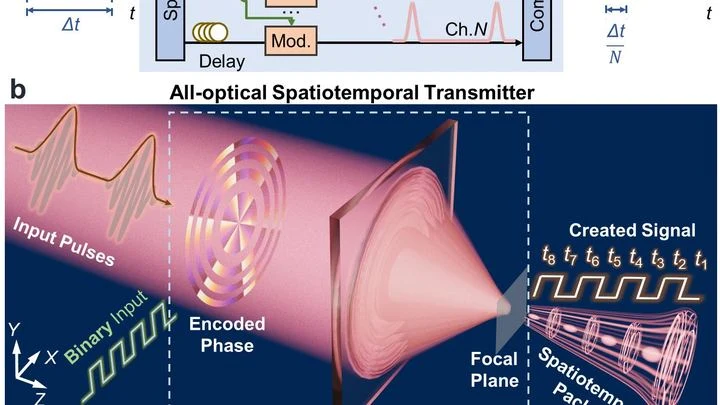
Light Instead of Wires: 3 Trillion Bits per Second
Light can carry information faster than any electronics. But usually, between a computer and a laser sits a digital-to-analog converter — a device that turns zeros and ones into electrical signals. It's the bottleneck. The new transmitter does away with this middleman.
Cosmology2026-03-312 minarXiv:2603.29879express
The Universe in Meters: How Units of Measurement Set Astronomers at Odds
Two astronomers look at the same universe but see it differently. One measures the expansion rate using ancient light that has been traveling toward us for nearly 14 billion years. The other uses recent stellar explosions in nearby galaxies. The first gets 67 kilometers per second per megaparsec, the second gets 73.
Geophysics2026-03-302 minarXiv:2603.28144express
A Snow Avalanche Under the Microscope
A powder avalanche isn't just a pile of snow sliding down a mountain. It's a cloud racing downhill at car speed. Inside, snow doesn't lie still: it flies: thousands of tiny particles are caught up in air vortices. Until now, no one had seen what actually happens to each snowflake in this chaos. Now scientists have the first footage.
physics.acc-ph2026-03-291 minarXiv:2603.27692express
The beam squeezes itself
An electron beam in an accelerator is like a flock of birds: it flies in a tight group, but over time it spreads out. To keep particles together, heavy magnets are usually used. Here they did without them — the beam squeezed itself.
Optics2026-03-281 minarXiv:2603.27191express
Ultrapure Yellow Laser from Diamond
The laser based on diamond converts almost half of the pump energy into bright yellow light — an efficiency of 47.7%, a record for such devices. But the main advantage is not the power, but the exceptional purity of the color: the beam is so monochromatic that it can be compared to a musical instrument playing just one note without the slightest wavering.
Atomic Physics2026-03-161 minarXiv:2603.14777express
An Atomic Compass That Never Loses Its Way
When an aircraft is on final approach or a submarine is navigating blind, the navigator needs an instrument that never loses track of motion. Conventional gyroscopes based on atomic waves are extremely precise, but they have a quirk: the signal repeats like a wallpaper pattern, and after half a step, the pattern starts to look the same. The instrument loses its sense of position.