A stellar-mass black hole is the compact remnant left behind when a very massive star (typically more than about 8–10 times the Sun's mass) exhausts its nuclear fuel and undergoes gravitational collapse. These black holes weigh from a few up to tens of solar masses, making them the most common type of black hole in the universe. They are the end point of stellar evolution for the most massive stars, and their existence is inferred from their gravitational influence on nearby matter, X-ray emission from accreting gas, and gravitational waves from mergers.
History
The concept of a body so massive that light cannot escape dates back to John Michell (1783) and Pierre-Simon Laplace (1796), but the modern theory emerged from Einstein's general relativity (1915). The first strong observational candidate, Cygnus X-1, was identified in the 1970s.
How it works
When a massive star's core can no longer produce enough energy to counteract gravity, it collapses. If the core's mass exceeds the Tolman–Oppenheimer–Volkoff limit (about 2–3 solar masses), no known force can halt the collapse, and a black hole forms. The event horizon, the boundary from which nothing can escape, has a radius proportional to the mass (the Schwarzschild radius). Matter falling into the black hole heats up and emits X-rays, which is how many stellar-mass black holes are detected in binary systems.
In practice
Stellar-mass black holes are natural laboratories for testing general relativity, and their mergers are detected by gravitational-wave observatories like LIGO and Virgo.
Fun fact
The nearest known stellar-mass black hole, Gaia BH1, is only about 1,560 light-years away, closer than many stars you can see with the naked eye.
A little monster hides in a dwarf galaxy, and its neighbor feeds it. The satellite galaxy is slowly merging with a massive companion, and gas from the outer regions falls toward the center, where a black hole sits. By cosmic standards, it is not large: only 800 to 5000 solar masses, but its appetite is ferocious.
A light ray passing near a massive body bends around it, like a runner rounding the corner of a stadium. For a neutron star, this deflection angle is usually assumed to be the same as for a point mass. But if the star is wrapped in an invisible halo of dark matter, the picture changes: light passing through the halo is deflected less than the total mass would predict.
At the center of a galaxy, where a supermassive black hole spins a disk of scorching gas around itself, giant stars sometimes form. They are unlike ordinary stars: the disk continuously feeds them with matter, and a star can grow to hundreds of solar masses, staying bright as long as the gas flow lasts.
A dance floor where couples whirl. At the center, an invisible master of ceremonies sets the rhythm. This is the supermassive black hole at the heart of the Milky Way, and the couples are stars whose orbits astronomers have tracked for years. But what if the master himself is wrapped in a fluffy fur coat of tenuous matter?
A neutron star is the ultra-dense remnant of a supernova: the mass of the Sun packed into a sphere the size of a city. For billions of years, it travels through space, gathering around itself invisible matter, dark matter, which emits no light but pulls with gravity.
In the dark outskirts of our Galaxy, far from bright star clusters, millions of black holes lurk. They are invisible: they don't shine and don't noticeably accrete matter. Conventional search methods, designed for dense stellar fields, are useless here. A different approach is needed.
Astronomers have proposed using the very fabric of space as a detector.
In a distant galaxy about 290 million light-years away, the object HLX-1 lies hidden. It once flared brighter than hundreds of billions of suns, but now it has quieted down. From 2018 to 2022, the Hubble, Chandra, and Swift space telescopes tracked its fading.
1799 kilometers per second — that's the speed at which star S5-HVS1 is permanently leaving the galaxy. 4.8 million years ago, it was ejected from the center of the Milky Way during a close encounter with the supermassive black hole Sgr A*.
Three invisible strings oscillate in the intergalactic void. This is not poetry, but a hypothesis about the nature of dark matter — an ultralight quantum field with spin 1, carrying three polarizations.
At the centers of many galaxies, not only supermassive black holes lurk, but also vast clouds of invisible matter. If this matter consists of ultralight particles, it can gather into dense clumps — a kind of 'star' made of dark matter.
Two ultradense spheres, each the size of a city, whirl in a dance. Their masses are less than the Sun's, but inside them is matter compressed to unimaginable limits. One sphere is a neutron star; the other is a strange star, made entirely of quarks — the elementary particles that build up protons and neutrons.
In the heart of a dense star cluster, a true forge reigns: here stars, like glowing blanks, collide and merge under gravity, and these mergers are not a catastrophe but an opportunity. Each strike of the stellar hammer transfers spin to the future black hole.
A detective story unfolded in the GWTC-5 catalog. Hundreds of signals from merging black holes, captured by the detectors of Rainer Weiss and his colleagues, held the secret to the origin of the most massive and rapidly spinning stellar-scale objects.
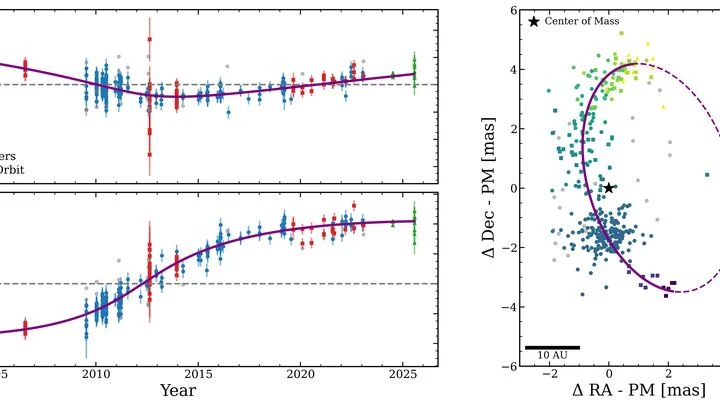
For 23 years, Hubble and James Webb have peered into the heart of Omega Centauri, a globular cluster where millions of stars crowd into a space just 150 light-years across. In this stellar beehive, the motion of the stars betrayed an invisible partner: a main-sequence star (one that has not yet left the main evolutionary branch) seemed to be tugged in a dance with an unseen weight.
The Universe at 700 million years old was a noisy construction site, just beginning to light up. Telescopes caught a signal from that distant epoch: the galaxy REBELS-25, massive and full of stellar fuel.
At the center of the Milky Way, like a matryoshka doll within a matryoshka doll, lies a supermassive black hole, surrounded by a swarm of stars and an invisible shell of dark matter. This shell, or "spike," is expected to be extremely dense right at the horizon.
When the James Webb Space Telescope turned its gaze deep into time, astronomers expected to see familiar galaxies. Instead, the images were dotted with a scattering of bright, incredibly compact red dots.
The James Webb space telescope peered into an era when the Universe was less than a billion years old and discovered hundreds of strange objects there. Tiny yet dazzlingly bright, they glowed a deep red — like burning coals scattered across the black velvet of space.
In the silent theater of the cosmos, a star’s life plays out over billions of years. But sometimes an invisible director sneaks onto the stage — a primordial black hole.
Among the precious scatterings of the early Universe captured by James Webb, there are objects that resemble ruby beads scattered on black velvet. These are the 'little red dots' (LRDs) — compact sources with steep red spectra, inside which lurk supermassive black holes up to a hundred million solar masses.
A vast hall where hundreds of orchestras play at once. Amid this din, you need to pick out one specific duet — two supermassive black holes circling each other in a distant galaxy. That's how pulsar timing arrays work: they listen to the "hum" of the entire sky, created by gravitational waves from many such pairs.
The cosmic accounting has hit a snag. The bookkeeper is balancing the books: in one column, all the planets astronomers have counted in the galaxy; in the other, the stockpile of building material in the dusty cocoons of newborn stars. The numbers don't line up. Even if you gathered every last grain of dust and molded it into planets, there wouldn't be enough material.
At the heart of our stellar metropolis — the Galaxy — lurks the supermassive black hole Sagittarius A*. Around it, star S2 whirls in a swift dance. But its movements reveal more than just the hole's pull: an invisible partner joins the dance — dark matter.
In space, merging black hole pairs are common, and often one is noticeably more massive than the other. This mass difference isn't just a number: it's a key to their shared history.
Astrophysicists studied the stable mass transfer channel — a process where matter flows smoothly from one star to another without disrupting the system.
A handful of sand weighing as much as a small mountain: that's roughly what strangelets are like: tiny clumps of 'strange' quark matter where particles are squeezed to unimaginable densities. In a new study, astrophysicists tested whether such objects could exist in nature and what they would look like.
The cosmos is full of mimicry. The clearwing moth wears a wasp's mask, a harmless fly buzzes like a bee. And in the world of gravity, the role of impersonator is perhaps played by boson stars — colossal clumps of scalar field, indistinguishable from black holes.
A galaxy is not a static picture but a bubbling cauldron where new stars are constantly born from tenuous gas. To understand how long this boiling will last, astronomers weigh the key ingredient — cold molecular hydrogen. It is invisible itself, but it is betrayed by carbon monoxide (CO), which shines in the radio range.
Astrophysicists have conducted a census of invisible objects that betray their presence only through the trembling of space. They studied the fresh catalog GWTC-4 — a list of dozens of black hole mergers recorded by the gravitational wave detectors LIGO, Virgo, and KAGRA.
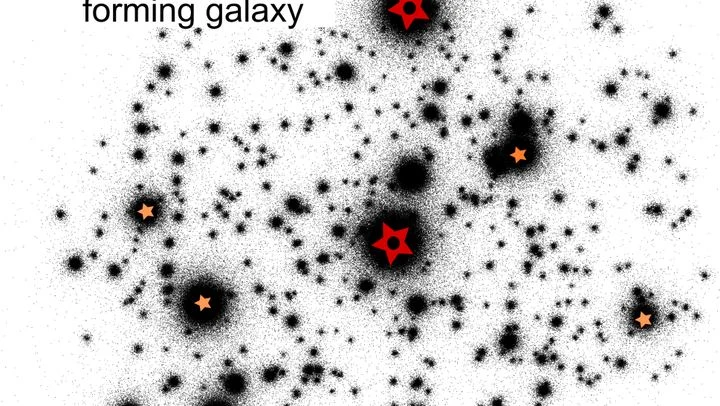
In the early Universe, star clusters were so dense that they gave birth to giants the size of the Solar System. If such a giant had taken the place of the Sun, its edge would have reached as far as Jupiter. These stars sometimes swallowed small black holes. The black hole would sink into the core and begin to grow, turning the star into a ghostly glow — a quasi-star.
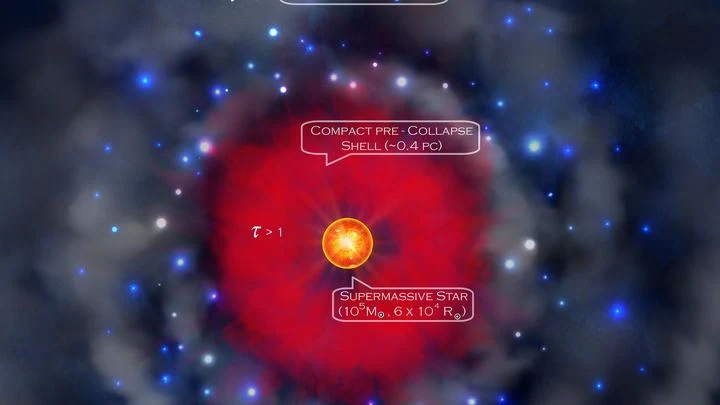
A star weighing a hundred thousand Suns lives bright and brief. Its finale is a rapid collapse into a black hole. But just before the end, it manages to wrap itself in a dense gas cocoon.
In a vast dark hall, someone invisible plucks the strings. The cosmic gas, the tenuous hydrogen that filled the young universe, resembles stretched strings that can resonate at a radio wavelength of 21 centimeters. This is hydrogen whispering about its temperature.
A stream of scorching gas races away from a star, and suddenly stalls, as if it hit an invisible wall. That's exactly what researchers saw when they tried to reproduce a stellar eruption on a laboratory scale. They used a laser to create a plasma jet and shot it through a magnetic field — first weak, then strong, like that of many stars.
The James Webb Space Telescope has spotted ancient galaxies harboring supermassive black holes — far too massive for their young age after the Big Bang. There wasn't enough time for normal growth, so they must have formed differently.
In a dark cloud where no star has yet ignited, gas begins to pull together toward a common center. This is how the most massive stars in the Galaxy are born: those tens of times heavier than the Sun. Astronomers pointed radio telescopes at the cloud SDC335.579-0.292 and saw gas molecules lining up into streams falling inward.
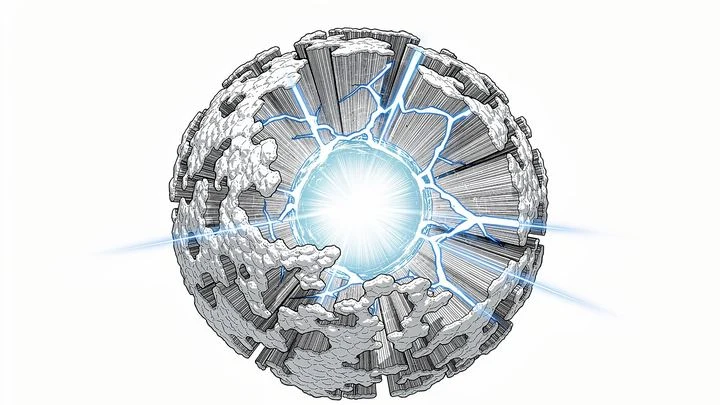
The mystery of how black holes grew so fast in the early Universe might be solved by quasi-stars. These are giant gas cocoons with a black hole tucked inside. Matter falling into the hole heats up and blasts out so much light that it prevents the cocoon from collapsing. Such an object weighs thousands of Suns and outshines an entire galaxy.
In its youth, Earth resembled a beehive: it grew by sticking together from countless rocky chunks. When the main construction was over, a late swarm of meteorites rained down on the young planet — the so-called late veneer. These impacts, scientists thought, brought platinum, gold, and other rare metals to Earth's upper layers.
A galaxy is like a giant merry-go-round: stars and gas whirl around the center, and their speeds reveal how much stuff is on the ride. If we only saw the luminous matter, the outer parts would spin slower than observations show. So there must be invisible mass, dark matter, that holds the galaxy together.
Astronomers used the infrared telescope and the old Hubble to discover a gaping void in the center of a galaxy in the Abell 402 cluster, as if an invisible tugboat had pulled billions of stars out of there. The missing mass equals two billion suns: it's not a cloud but a real lack of stars.
A star made of dark matter is an invisible ocean of ultra-light particles, whose existence was first suspected by Fritz Zwicky back in the 1930s. Into this ocean plunges a neutron star — a tiny, yet unimaginably dense sphere.
At the heart of the Milky Way spins a stellar bar — an elongated cluster, like a rotating paddle. Its gravity creates a rhythmic field around it, like waves from a speedboat.