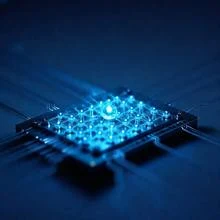
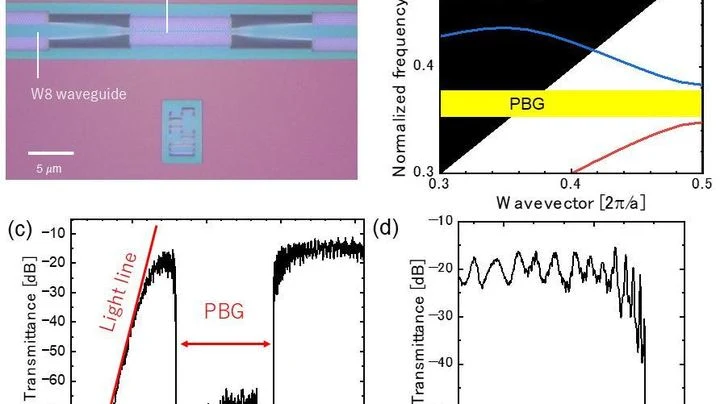
A photonic crystal is a periodic structure with a contrast in refractive index (the ability to refract light). Alternating regions of high and low index create photonic band gaps — ranges of wavelengths that cannot propagate inside the crystal. An electronic analogy: just as band gaps in semiconductors block electrons, here they block photons. The typical lattice period is hundreds of nanometers, to match the wavelength of visible light.
History
The concept of periodic structures for controlling waves dates back to Lord Rayleigh (1887), but the birth of photonic crystals is dated to 1987. That year, Eli Yablonovitch (USA) published a work on the suppression of spontaneous emission in three-dimensional dielectric lattices, and Sajeev John (Canada) on the localization of light in disordered media. Their ideas quickly grew into an active field: in 1991, the first three-dimensional photonic crystal for the optical range was demonstrated, and by the late 1990s, photonic crystal fibers appeared. Today, developments are applied in optoelectronics, quantum electrodynamics, and sensors.
How it works
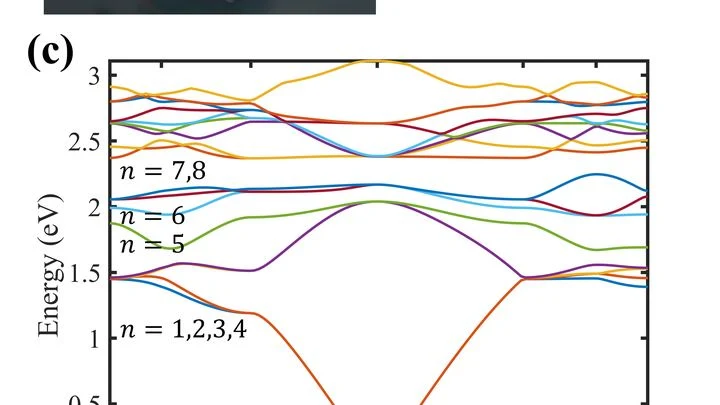
Maxwell's equations for a periodic medium lead to an eigenvalue problem analogous to the Schrödinger equation for electrons in a crystal. The role of the potential is played by the periodic dielectric function. Solutions yield dispersion relations ω(k) — photonic bands. In certain directions and frequency ranges, solutions are absent: these are the band gaps. For a complete band gap, it must overlap for all directions and polarizations. The Bragg condition for a one-dimensional crystal: λ = 2d n_eff / m, where d is the period, n_eff is the effective refractive index, and m is an integer. In real structures, numerical methods (plane wave, FDTD) are used to calculate the band structure. The introduction of defects — i.e., breaking the strict periodicity — creates allowed levels within the band gap, enabling the localization of light in microcavities and the formation of waveguides.
In practice
Photonic crystals make LEDs brighter and lasers more efficient. They also hide in opals and butterfly wings, creating iridescent colors.
Fun fact
Natural photonic crystals are found in opals and butterfly wings. Their iridescent shimmering is not a pigment, but a play of light on periodic nanostructures.
In a dark room, a sunbeam passes through a pinprick in cardboard, and an upside-down image of the street appears on the wall. A pinhole camera needs no lenses: the tiny hole itself selects the rays coming from each point of the scene. Scientists at the ESRF applied this principle not to light but to X-rays, and made the camera see not shape but chemical composition.
Light born when a fast electron enters a material is usually assumed to be the same in all directions. But in crystals where optical properties depend on direction, that's not the case. Run your hand over velvet: one way it's smooth and shiny, the other — dark and rough. Similarly, a crystal responds differently to light depending on how it's oriented.
Light born when a fast electron enters a material is usually assumed to be the same in all directions. But in crystals where optical properties depend on direction, that's not the case. Run your hand over velvet: one way it's smooth and shiny, the other — dark and rough. Similarly, a crystal responds differently to light depending on how it's oriented.
In a dark room, a spark jumps between two wires, and for an instant, there is light. Physicists have done something similar, but a million times smaller: at the boundary of two transparent crystals, they drew a conducting path and left a break just a few atoms wide. When a direct voltage was applied across this tiny gap, it began to glow.
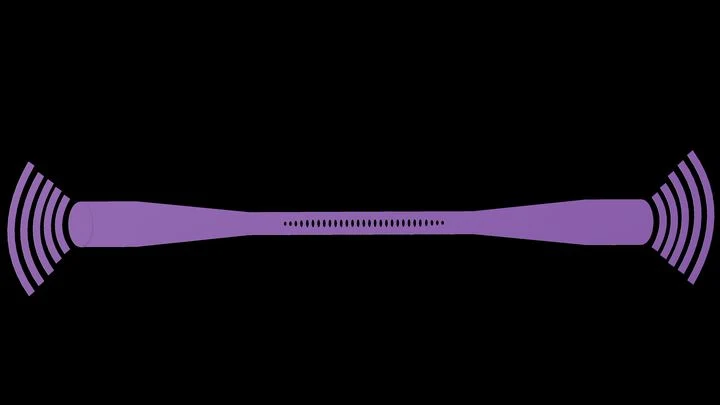
The mirror races along at nearly forty thousand kilometers per second. Light that strikes it bounces back, but changed, like a ball volleyed by a racket in mid-swing. That's exactly the kind of mirror scientists have built inside an ultra-thin glass thread filled with hydrogen.
First, a powerful laser pulse is sent down the fiber.
Light that never reaches the camera still leaves its mark on it. That's how the new imaging method works: you illuminate the object with one color, and the picture is assembled from another. Inside the crystal, light waves mix, and information about the invisible transfers to a visible beam.
In the experiment, they used a silver thiogallate crystal.
Light that never reaches the camera still leaves its mark on it. That's how the new imaging method works: you illuminate the object with one color, and the picture is assembled from another. Inside the crystal, light waves mix, and information about the invisible transfers to a visible beam.
In the experiment, they used a silver thiogallate crystal.
Light in an optical fiber is like a stream: it flows inside a glass thread and doesn't spill out. A thick thread carries many streams at once, a thin one only one. Astronomers often need to pour light from a thick fiber into several thin ones to split it into colors.
The laser beam in an optical tweezer is not just a spot of light but a force bag. A particle caught in it usually rolls toward the brightest point, like a ball into a dimple.
No one has ever seen dark matter, but it should pass through detectors like wind through leaves. Sometimes, very rarely, a dark matter particle bumps into an atomic nucleus, and then the detector must catch that jolt. The trouble is that light dark matter particles can hardly move heavy nuclei: it's like trying to knock down a bowling pin by throwing a feather at it.
An ordinary light bulb is either on or off. But tiny glowing particles, nanocrystals with rare-earth ions, have so far emitted steady light, like small flashlights. Inside such a crystal, there are thousands of emitting ions, and even if one 'gets tired,' the others keep shining. Therefore, blinking, sharp on-and-off switching, was considered impossible for them.
A single photon is like a perfectly smooth brick from which quantum technologies can be built. But to build a house, you need thousands of identical bricks. Rubidium atoms are natural emitters: each atom emits photons of exactly one wavelength, like a tuning fork that always produces a single note.
You can make light turn on command, like water in a hose — if you know where to squeeze. That's what electro-optic circuits do: they change the direction of a beam inside a chip using an electric field. The classic material for such tricks is lithium niobate, a crystal that responds to voltage like a string to a pluck.
Waves on the water's surface usually break against any obstacle — a rock, a piling, an island. But what if you arrange obstacles so cleverly that the wave barely notices them? In a new study, scientists assembled a pattern of many points on the water, arranged according to special mathematical rules, and sent waves through them.
In an ordinary room, light vanishes the moment you switch off the lamp. In a tiny silicon nitride cavity, a photon can bounce between the walls 80,000 times before it gets lost. It's like a ball thrown into a room that rebounds off the walls with almost no loss of speed.
A light beam usually travels in a straight line, but you can make it spin around its axis, like water swirling into a vortex as it drains. This 'twisted' light carries more information and is needed for ultra-fast communication and quantum computing.
In an ordinary room, light vanishes the moment you switch off the lamp. In a tiny silicon nitride cavity, a photon can bounce between the walls 80,000 times before it gets lost. It's like a ball thrown into a room that rebounds off the walls with almost no loss of speed.
A light beam usually travels in a straight line, but you can make it spin around its axis, like water swirling into a vortex as it drains. This 'twisted' light carries more information and is needed for ultra-fast communication and quantum computing.
Dark matter doesn't emit or reflect light, but its presence is revealed through gravitational effects. To catch even a single particle, physicists build detectors that are like very quiet rooms: inside lie crystals that flash when a particle hits them. But the flash is faint, and if light is lost along the way, the signal can be missed.
A piece of metal smaller than a millimeter, when cooled to minus 256 degrees Celsius, behaves like a kaleidoscope: in one corner, magnetic arrows align in neat rows, while in a neighboring corner, they twist into a screw. This was observed by directing a narrow X-ray beam at the sample and slowly sweeping it across the surface, like a flashlight along a dark wall.
In a pot of water, microscopic spheres, colloidal particles, are floating. Each sphere is coated with long polymer chains that look like a brush and carries an electric charge. If you get the temperature and solution composition right, the spheres start arranging themselves into ordered patterns — crystals.
A stack of playing cards lies still. You can slide the top card with your finger: that's crude intervention. Or you can blow so that the whole stack momentarily changes shape, but the cards don't scatter. That's roughly how light, in a new experiment, rearranges a crystal of tin selenide (SnSe).
Usually, to change the structure of a solid, you heat it or pass a current through it.
Two pebbles drop into water at a distance. The waves from them run toward each other and at certain spots they cancel out — the water becomes smooth, even though each stone alone would create ripples. Much the same happens with a pair of photons (light particles) born in a single crystal and flying off in different directions.
A guitar string plucked exactly at its middle produces only odd overtones. The same prohibition holds in symmetric crystals: when light knocks out electrons, their re-emitted radiation contains only odd harmonics. But physicists have found a way to bypass this rule — without shifting a single atom.
The secret is electric current.
In extreme cold — minus 268 degrees — a crystalline perovskite film starts transmitting light differently depending on its polarization. The beam seems to split in two: one part travels slightly faster, the other slightly slower.
In an ultrathin sheet of four-layer graphene, electrons can behave like a frozen liquid. When cooled strongly and subjected to an electric field, they stop darting around and line up into a regular pattern — a Wigner crystal. It's similar to how water droplets on a frosty morning turn into ice honeycombs.
A mosaic of squares and triangles covers the floor without gaps, yet it never settles into a simple repeating pattern. Such a pattern is a quasicrystal — a solid where atoms are arranged not periodically but according to a pattern of several waves of different lengths. These waves are incommensurate with each other, and together they create long-range order.
A light wave is like a rope that has been shaken: it oscillates in a specific plane. This property, polarization, reveals the shape and composition of objects. But capturing it is not easy, especially when you need to cover a wide range of colors. Usually, this requires bulky systems of lenses and filters.
Light running through a waveguide sometimes gets trapped. In special structures, flat bands, it freezes in place: the wave doesn't spread but sits in a few neighboring channels, like a squeezed spring. A flat band is an energy range where the speed of light drops to zero.
A thin film of a special crystal (for instance, molybdenum disulfide) sits on a microscope stage. The temperature is just above the point where the material becomes a superconductor.
In the world of two-dimensional materials, states sometimes emerge that are as extraordinary as they are fragile. One of them — the fractional anomalous Hall crystal (FAHC)—is like a quantum centaur: half ordered lattice, half topological liquid.
A surfer glides across the ocean surface until a big wave comes, and then they're flying forward. Similarly, a free electron interacts with light: usually the energy exchange is barely noticeable, but if the surrounding medium begins to oscillate rhythmically, each wave crest pushes the particle harder and harder.
Light gets trapped in a crystal lattice, but not an ordinary one: it's turned inside out, like a honeycomb where instead of wax there's emptiness, and the edges are made of material. That's how an inverted opal is built: a three-dimensional photonic crystal that blocks light of certain colors.
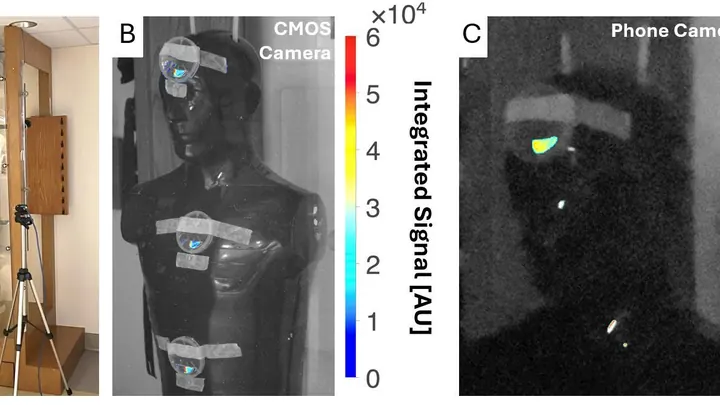
A crystal the size of a matchbox was placed under the beam of a clinical accelerator. Half of its surface was covered with a pattern of nanoscale bumps — tiny, smaller than the wavelength of light. The other half was left smooth. The difference was striking: the coated part produced a signal 4.1 times brighter.
In 1958, Philip Anderson showed that strong disorder can stop a wave. Since then, physicists have discovered that between complete stoppage and free travel there are intermediate regimes. A particle can not only stand still or fly, but also jitter in place, pulse, or combine several types of motion at once.
A pebble drops into a pond, and ripples spread across the water. But one wave suddenly doesn't spread out: it clings to an invisible fold on the surface and runs only along it.
Perovskite crystals harvest sunlight almost as well as silicon, but cost pennies. Their trouble is an inborn fragility: from warmth and ordinary water in the air, they “get sick.” Inside, disorder builds up, and the shiny plate turns cloudy, losing its abilities within a couple of days.
Light hits a crystal and knocks an electron out of its rightful place. A void remains — a hole that behaves like a positive charge. The electron and hole attract each other and circle around one another, like a pair in a slow dance. Such a pair is called an exciton (from the word "excitation").
But this dance is not in a vacuum.
In a thin plate of a layered crystal, light can get stuck, like sound in an empty room. At low temperatures, samples of (PEA)₂PbI₄ with thicknesses ranging from tens to hundreds of nanometers almost stop transmitting light at certain wavelengths.