Bacteria Weave Braids: How Chaos in Fluid Gives Rise to Order ✛
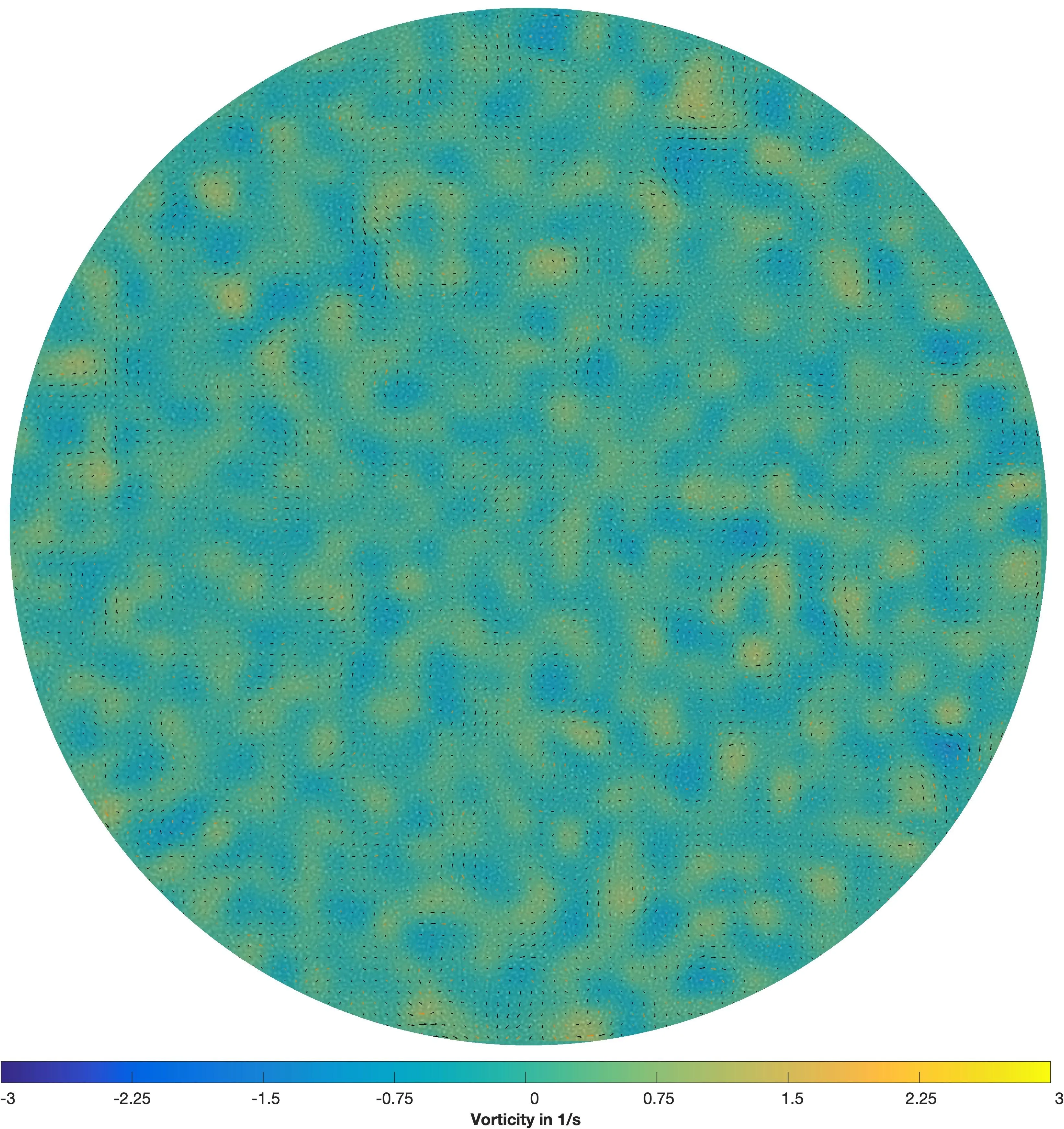
A weaver sits at her loom, her hands moving in a rhythm that cannot be predicted in advance. The threads converge and diverge, forming a pattern that seems random yet follows strict rules. Bacteria in a dense suspension behave much the same way: each cell swims along its own trajectory, but together they create a flow that mixes nutrients far more effectively than any single movement could.
Scientists wanted to understand how microscopic motions add up to macroscopic mixing. To do this, they added rare glowing bacteria of the same species to a suspension of ordinary E. coli. These "scouts" served as both stirrers and tracers: their trajectories were recorded with a microscope and then turned into mathematical braids. A braid is an interlacing of lines that shows how particles move through space and time.
From these braids, they calculated the braiding rate, which shows how quickly the entanglement of trajectories grows. It turned out that this rate is directly related to how well the fluid mixes. Moreover, the relationship is very simple: the braiding rate grows as the square root of the bacterial spreading speed. This rule holds under different conditions, even when the chamber containing the bacteria is very thin.
Now let's return to the weaver. Her pattern turned out to be not just a random interlacing of threads, but a precise record of how microscopic motions add up to a macroscopic flow. By weaving braids, bacteria literally encode the topology of their motion into the geometry of the flow. This method helps assess mixing in microfluidic devices without complex calculations, simplifying the control of mixing in bioreactors.
At a chamber height of 5 μm, comparable to the size of a bacterium, hydrodynamic interactions are screened so strongly that the system behaves like 'dry' active matter, even though the fluid never disappears.
In Greg Egan's novel 'Permutation City', artificial lives exchange information through complex topological structures; here, bacteria weaving into braids literally record the topology of their motion in the geometry of the flow.