Topological mixing and braiding universality in polar active matter ✛
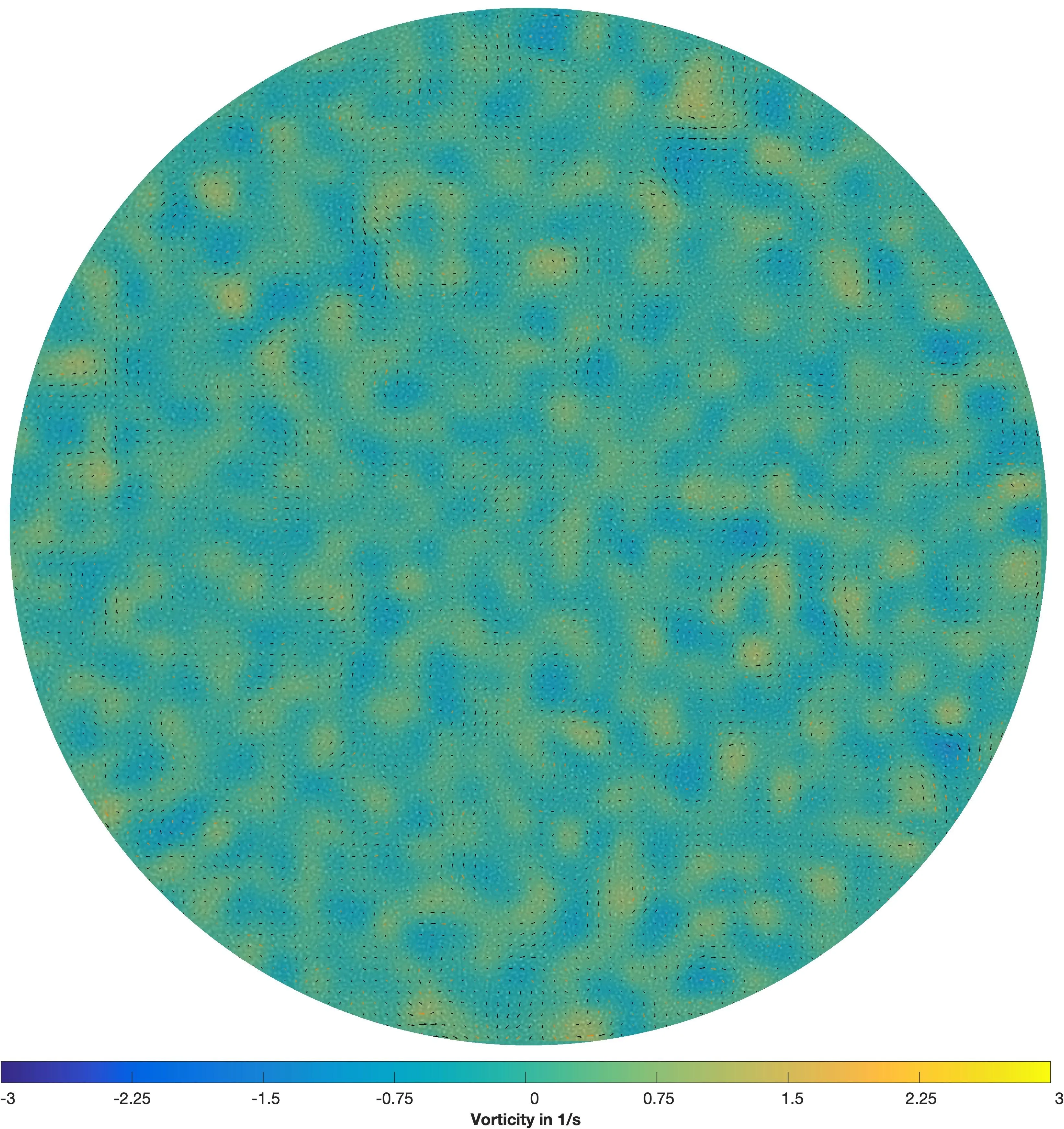
Context
This work stands apart: the nearest neighbors in the archive study collective bacterial motion, quantum knots, and topology in superconductors, but no one has applied braid theory to polar active turbulence. Unlike apolar nematics, where topological chaos has been linked to defects, here the moving cells themselves, not external fields, are the source of entanglement. This is the first experimental test of how hydrodynamic interactions and steric constraints compete in generating topological complexity.
Methods
Rare fluorescent 'scouts' of the same species were added to a suspension of non-fluorescent E. coli, serving as both stirrers and tracers. Scout trajectories were tracked in chambers of heights 20 and 5 μm at various concentrations, then lifted into the third dimension of time, turning each trajectory into a world line. Projecting these lines onto a plane yielded a geometric braid, and the sequence of crossings was recorded using operators of the Artin braid group. The finite-time braiding exponent (FTBE) was computed as the growth rate of the length of a material loop enclosing the tracers, using the Braidlab library.
Results
In the moderately confined system (H = 20 μm), FTBE exhibits three regimes depending on the bacterial volume fraction. At low concentrations (ϕ ≤ 1%), swimming speed and effective diffusion grow linearly, and FTBE increases with them: this is the dilute active gas regime. At intermediate concentrations, coherent vortices emerge that synchronize bacterial orbits, and FTBE plateaus. As density increases further, vortices break into fast jets, and FTBE rises sharply with the onset of active turbulence. In the extremely confined system (H = 5 μm), hydrodynamic interactions are screened, and for ϕ > 3% FTBE decreases monotonically: frequent steric collisions generate trivial crossings that cancel algebraically. Normalized by the characteristic encounter time, FTBE′ exhibits two scalings: ϕ^-1/3 in the dilute limit and ϕ^-2/3 in the dense limit, corresponding to a transition from a discrete geometric encounter regime to an area-based escape mechanism. A universal relation FTBE ∝ $D_{eff}^1$/2 was established, valid for both chamber heights.
Implications
Unlike neighboring works that either describe collective dynamics at the level of correlations or apply braid theory to apolar systems, this study shows for the first time that the topological entropy of polar active turbulence follows a universal scaling with effective diffusion. This links microscopic trajectory braiding to macroscopic transport without reconstructing the velocity field. The result places the self-organized mixing of active fluids into the universality class of streamline braiding, previously predicted for random braids.
Future development
The topological approach can be extended to three-dimensional suspensions, where the vertical component of motion adds new types of crossings. It would be interesting to test whether the FTBE ∝ $D_{eff}^1$/2 scaling holds for mixed systems with different types of microorganisms or in the presence of external flows. Theoretically, one should investigate how the transition from the discrete to the area-based regime relates to a phase transition in collective motion.
Impact
The results are applicable to the design of self-mixing microfluidic devices and reconfigurable active metamaterials, where controlling chaotic mixing without external fields is important.
Next steps
The next step will be to measure FTBE in systems with variable obstacle geometry and in three-dimensional droplets, to test the universality of the scaling beyond the quasi-two-dimensional case.
Key open problems
This work connects topological complexity to anomalous transport in active matter, which remains an open problem: how microscopic interactions generate macroscopic diffusion. The transition from a dilute gas to a collective regime also touches on the question of the critical concentration for the onset of collective swimming.
The knowledge machine's view
This section is addressed to the author of the paper and their colleagues. Neighbouring works were found by meaning-based search across our archive, not by word overlap. We do not review: we show the field around the work.
What the work does
The study traces the trajectories of fluorescent tracer bacteria in quasi-two-dimensional chambers and turns them into mathematical braids that encode the spatiotemporal entanglement of the flow. By measuring the finite-time braiding exponent (FTBE), the authors identify three regimes of topological mixing in moderately confined systems and a transition to the dry limit under strong compression. They establish a power law FTBE ∝ D_eff^1/2, linking topological entropy to effective diffusion.
Where its strength is
For the first time, braid theory is applied to polar active turbulence, directly connecting the microscopic braiding of trajectories to macroscopic transport without reconstructing the velocity field. The universal scaling of FTBE with effective diffusion places the self-organized mixing of active fluids into the universality class of streamline braiding.
Where it could go next
- It might be interesting to compare the observed FTBE regimes with correlation analyses of collective bacterial motion, where similar transitions from a dilute gas to vortices and turbulence are identified.based on: Why Bacteria Swirl in a Shared Dance arXiv:2603.26025
- A related approach measures turbulence complexity via topological invariants; its methods could help clarify how trajectory braiding reflects the structure of active flows.based on: Dancing Chaos: How to Measure the Complexity of Turbulence arXiv:2602.00600
- There is a paper in the archive on turbulence that does not destroy order; its findings might suggest how coherent structures in active matter coexist with topological chaos.based on: Turbulence That Doesn't Get in the Way of Order arXiv:2601.17674
Worth trying
- Test the computation of FTBE on subsets of tracers to check the robustness of the scaling with respect to the number of tracked particles.
- Compare FTBE with the braiding exponent calculated from the velocity field reconstructed from trajectories to assess the contribution of hydrodynamic interactions.
- Use methods from the paper on neural network recognition of knots to automatically classify braiding regimes from experimental data.
Why this may matter
The universal link between topological entropy and effective diffusion could provide a basis for predicting transport properties of active fluids without costly field reconstruction, and it opens a route to controlling mixing in microfluidic devices.
Nearby works in our archive
- Turbulence That Doesn't Get in the Way of Ordersimilarity 0.52
- Quantum Waves Mix Like Paintssimilarity 0.51
- Why Bacteria Swirl in a Shared Dancesimilarity 0.50
- Noise as the Architect of Quantum Ordersimilarity 0.50
- Neural Network Spots Knots in Quantum Fogsimilarity 0.50
- How Plasma Waves Learn to Live with Inhomogeneitysimilarity 0.50
- Dancing Chaos: How to Measure the Complexity of Turbulencesimilarity 0.49
The archive is sparse around this work: the closest review is only 0.52, against a usual 0.64. It looks like few have drilled nearby.
At a chamber height of 5 μm, comparable to the size of a bacterium, hydrodynamic interactions are screened so strongly that the system behaves like 'dry' active matter, even though the fluid never disappears.
In Greg Egan's novel 'Permutation City', artificial lives exchange information through complex topological structures; here, bacteria weaving into braids literally record the topology of their motion in the geometry of the flow.
Key numbers
- chamber height (wet system): 20 μm
- chamber height (dry system): 5 μm
- bacterial volume fraction range: 0.02% – 7%
- number of tracers for the braid: up to 60
- scaling exponent of FTBE ∝ D_eff^1/2: 0.5