Brownian motion is the erratic, jittery movement of microscopic particles suspended in a fluid (liquid or gas), caused by continuous collisions with the fluid's molecules. It is a direct, visible manifestation of thermal energy at the molecular scale, providing evidence for the atomic theory of matter. The phenomenon is fundamental to understanding diffusion, transport processes, and the behavior of colloids, and it has profound implications across physics, chemistry, and biology.
History
The phenomenon was first observed by botanist Robert Brown in 1827 while studying pollen grains in water. Albert Einstein provided a theoretical explanation in 1905, linking the motion to molecular kinetic energy and enabling Jean Perrin's experimental verification, which earned Perrin the Nobel Prize in Physics in 1926.
How it works
A small particle in a fluid is constantly bombarded from all sides by molecules moving at high speeds. While the impacts average out on a macroscopic scale, for a tiny particle the random fluctuations in the number and direction of collisions produce a net force that changes randomly over time. This results in a random walk, where the particle's displacement over time is proportional to the square root of time, a hallmark of diffusive behavior.
In practice
Brownian motion is used in biology to model the movement of molecules within cells, in materials science to understand the stability of colloidal suspensions, and in finance as a mathematical model for stock price fluctuations.
Fun fact
Brownian motion is the reason why dust particles in a sunbeam appear to dance — the air molecules are constantly jostling them around.
A weaver sits at her loom, her hands moving in a rhythm that cannot be predicted in advance. The threads converge and diverge, forming a pattern that seems random yet follows strict rules.
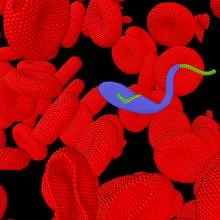
A swimmer in a pool filled with light balls pushes off them and swims faster than in clear water. That is roughly how a trypanosome, a single-celled parasite that causes sleeping sickness, behaves when it enters blood, where red cells occupy nearly half the volume.
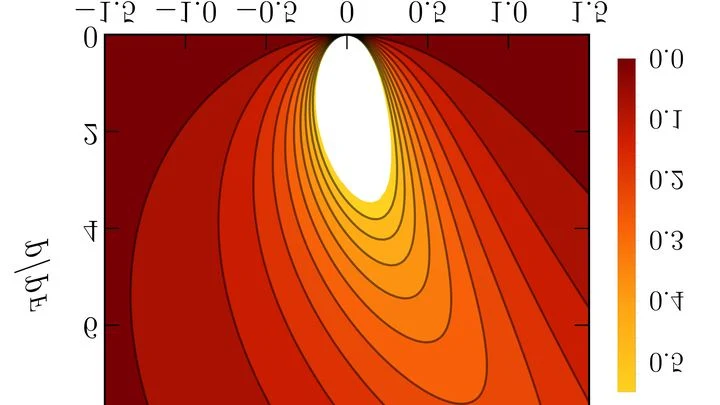
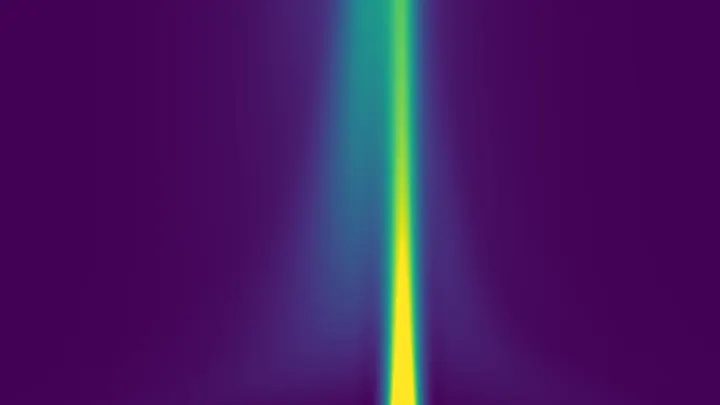
A crowd at the entrance to a narrow corridor behaves differently than in a spacious hall: some people get pressed against the walls, others are pushed forward. Roughly the same happens when an elongated particle finds itself in a fluid teeming with self-propelled dumbbells. Until now, it was unclear why such a particle moves faster along its long axis than across it, and how the crowd density affects its speed.
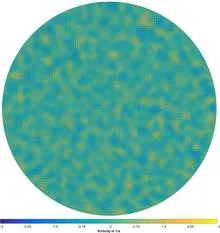
A cluster of glowing dots drifts through the darkness, now compressing into islands, now spreading out in waves. These are not fish or birds: this is a mathematical model of active matter, where each particle spends its own energy on movement, and also is born, dies, and competes with neighbors for space.
A pebble falls into a pond, and ripples spread across the water. In the quantum world, the pond is not made of water but of many identical particles, and the pebble is also a particle, just a foreign one. Such a foreign particle is called a Fermi polaron.
A drop of thick shampoo falls into water and freezes into a strange rope. A liquid that both flows and springs back is called viscoelastic. In it, tiny particles under ultrasound behave quite differently than in water. Viscoelasticity is a material's ability to both spread like honey and return to shape like rubber.
When you squeeze ketchup out of a bottle, you're battling its stubbornness: it sits still at first, then suddenly shoots out in a blob. That's typical non-Newtonian behavior — resistance to flow changes with how hard you push. But the authors of a new study found a way to almost completely eliminate that resistance.
A tiny oil drop squeezes through a water channel narrower than itself. In pure water, it crawls along calmly, like a round bead. But add a little soap to the water, and the drop begins to bend, like a caterpillar.
An electron flying through a gas is like a swimmer trying to cross a crowded pool. Each collision with an atom changes its course and speed. In dense argon gas, there are so many collisions that a simple description no longer works.
Physicists measured electron mobility — how easily electrons drift under an electric field.
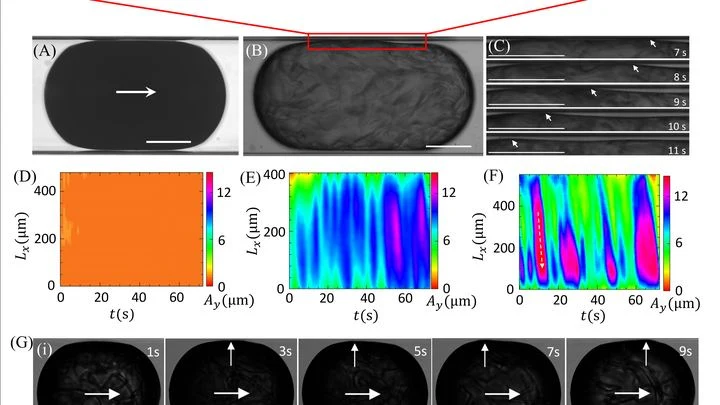
When a crowd of bacteria (mostly composed of carbon) gathers in a droplet of water, a synchronized round dance begins: millions of tiny ones glide along giant ellipses, like dancers on a ballroom floor. Without a conductor, complex patterns emerge from simple movements.
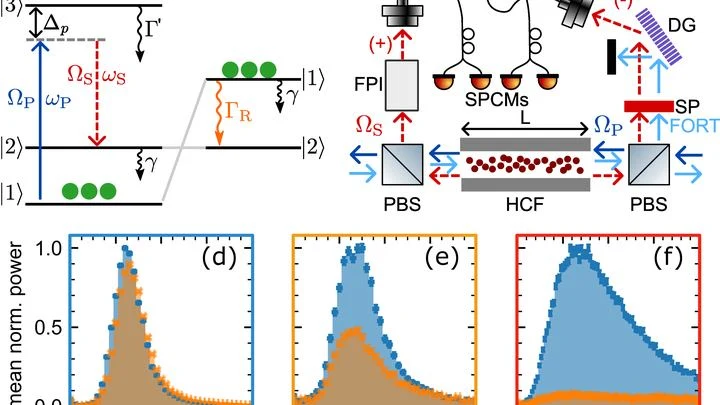
A swarm of fireflies in a night forest flashes randomly: each beetle blinks on its own, and the light scatters equally in all directions. Now imagine the fireflies agreeing to blink so that their combined light goes only north — even though they stay put and none of them turns. That's roughly what physicists did with atoms inside a thin glass tube.
In the macroscopic world we know, any motion inevitably decays: friction, a dissipative process that scatters energy, intervenes. But quantum reality has surprises in store.
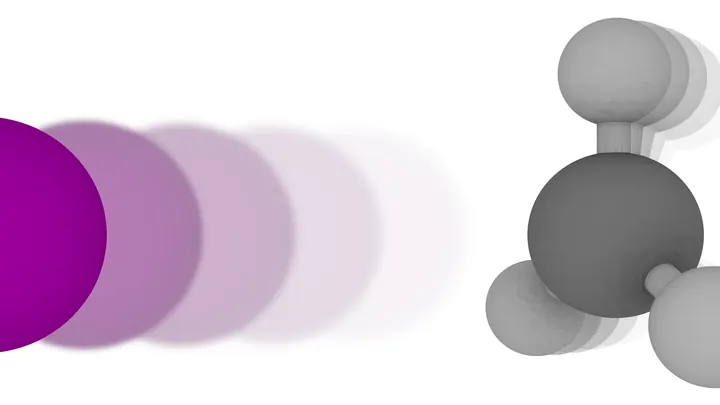
A chemical bond is like a stretched spring between atoms. When it's snapped, the molecular fragments fly apart, but they don't freeze: they keep vibrating, like a plucked string. That's exactly the vibration a team of researchers caught when they broke a methyl iodide molecule with an ultraviolet laser.
Toss a handful of peas into a pot of semolina porridge — the peas quickly sink, pushing the grains aside. But if you make the porridge very thick and sticky, the peas get stuck. That's roughly how light lithium atoms behaved in a cloud of heavy potassium atoms at temperatures just a few millionths of a degree above absolute zero.
A single photon passes through two slits and leaves an interference pattern on a screen. Quantum mechanics describes this process with a wave function, but what happens to the particle itself?
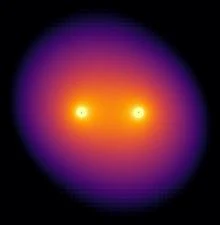
Two black holes circle in a tight dance, and around them something remarkable is born: a gravitational molecule. A cloud of ultralight bosons, particles with masses below an electronvolt, envelops the pair like the electron cloud in an H2+ ion.