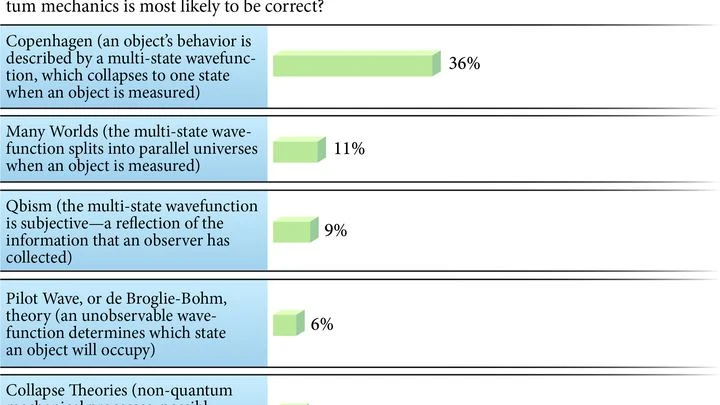
Big Mysteries: Survey Reveals Physicists' Disagreements
Physics often resembles the construction of a giant ship — the Universe. The physicist-engineers have yet to agree on the basic blueprints.
The branch of astronomy dealing with the physics of celestial objects and phenomena.Astrophysics is the branch of astronomy that applies the laws of physics to understand celestial objects and phenomena. It bridges the gap between the observational tradition of astronomy and the theoretical framework of physics, allowing scientists to explain not just what is out there, but why it behaves the way it does. From the nuclear fusion powering stars to the expansion of the universe, astrophysics seeks to describe the cosmos using the same fundamental principles that govern everyday life on Earth.
The term 'astrophysics' came into use in the mid-19th century, notably with the work of Gustav Kirchhoff and Robert Bunsen, who showed that spectral lines could identify chemical elements in the Sun. This marked a shift from simply mapping the heavens to understanding their physical nature.
Astrophysicists use a combination of observational data—light, particles, gravitational waves—and theoretical models to build a coherent picture of the universe. They apply known physics (gravity, electromagnetism, thermodynamics, nuclear and particle physics) to extreme conditions that are often unattainable in laboratories, such as the intense gravity of black holes or the high temperatures inside stellar cores. The field is highly interdisciplinary, drawing on plasma physics, nuclear physics, and general relativity.
Astrophysics drives technological innovation in detectors, imaging, and data analysis, and its discoveries—like the cosmic microwave background—have led to practical applications in fields from satellite navigation to medical imaging.
The gold in your jewelry was forged in the violent collision of neutron stars, an event that astrophysicists study to understand the origin of heavy elements.