Laser Brakes for Potassium and Cesium: A Mix That Had Never Been Made ✛
Two cars of different masses roll down the same track, and a laser beam acts as a common brake that slows both to a pedestrian's pace. That's exactly how physicists from the University of Warsaw for the first time stopped and held together atoms of potassium-41 and cesium, a mixture that no one had been able to catch in a light trap before.
The atoms were loaded directly from vapor in a vacuum chamber. Potassium was cooled at one wavelength, cesium at another, and then both species were pushed into an optical dipole trap, a laser tweezer made of infrared light. To separate the spin states of potassium, they used the Stern-Gerlach method: in an inhomogeneous magnetic field, atoms with different spin orientations flew apart like peas of different sizes on a sieve.
The trap held more than a million atoms of each species, and the temperature dropped to 10-15 microkelvin, which is only about a hundred times above absolute zero. At such temperatures, atoms move at speeds of a few centimeters per second, like a leisurely walker. For the potassium-39 and cesium mixture, they found 14 Feshbach resonances, nine of which were new. These resonances act like tuning screws that let you adjust the strength of atomic collisions with a magnetic field.
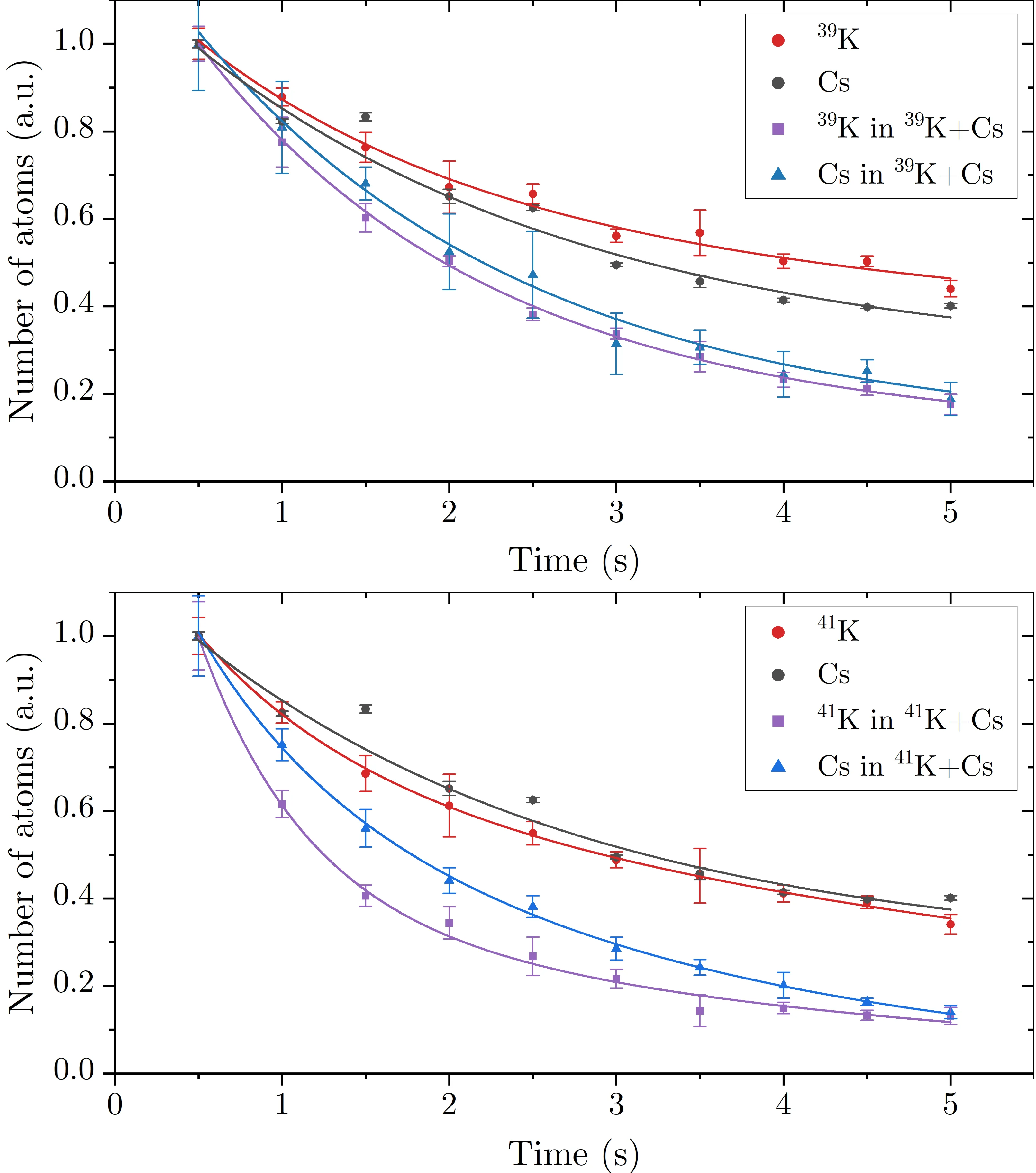
Previously, no one knew whether potassium-41 could be held together with cesium at all. Now it's clear that it can, but the problem of rapid losses needs to be solved. For potassium-39, the new resonances refine the interaction map and provide guideposts for finding resonances in potassium-41. Next up is assembling ultracold KCs molecules, which could become qubits in quantum computers or model systems for chemistry at extremely low temperatures.
The laser brake worked for two different machines. Now they can not only be stopped but also carefully coupled into molecular 'trailers', step by step, with precise adjustments of every screw.
The mixture's temperature of about 10 microkelvin is only a hundred times above absolute zero. At such a temperature, atoms move at speeds on the order of a few centimeters per second, like a leisurely pedestrian.