Laser Brake for Potassium and Cesium: A Mixture Never Seen Before ✛
Context
This work stands apart: the nearest neighbors work on laser cooling of individual atoms and molecules, but no one had tackled a potassium-41-cesium mixture. Previous experiments with potassium-39 and cesium had already yielded Feshbach resonances and even ground-state molecules, but the potassium-41 isotope remained a blank spot. The authors fill this gap using the same approach as for single atoms, but adapted to a mixture.
Methods
Potassium and cesium atoms were loaded directly from background vapor into a single chamber. Potassium was cooled using a gray molasses on the D1 line, while cesium was cooled only on D2 line transitions. To improve loading efficiency into the optical dipole trap (a laser tweezer made of light at 1064 nm), an additional gray molasses stage optimized for transfer was introduced. Spin polarization was achieved by optical pumping, and the Stern-Gerlach method was used to separate the spin components of potassium: in an inhomogeneous magnetic field, atoms with different spin projections flew apart in space, allowing them to be measured individually.
Results
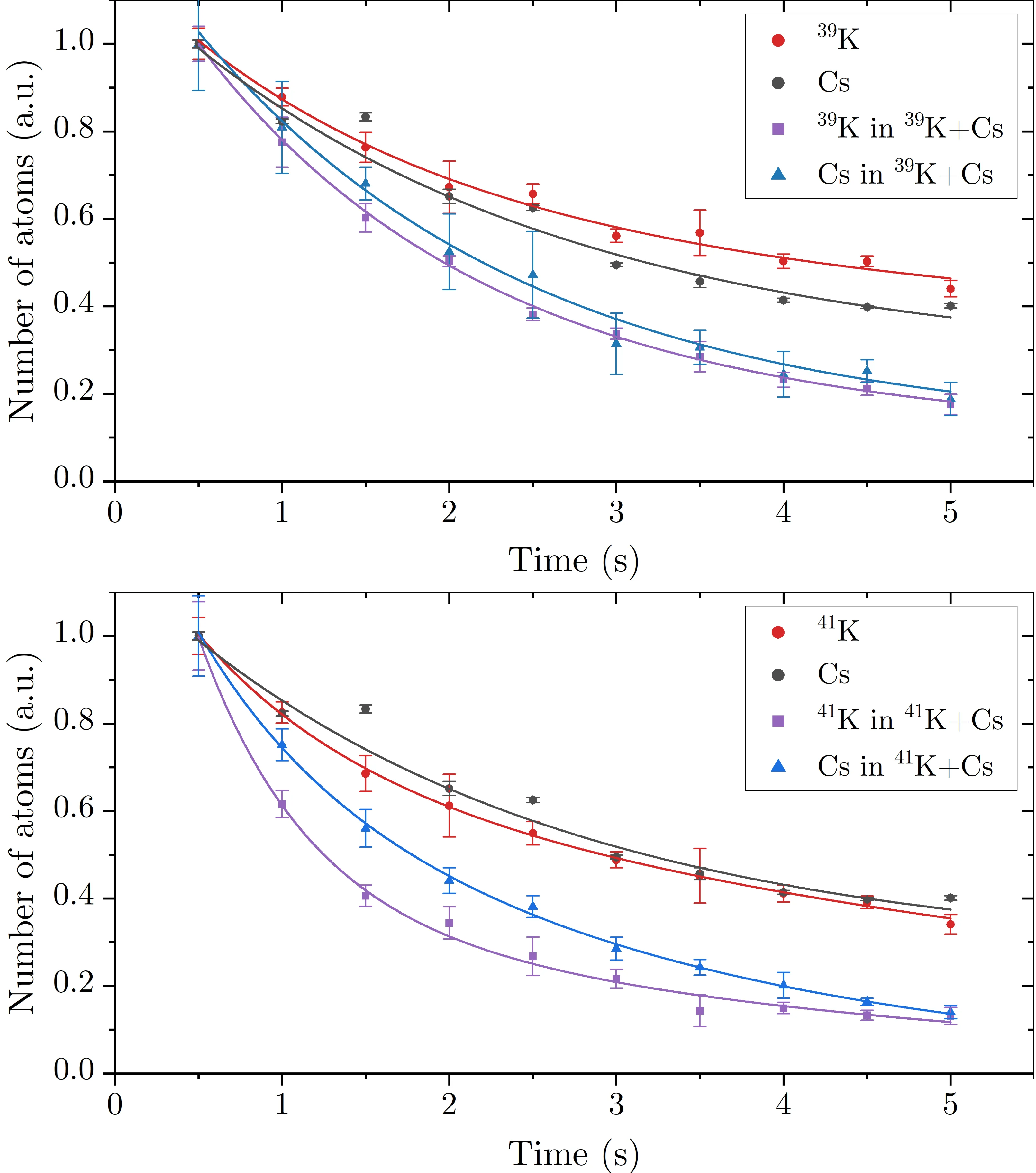
In the optical trap, mixtures with more than one million atoms per species were obtained at temperatures of 10–15 microkelvin. For the potassium-39 + cesium mixture, 14 resonant losses were recorded, of which five matched previously known ones and nine turned out to be new, including p-wave resonances and resonances in additional spin channels. Comparison of lifetimes showed that the potassium-41 mixture decays noticeably faster than the potassium-39 one, and the decay is not exponential, indicating additional density-dependent losses.
Implications
Unlike neighboring works, where the potassium-41-cesium mixture was not studied at all, here the very possibility of preparing and holding it is demonstrated for the first time. This is not just a repetition of the method for another isotope: the changed reduced mass alters scattering lengths and, consequently, collisional properties, as confirmed by different loss dynamics. The obtained data on Feshbach resonances for potassium-39 refine interaction potentials and provide guidelines for searching for resonances in potassium-41.
Future development
The next step will be systematic spectroscopy of Feshbach resonances for the potassium-41 + cesium mixture, which will require increasing the trap lifetime, for example, by reducing density or improving vacuum. Then one can proceed to magnetoassociation and coherent optical transfer to obtain ultracold 41KCs molecules in the ground state.
Impact
The result will impact the physics of ultracold molecules, quantum simulations with dipolar gases, and precision spectroscopy. It is also useful for experiments on controlled chemistry at ultralow temperatures.
Next steps
Optimize trapping conditions for the potassium-41 + cesium mixture to suppress fast losses. Perform a magnetic field scan to search for Feshbach resonances in this mixture.
Key open problems
In ultracold atomic physics, the exact form of interatomic interaction potentials for different isotopic combinations remains an open question. This work adds experimental data points for potassium-39 and cesium, which will help refine theoretical models, and for potassium-41 it highlights the problem of fast losses that needs explanation.
The knowledge machine's view
This section is addressed to the author of the paper and their colleagues. Neighbouring works were found by meaning-based search across our archive, not by word overlap. We do not review: we show the field around the work.
What the work does
The authors have, for the first time, prepared and held an ultracold mixture of potassium-41 and cesium in an optical dipole trap, using laser cooling and the Stern-Gerlach method to separate spin states. For the mixture with potassium-39, they measured 14 Feshbach resonances, nine of which are new, and compared the lifetimes for the two potassium isotopes.
Where its strength is
This work fills a gap for the potassium-41 isotope, demonstrating the versatility of the approach and providing resonance data that refine interaction potentials and set benchmarks for further searches.
Where it could go next
- It might be interesting to see how the molecular cloud manipulation techniques from work 2502.09437 can be adapted to form ultracold KCs molecules from the obtained mixture, for example, to increase yield or control collisions.based on: A Lens for a Molecular Cloud arXiv:2502.09437
- A related approach is the laser cooling of ions from 2602.02937: perhaps transferring some techniques to neutral potassium and cesium atoms could improve trap loading or reduce losses.based on: Laser Brake for a Restless Ion arXiv:2602.02937
- In light of the measured Feshbach resonances, it is useful to compare the obtained data with precise calculations of interatomic potentials, similar to those used in work 2601.09959 for weighing nuclei, to refine scattering lengths for the potassium-41 mixture.based on: Weighing Atomic Nuclei: A New Level of Precision arXiv:2601.09959
Worth trying
- Test the optimization of gray molasses for potassium-41, taking into account its hyperfine structure, to improve loading efficiency into the dipole trap.
- Investigate the applicability of the Stern-Gerlach method for simultaneously separating cesium spin states in the mixture, which would allow measuring resonances in additional channels.
- Use non-exponential decay as an indicator of three-body losses and attempt to isolate their contribution by varying density and temperature.
Why this may matter
The obtained KCs mixtures with different potassium isotopes pave the way for creating ultracold molecules with tunable dipole moments, which is important for quantum simulations and studying chemical reactions at ultralow temperatures.
Nearby works in our archive
- A Lens for a Molecular Cloudsimilarity 0.52
- Laser Brake for a Restless Ionsimilarity 0.50
- Laser Shower for Molecules: 12 Times the Catchsimilarity 0.49
- Five Ions in a Trap Swap Places Like an Upside-Down Pyramidsimilarity 0.49
- Superconductors at the Quantum Brinksimilarity 0.49
- Quantum van der Pol Oscillators: A Dance Without a Soloistsimilarity 0.48
- Weighing Atomic Nuclei: A New Level of Precisionsimilarity 0.47
The archive is sparse around this work: the closest review is only 0.52, against a usual 0.64. It looks like few have drilled nearby.
The mixture's temperature of about 10 microkelvin is only a hundred times above absolute zero. At such a temperature, atoms move at speeds on the order of a few centimeters per second, like a leisurely pedestrian.
Key numbers
- mixture temperature: 10–15 μK
- number of atoms in trap: more than 106 per species
- number of new Feshbach resonances: 9
- fast decay time for 41K-Cs: 0.63 s
- transfer efficiency into trap: up to 7%