Chemistry is the science of matter—its properties, composition, and the transformations it undergoes through chemical reactions. It bridges physics and biology, explaining how atoms combine into molecules and how these molecules interact. In physics, chemistry is essential for understanding the behavior of materials, the formation of compounds in astrophysical environments, and the dynamics of reactions at the quantum level.
History
Chemistry as a modern science began in the 18th century with Antoine Lavoisier's law of conservation of mass, followed by John Dalton's atomic theory in 1803. The field matured with Dmitri Mendeleev's periodic table in 1869 and the quantum mechanical model of the atom in the 20th century.
How it works
Chemistry operates through the interactions of electrons in atoms. Atoms bond by sharing or transferring electrons, forming molecules with distinct structures and energies. Chemical reactions involve breaking and forming these bonds, which rearranges atoms into new substances. The rates and outcomes of reactions are governed by thermodynamics and quantum mechanics, linking chemistry directly to physics.
In practice
Chemistry is used in everything from drug design and materials science to energy storage and environmental monitoring, and it underpins the synthesis of new compounds in industry and research.
Fun fact
The chemical reactions in your body produce about as much energy as a 100-watt light bulb, but most of it is released as heat to keep you warm.
A speed of 7,5 kilometers per second is the threshold beyond which a cosmic collision turns dust grains into a chemical reactor. In the interstellar medium drift tiny cosmic dust grains — the legacy of dying stars.
Cooking a complex dish requires a clear recipe: first chop, then sauté, add spices at just the right moment. Chemical transformations also follow step-by-step recipes — mechanisms where atoms of carbon and hydrogen rearrange in a strict order.
Previously, neural networks often invented nonexistent steps, like a whimsical cook swapping salt for sugar.
The Standard Model is a set of rules for all known particles. But it says nothing about dark matter, which makes up a quarter of the Universe. To find it, you don't need to build city-sized colliders. Radioactive molecules act like sniffer dogs: their incredible 'scent' picks up the faintest traces of unknown forces that slip past giant machines.
Three craftsmen work in the same workshop. The first tries to figure out whether tiny hourglasses are built into nature's own machinery. The second attaches a laser pointer to a microscope to see details invisible to the naked eye. The third, conversely, takes living threads and carefully weaves them into fragile quantum circuits.
The nose is an amazing instrument. A single coffee molecule entering a nostril can awaken a memory of a morning kitchen. Another, nearly identical in shape, smells like rotten eggs.
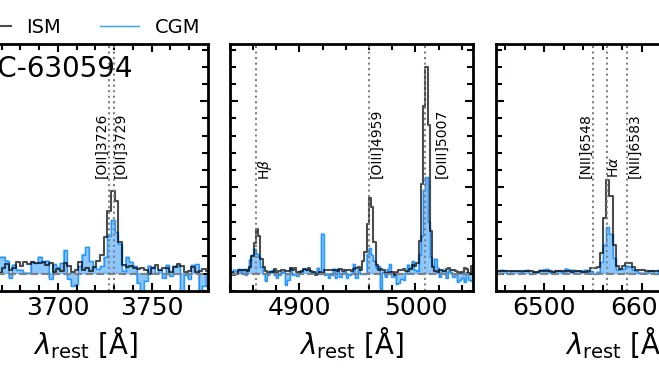
The kitchen of a distant galaxy isn't limited to its bright disk. Around every star system, there's an invisible cloud of gas, like steam above a pot of soup. Astronomers peeked into this steam around galaxies that appear as they were just one and a half billion years after the Big Bang.
An ordinary chemical reaction is like a ball rolling down a hill: it has one natural path. But if you place molecules in a tiny mirrored box, an optical microresonator, the light inside starts to interfere with the ball's motion. It can nudge it, hold it back, or even split its trajectory.
In a new study, physicists traced exactly how this happens.
Matter is like a house. In some rooms, there is the strict order of a crystal, where every atom is in its place. In others, the chaos of superfluid helium, where atoms forget about their neighbors.
In a dark room, a laser beam draws a bright spot on the wall. Light seems warm and uncontrollable, but for three decades physicists have used it as a conductor's baton, making atoms dance in unison.
A team assembling a jigsaw puzzle from random pieces: how many simultaneous moves does it take to complete the picture? If the pieces are independent, they all go down at once. If each piece depends on the previous one, you have to work one at a time. So it is with systems: some states assemble instantly, others require a long sequential effort.
A woven basket holds its shape not because it has a rigid frame, but because each strand is interlaced with its neighbors. Pull one out, and the pattern unravels, leaving a heap of twigs. Quantum mechanics, according to a new paper, works the same way: its elementary objects do not exist independently, but only in interweaving with each other.