Measurement accuracy refers to how closely a measured value matches the true, actual value of the quantity being measured. In physics, achieving high accuracy is crucial because small discrepancies between theory and experiment can reveal new phenomena or flaws in existing models. The seed definition highlights an improvement to 0.15 percent, which is exceptionally precise for many types of measurements, often requiring careful control of systematic errors and large statistical samples.
History
The pursuit of measurement accuracy has been central to physics since Galileo's experiments on falling bodies, with significant milestones including Michelson's interferometer for the speed of light and modern precision measurements of the electron's magnetic moment.
How it works
Improving measurement accuracy involves minimizing both random errors (which average out with more data) and systematic errors (which bias results consistently). Techniques include calibrating instruments against known standards, using redundant measurement methods, and employing sophisticated statistical analysis to correct for known biases. In particle physics, accuracy is often enhanced by collecting millions of events and using advanced detectors with fine granularity and precise timing.
In practice
High measurement accuracy is essential in fields like metrology (defining units), GPS navigation (time synchronization), and particle physics (testing the Standard Model), where even tiny deviations can point to new physics.
Fun fact
The most accurate measurement ever made is of the electron's magnetic moment, which matches theoreticalpredictions to better than one part in a trillion.
Conventional antennas for precise direction finding must work coherently: they capture not just volume, but also the wave's phase at a given moment. The slightest tuning mismatch, and the direction is lost. The new method relies solely on signal strength. It's like finding your way in fog, seeing only the brightness of lights, not their color.
Tiny magnets on a lattice, the classic Ising model, are usually described by how neighbors influence each other. But what happens when the system is closely watched? Each measurement of a coupling energy is like a gaze that forces the magnets to 'decide' their state.
An X-ray image is like a photo taken in the dark: the less light, the harder it is to see details. Doctors wanted to know how much you can dim the "light" in computed tomography (CT) and still not miss a disease. To do this, they took 50 pairs of chest images: one with a full radiation dose, the other with a low dose.
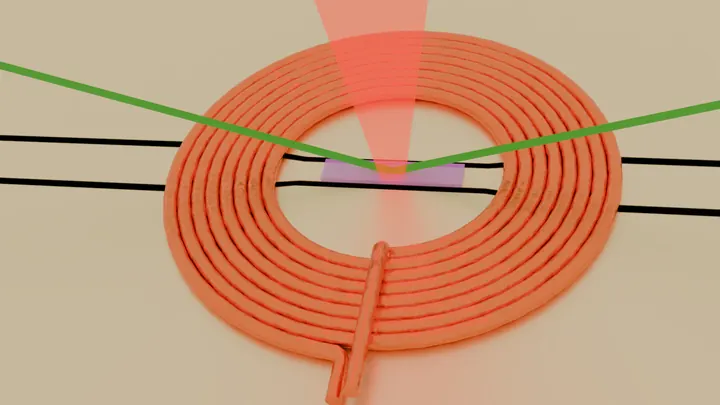
A tiny defect in a diamond crystal works like a sensitive antenna. When a magnetic field oscillates nearby, this defect, a nitrogen vacancy, responds by glowing. Previously, to hear the signal, you had to accumulate many repeated measurements, like listening to a whisper with your ear pressed against a door. Now a single short "look" suffices.
When matter accumulates on the surface of a neutron star, the ultra-dense remnant of a dead star, an explosion occurs, akin to a giant thermonuclear bomb. In this inferno, nuclei of elements not found on Earth are born within seconds. To understand which ones, their masses must be known with great precision.
Two twins look identical, but one is left-handed and the other right-handed. In the world of elementary particles, there are similar pairs: Ξ- and its antiparticle Ξ+. They are born together in the decay of the J/ψ particle and, like entangled twins, maintain a connection even at a distance.
The hydrogen atom is like a tiny clock, ticking with a precision engineers can only dream of. When an electron jumps between orbits, it absorbs or emits light at a strictly defined frequency: that's the 'tick.' In the new work, physicists caught one such transition, between the 2S and 6P states, and measured its frequency with an…
On a lab table sits an instrument that looks like a balance, but instead of pans it has two weights made of different metals — beryllium and aluminum. The balance is suspended from a thin fiber that twists if the weights are pulled differently. The whole apparatus turns to follow the Sun, like a sunflower tracking the light, but instead of light it catches the Sun's gravity.
The helium atom is like a tiny solar system: electrons orbit the nucleus, but their orbits are governed by strict rules. Scientists have learned to observe these motions with incredible precision.
In a quiet lab, a device the size of a microwave oven sits on a table. Inside, a coil glides smoothly up and down while a computer reads electrical signals. This is the tabletop Kibble balance — a machine that links mass to quantum constants.
Previously, such balances occupied a whole room and required a team of engineers.
A ruler made of light: that's one way to describe a new method for measuring tiny time delays. In 1987, Chong Ki Hong, Zhe-Yu Ou, and Leonard Mandel noticed that when two indistinguishable photons hit a beam splitter simultaneously, they always exit together from the same port.