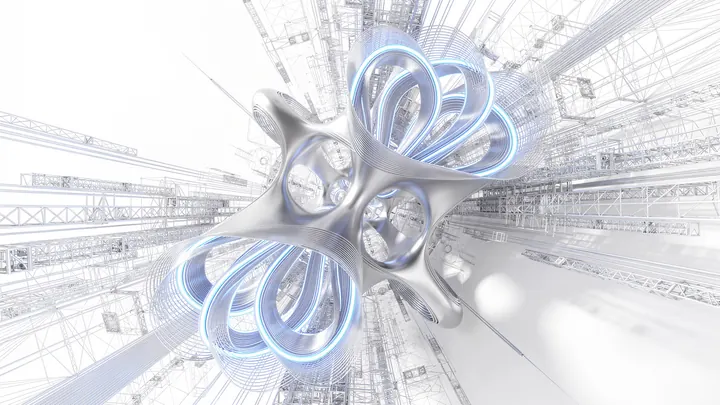
A Lie group is like a round dance where the figures can change smoothly, and each figure is obtained from the previous one by a precise rule. Imagine a kaleidoscope: you turn the tube — the pattern shimmers, and all possible rotations live in a special world of symmetries that mathematicians called a Lie group.
History
The theory of Lie groups emerged in the works of Sophus Lie (1870s) while studying symmetries of differential equations. Later, Wilhelm Killing and Élie Cartan classified simple Lie groups. The connection to physics was established through the works of Hermann Weyl and Eugene Wigner on group representations in quantum mechanics. In the second half of the 20th century, Lie groups became the foundation of the gauge principle.
How it works
Key fact: Lie groups are locally determined by their Lie algebra via the exponential map exp: g → G. For matrix groups, exp(X) = Σ_{k=0}^∞ X^k/k!. The structure constants of the algebra determine all local properties of the group. Representation theory describes how the group acts on vector spaces: for example, SO(3) on spherical harmonics. In physics, gauge fields are connections in principal bundles with a structure group, and their curvature is the field strength (Yang-Mills equations). According to Noether's theorem, every continuous symmetry described by a Lie group leads to the conservation of some quantity.
Fun fact
Using Lie groups, physicists have described all particles in the universe: quarks and electrons live in symmetrical patterns, like in a magical kaleidoscope where every shift is a new transformation.
In some quantum theories, symmetries intertwine in an unusual way, as if a lock had two keys, but turning one slightly shifted the other. Such intertwined symmetries are called 2-groups. One is an ordinary symmetry acting on point particles (0-form), and the other is a 'linear' symmetry (1-form) governing extended objects like strings or lines.
Dim the lights. The stage belongs to a shadow theater, with just r puppeteers, but the screen obeys the laws of hyperbolic geometry. Every wave of the hand births a pattern that mathematicians call a discrete group of isometries.