Imagine an ant crawling on the surface of a huge ball. To it, the ball seems flat, like an endless plain. But in fact, it lives on a curved surface that looks flat up close. So a manifold is a space that in each small region looks like ordinary Euclidean space, but as a whole may be more complex, like the surface of the Earth or a donut.
History
The concept of a manifold arose from attempts to mathematically describe complex geometric shapes. Bernhard Riemann, in his 1854 lecture 'On the Hypotheses Which Lie at the Foundations of Geometry', introduced a generalized concept of multidimensional space. At the end of the 19th century, works by Felix Klein and Sophus Lie gave rise to the theory of Lie groups — smooth manifolds with a group structure. In the early 20th century, Henri Poincaré laid the foundations of topology, in particular, formulating the conjecture about the homotopy equivalence of the three-dimensional sphere. Later, the development of manifold topology led to the classification of surfaces, the creation of knot theory, and modern differential geometry.
How it works
In physics, spacetime is modeled as a four-dimensional pseudo-Riemannian manifold, whose metric is determined by Einstein's field equations: R_{μν} - ½Rg_{μν} = (8πG/c⁴) T_{μν}. Here, the manifold sets the geometric properties of the universe, and curvature describes gravitational interaction. In quantum mechanics, wave functions are defined on infinite-dimensional Hilbert spaces, but their configuration spaces are often finite-dimensional manifolds (e.g., the Bloch sphere for a single qubit). Gauge symmetrygroups (U(1), SU(2), SU(3)) are Lie groups naturally acting on corresponding manifolds.
Fun fact
If we lived on the surface of a donut, we could walk in any direction and eventually return to the starting point, unaware that our space has a hole! Manifolds allow us to study such unusual shapes of the universe.
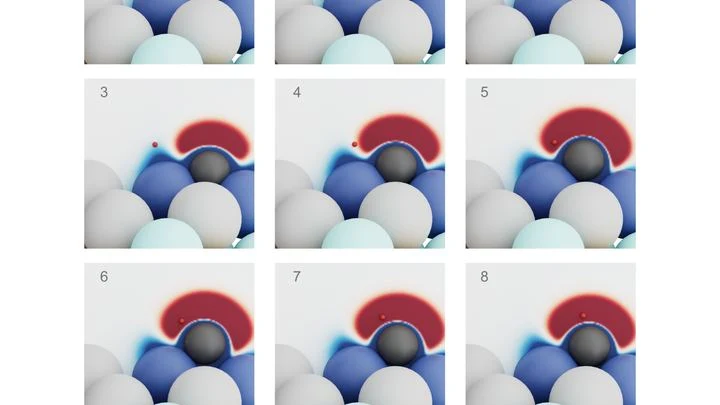
In a vast hall, billiard balls are scattered about. At first they lie sparsely, each on its own. Then someone adds more, and suddenly the balls compress into dense clusters. This is a phase transition — the moment when matter abruptly changes its state.
Physicists have long described such a picture with the hard-sphere model: particles are identical balls that cannot overlap.
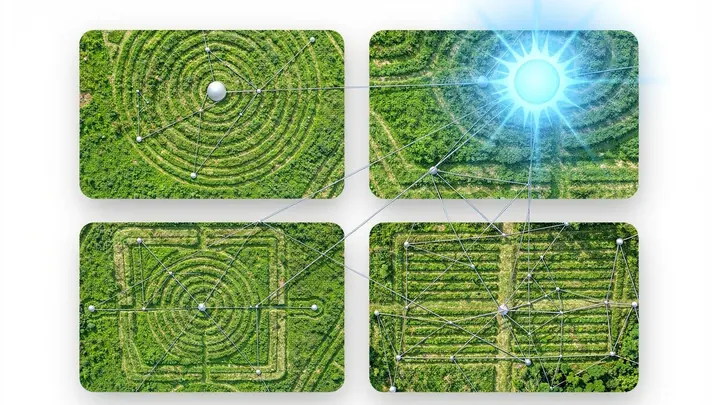
Deep in the Amazon rainforest, beneath a multi-layered canopy of leaves, lie vast earthen figures — squares, rectangles, the occasional rhombus. For decades they teased archaeologists with their silent geometry, until a researcher armed with orbital optics saw them as an astronomical instrument.
In cricket, there's a special delivery — the googly. The ball spins in a way that deceives the batsman. Physics had its own googly: for nearly half a century, mathematicians couldn't make twistor theory work with real gravity. It described 'nice' fields perfectly, where everything twists in one direction. But as soon as an 'awkward' component appeared, the machinery broke down.
Two passengers step into an empty car on a ring subway line and take their seats. After one full loop, they are surprised to find themselves in each other’s seats — even though nobody moved. That’s pretty much how monodromy plays out in vineyards — families of persistence diagrams, a method rooted in the work of Henri Poincaré.
In mathematics there is a sieve that sifts not dust, but infinity itself. It’s called a Q-space: here any subset turns out to be a Gδ set — a countable intersection of open sets, as if sifted through an unimaginably fine mesh.
A huge sheet of paper lies on the table. A cartographer tries to fit all conceivable landscapes onto it: mountain ranges, tangled gorges, endless plains. Each landscape is a finitely generated group, and the map is its Cayley graph, a graphic portrait of the group, where vertices are elements and edges are connections between them.
A flashlight beam travels straight into the dark: that's how we usually think of light. But near a massive body, like a star or a black hole, space is curved, and the beam bends smoothly, as if guided by an invisible hand. The authors of a new study have worked out exactly how gravity alters the familiar laws of electricity and magnetism.
A kitchen sponge soaked in syrup: in some spots there's more syrup, and your finger sticks right away; in others, it barely touches. That's roughly how a catalyst surface works. Molecules don't react everywhere but at especially sticky points — active sites.
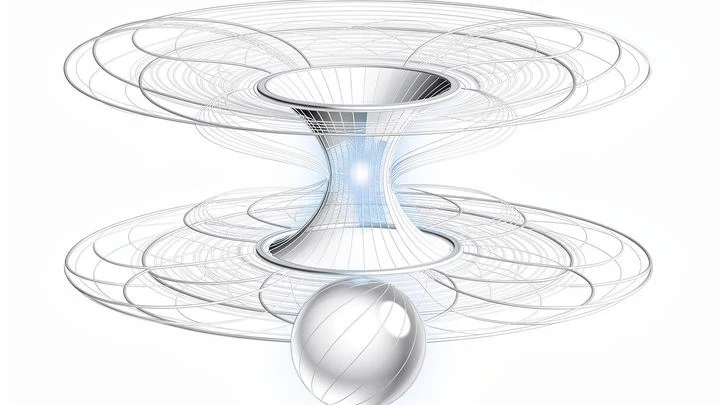
Usually, a wormhole is imagined as a tunnel in space, whose walls are held open by something unusual — matter with negative energy. Like the supports in a mine that keep the ceiling from collapsing. But in this work, the physicists did without supports.
Imagine a library where instead of books, you have every conceivable combination of a few dozen quantum particles. The number of combinations grows like a snowball: add one particle, and the volume doubles. For fifty particles, there are more shelves than atoms in the visible universe.
A soap bubble hangs in the air, and its shape already contains everything needed to calculate the internal tension. A similar principle worked in a new study on quantum gravity. Physicists took a closed surface, an analog of such a bubble, and specified a few numbers on it: for example, the electric field strength and the curvature.
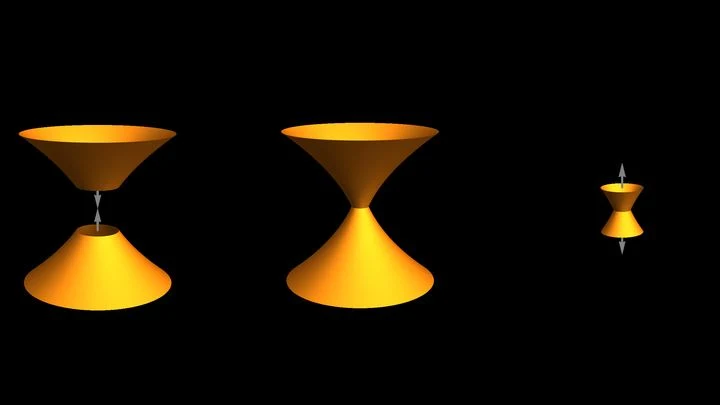
First thing that comes to mind when thinking about the birth of the Universe is an explosion. But modern cosmology paints a more refined picture: birth through the neck of a wine glass. This geometry is not a sommelier's fantasy, but a rigorous form of Euclidean wormhole that connects two anti-de Sitter worlds.
A handful of sand lands on the table. The grains settle in different ways, but if the handful is large, the total volume barely changes. That's roughly how classical gravity works: space appears smooth and definite. But look closely at the individual grains, and you'll find that at the quantum level, volume itself is no longer fixed.
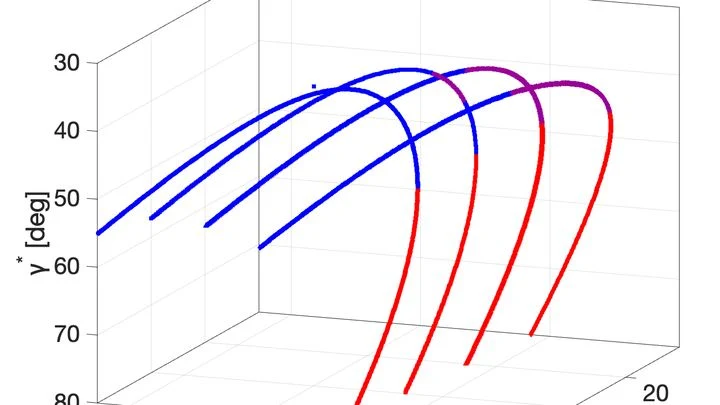
A lizard falling from a branch doesn't just tumble: it catches the air with its body and turns the fall into a glide. Engineers have long borrowed tricks from such feats, but until now there was no common language to compare the gliding of a snake, a lizard, and a man-made wing. The new study introduces such a language: a three-dimensional map of velocities that shows where any motion inevitably ends up.
Picture a globe divided into cells: near the poles they shrink into narrow wedges, while at the equator they stretch into wide bands. If you connect random points on such a globe with lines, the compass arrows will lie: connections will point to where there are more cells, not where the flows actually go.