Spontaneous symmetry breaking (SSB) occurs when the ground state (vacuum) of a system is less symmetric than the equations describing it. The classic model is the 'Mexican hat' potential: the energy minimum is not at the center but on a circle of equally possible states. By randomly choosing one, the system generates massless excitations (Goldstone bosons). In gauge theories such as the electroweak theory, these bosons are 'eaten' by fields, becoming their longitudinal components and giving them mass (the Higgs mechanism). In a ferromagnet, rotational symmetry is broken, and the Goldstone bosons are magnons—magnetization waves.
History
The idea of spontaneous symmetry breaking goes back to Werner Heisenberg's theory of ferromagnetism in the 1920s and Lev Landau's theory of phase transitions (1937). In 1961, Yoichiro Nambu and Giovanni Jona-Lasinio built a model of chiral symmetry breaking in hadrons. In 1964, Peter Higgs, as well as François Englert and Robert Brout, showed how to combine SSB with gauge invariance, solving the problem of gauge boson masses. Emmy Noether had earlier in 1918 proved the fundamental connection between symmetries and conservation laws, which formed the basis for understanding broken symmetries.
How it works
Consider the Lagrangian L = (∂_μ Φ)* (∂^μ Φ) - V(Φ) with the potential V(Φ) = -μ^2 |Φ|^2 + λ |Φ|^4. The minima lie on the circle |Φ| = v = √(μ^2/(2λ)). Choosing a specific direction for the vacuum expectation value ⟨Φ⟩ = v breaks the U(1) symmetry. Parameterizing Φ = (v + h) e^{iθ/v} reveals a massive field h (the Higgs particle) and a massless field θ (the Goldstone boson). In the presence of a gauge field A_μ, the covariant derivative D_μ Φ = ∂_μ Φ - i e A_μ Φ leads to the field θ being absorbed, becoming the longitudinal mode of A_μ, which acquires the mass m_A = e v. Thus, like a ball rolling into one of the valleys, the vacuum chooses a specific state, and this choice determines the properties of elementary particles.
In practice
Thanks to this mechanism, particles gain mass, magnets stick to refrigerators, and superconducting magnets work in tomographs.
Fun fact
In the expanding Universe, spontaneous symmetry breaking could have produced cosmic strings—filament-like defects as thin as a proton but millions of light-years long. The search for them continues through light distortions from distant galaxies.
A tightly stretched membrane, squeezed into a narrow case, decides on its own where to burst. So does a cell: when it is cramped, the point of division shifts from the middle, and the two halves come out unequal. Previously, it was thought that such asymmetry is predetermined by chemical labels, but the new work shows that mechanics alone is enough.
In a mountain range, there are trails that can be contracted to a point if you walk through a flat valley. But there are also loop routes that cannot be shrunk without crossing a ridge.
Neutrinos are tiny particles that pass through our bodies by the billions every second without touching a single atom. They have a mysterious property: on their way from the Sun or an accelerator, they can change their type, or 'flavor'—for example, turning from an electron neutrino into a muon neutrino.
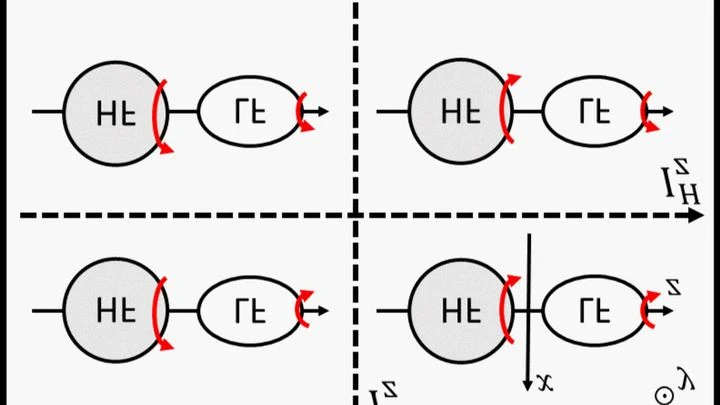
An ordinary mirror swaps left and right. Many laws of physics don't notice the swap: they are mirror-symmetric. But some phenomena, like the weak interaction, break this symmetry. Until now, it was thought that gravity and light each break mirror symmetry in their own independent way.
In some quantum theories, symmetries intertwine in an unusual way, as if a lock had two keys, but turning one slightly shifted the other. Such intertwined symmetries are called 2-groups. One is an ordinary symmetry acting on point particles (0-form), and the other is a 'linear' symmetry (1-form) governing extended objects like strings or lines.
In some quantum theories, symmetries intertwine in an unusual way, as if a lock had two keys, but turning one slightly shifted the other. Such intertwined symmetries are called 2-groups. One is an ordinary symmetry acting on point particles (0-form), and the other is a 'linear' symmetry (1-form) governing extended objects like strings or lines.
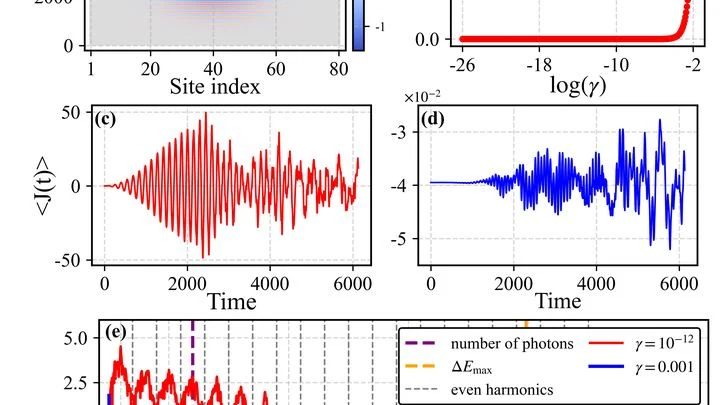
A guitar string plucked exactly at its middle produces only odd overtones. The same prohibition holds in symmetric crystals: when light knocks out electrons, their re-emitted radiation contains only odd harmonics. But physicists have found a way to bypass this rule — without shifting a single atom.
The secret is electric current.
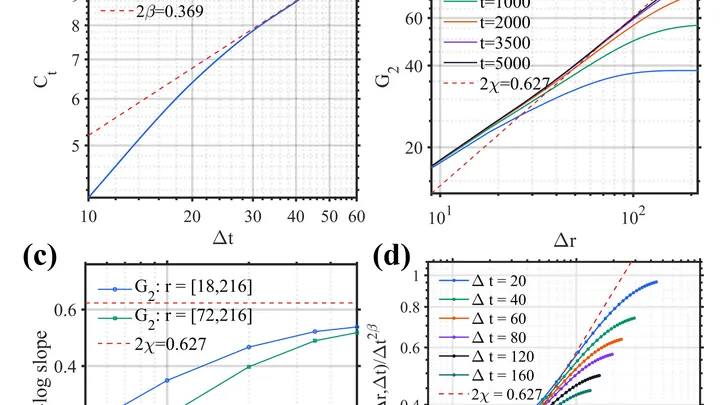
A snow-covered mountain slope looks like a chaotic jumble. But measure the roughness and you find that the height variations follow strict mathematics. Stochastic modeling shows these random processes aren't entirely random. They produce universal patterns, whether in snow, the flame front of a wildfire, or the growth of a bacterial colony.
A quantum chain is like a string of lights, where the bulbs are the spins of particles. Ideally, all bulbs glow in sync, following a common rhythm: that's symmetry. But if you cut off a piece of the string, the rhythm can get out of step: within that segment, symmetry is broken.
Physicists study a chain of strongly interacting particles (the XYZ model).
A black hole sitting on a thin cosmic membrane (brane) resembles a heavy ball stretching an elastic sheet. In classical physics, it is bald — only mass, charge, and rotation. But add a scalar field (an invisible substance like temperature), and the hole can spontaneously grow 'fur' from this field.
Neutrinos are like invisible dancers who change masks mid-flight. The three types (electron, muon, and tau neutrinos) constantly morph into each other. This dance is described by a complex mixing matrix, and physicists have long tried to break it down into simple moves.
The authors of the new work reassembled one such decomposition, TM1, using the 'flavor spin' formalism.
The quantum world is often compared to a musical instrument. Each system, whether an atom or a chain of particles, sounds at its own frequencies, which physicists call energy levels. In chaotic systems, like an orchestra without a conductor, these frequencies usually fill the entire available range without gaps.
Musicians in an orchestra each play their own part, not hearing the others. In a perfect crystal of tungsten disulfide on graphene, excitons, bound electron-hole pairs, behave the same way: they barely mix due to a hidden symmetry called the valley. The energy levels of such a system resemble notes sorted into separate folders — the chaos is incomplete.
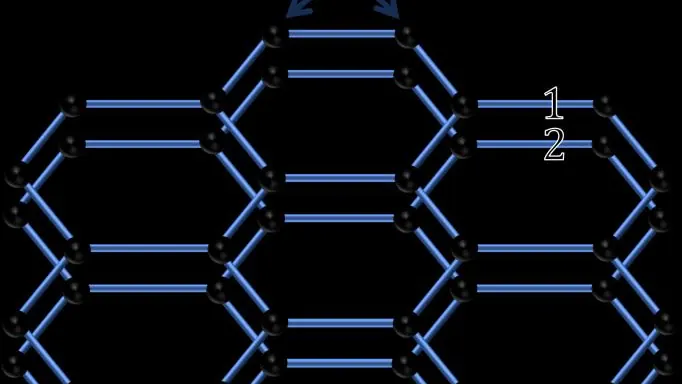
In water cooled to –40°C, a paradoxical pause sets in: perfect hexagonal ice is in no hurry to form. Instead, a disordered structure with interspersed cubic layers emerges — a real cradle for future symmetry, brimming with disorder yet already charged with hidden architecture.
A thin magnetic film is like a row of toy soldiers with tiny magnetic arrows. In the flat world, thermal jostling quickly disrupts this formation — even the slightest heating destroys the order. This is the Mermin–Wagner prohibition: in two dimensions, continuous symmetry cannot survive at finite temperature.
A sheet of rubber is squeezed from two sides. At first glance, it's just deformation. But inside, deep within the material, a hidden order awakens. This is not just wrinkles on the surface. It's the birth of special zones where vibrations become trapped, as if in a cage.
Previously, it was thought that such effects require intricate lattices and periodic structures.
At the very beginning of the universe, when all of space was compressed into a point, the laws of physics break down. This point is called a singularity — an edge where our equations lose meaning. But what if it's not an end, but a special type of boundary?
The authors of this work propose viewing the singularity as a free boundary.
Two clouds of ultracold atoms, almost frozen at temperatures of a few nanokelvins, mix in a trap. One cloud consists of light atoms, the other of heavy ones. They push each other differently. Physicists have long been able to describe such mixtures with simple equations, but those work only if the atoms are perfectly identical.
In the hot early universe, like in an overcrowded dance hall, magnetic monopoles swirled — loner particles carrying only a north or only a south pole. In an ordinary magnet, poles always come in pairs, but here each one is on its own. Theories that unify all forces of nature predict that such particles should have been produced in vast numbers, yet today we don't see them.
An atomic nucleus is like a crowded bus. To free up space, a group of two protons and two neutrons — a helium nucleus, an alpha particle — exits through the front door: this is alpha decay, described by George Gamow as tunneling under an energy barrier.
An orchestra without a conductor. Each musician hears not only their neighbor but also echoes from across the stage. That's roughly how the idea of a nonlocal Higgs field works: a particle 'feels' what's happening not at a single point but across an entire region of space.
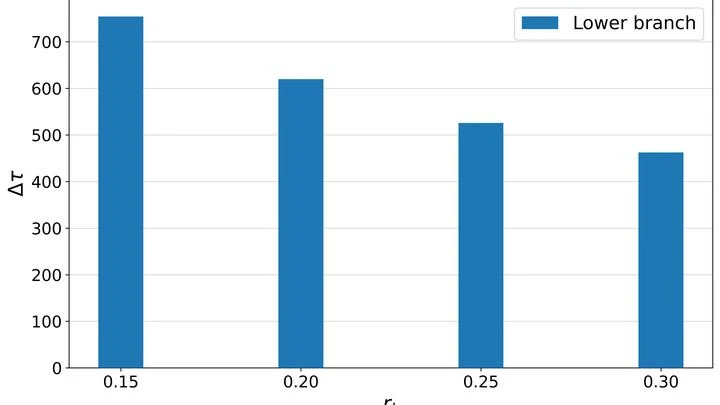
A heavy atomic nucleus of californium-252 can spontaneously split into two large fragments — much like a water droplet bursting apart. But inside such a droplet, quantum laws are at play, and each fragment acquires its own rotation — a spin.
A translator gets distracted by every rustle in the hall, and a one-hour meeting stretches into two. That's roughly how ordinary quantum mechanics works: a particle evolves in time, while space serves as the stage. But what if we swapped their roles? Then the particle 'moves' through space, and time becomes a static backdrop.
An infinite chain of atoms spaced at equal intervals. Shift the entire chain by one step, and the picture doesn't change. That's translational symmetry: the world looks the same wherever you look. You'd think such a simple rule would give rise to simple states, like a crystal lattice assembled from identical building blocks.
But the authors counted those blocks anew.
On the table sits a glass of water. For each molecule, all directions are equivalent: it doesn't distinguish north from south. That's symmetry. But if you freeze the water, the molecules align into an ice lattice, and symmetry breaks: a preferred direction emerges.
The quantum world breaks symmetry more cunningly. The glass freezes, yet each molecule still tumbles randomly.
When hot soup cools, clumps form on the surface — similarly, as the early universe cooled, it gave birth to threadlike clumps of energy: cosmic strings. Some of them are like a stretched rubber band: as long as it's intact, it's stable. But if you nick the band, it snaps.
Throw a stone into a pond — ripples spread out, changing the scale of the wave. The new theory works much the same way: it gives each particle its own "scale ripple," and it's this curvature of an invisible space that turns out to be the source of mass.
In particle physics, it has long been taken for granted that the forces of nature (electromagnetism, the weak and strong interactions) obey a strict symmetry called gauge symmetry. It's like a set of rules by which particles exchange force carriers. But where do the rules themselves come from?
A stone falls into a pond, and ripples spread across the water. But if the stone is very small and the water is not quite ordinary, the ripples pass right through it, as if it weren't there.
Tiny magnets on a lattice, the classic Ising model, are usually described by how neighbors influence each other. But what happens when the system is closely watched? Each measurement of a coupling energy is like a gaze that forces the magnets to 'decide' their state.
Imagine a soap bubble with electricity trapped inside and walls made of an invisible field: that's roughly what a black hole with 'resonant hair' looks like. This isn't real hair, but a cloud of scalar field held around the hole by its own interactions.
An orchestra without a conductor is playing, and suddenly, without any visible cue, the violins grow louder and the woodwinds shift slightly in time. From the outside, nothing seems to have changed, but inside the ensemble, a regrouping has occurred. This is roughly how small physical systems behave during so-called third-order pseudotransitions.
In a pot of boiling water, steam bubbles rise and pop. In the quantum world of a superfluid, bubbles behave differently: they can collide and give birth to vortices — tiny swirling flows, like whirlpools in a river.
Scientists modeled such a liquid using a holographic approach.
A handful of coins drops onto a table. While they spin, each can land heads or tails: that's quantum uncertainty. But once they settle, the picture becomes definite, classical. That's roughly how noise destroys quantum order, turning it into ordinary disorder.
Imagine a balance scale with identical weights, yet one pan always tips lower. In the world of elementary particles, this imbalance is called CP violation: particles and their mirror twins (antiparticles) behave slightly differently.
In an orchestra where every musician plays the same note, the sound merges into a powerful unison. This is how a Bose–Einstein condensate is born: many boson particles at extremely low temperatures behave as a single entity.
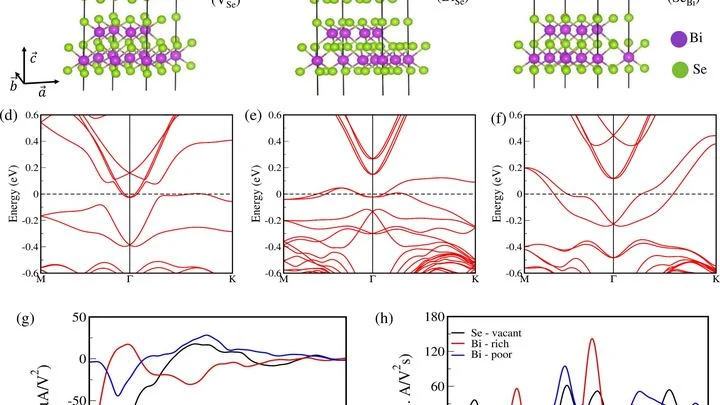
The crystal bismuth selenide (Bi₂Se₃) is symmetric by itself, like a neatly stacked sandwich: flip it over, and nothing changes. But twist one layer slightly relative to the other, and the symmetry breaks. The material begins to 'feel' which side the light comes from and responds with an electric current.
A crowd of people moves freely across a square, but suddenly freezes in place without changing their positions. Everyone stays where they were, but motion stops. This is exactly what a symmetric mass generation transition looks like: the system gains rigidity, yet its symmetry remains untouched.
Light travels across a room, bouncing off mirrors and walls. The emptiness in between seems perfectly neutral: it doesn't hinder the beam or curve its path. But what if, at the deepest foundations of the world, emptiness is more complex? Physicists have long suspected that the symmetry of space might break at tiny scales, and then light would behave differently.