A differential equation is a compass for a moving world. It tells us not where we are, but where we are going and how fast, depending on our surroundings. Solving it means reconstructing the entire route from instantaneous clues. Such equations can be ordinary (with one independent variable, such as time) or partial (with many variables, as in describing a vibrating string). They underlie everything: from a ball's trajectory to the dynamics of galaxies.
History
The origins lie in the 17th century, when Isaac Newton and Gottfried Leibniz independently created differential and integral calculus. Newton formulated the second law of motion as a differential equation. In the 18th century, Leonhard Euler, Joseph-Louis Lagrange, and Pierre-Simon Laplace developed methods for solving broad classes of equations, especially in celestial mechanics. The 19th century brought the theory of partial differential equations: Jean Baptiste Joseph Fourier—the heat equation, James Clerk Maxwell—electrodynamics. In the 20th century, Henri Poincaré's qualitative theory and functional analysis made it possible to study solvability and stability even without explicit formulas.
How it works
Consider a first-order ODE dy/dx = f(x, y). Geometrically, this equation defines a direction field on the plane: at each point (x, y), the slope of a small segment equals f(x, y). An integral curve passing through a given initial point must be tangent to this field at every point. The simplest solution method is separation of variables, if f(x, y) factorizes. For linear ODEs with constant coefficients, solutions are sought as exponentials; multiple roots of the characteristic equation lead to resonant terms of the form x e^{λx}. Partial differential equations require more delicate techniques: separation of variables, Green's functions, Fourier transforms. The well-posedness of a problem (existence, uniqueness, stability of the solution) is established by theorems, such as the Cauchy–Kovalevskaya theorem for analytic PDEs or the Galerkin method for weak solutions. Numerical methods (finite differences, finite elements) allow approximating solutions with controlled accuracy.
In practice
Differential equations describe how coffee cools, populations grow, and signals propagate in neurons.
Fun fact
Schrödinger's equation is a differential equation that governs the behavior of quantum particles. It is as fundamental to the microworld as Newton's laws are to the planets.
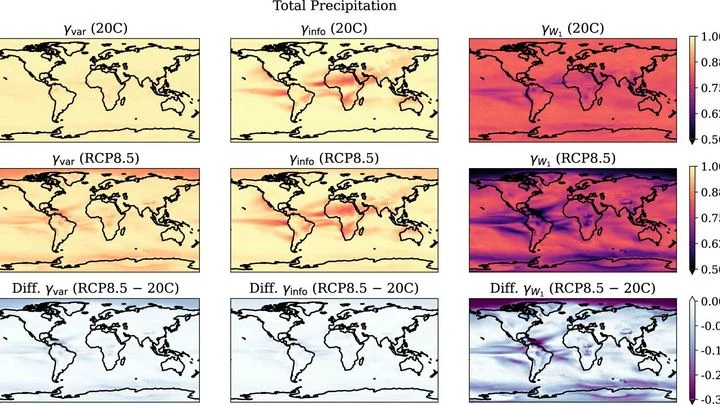
In winter, one part of town gets three times as much snow as the neighborhood next door. One year is a scorcher, the next is a cold snap. That's the whims of weather. But over decades, a different, slow shift emerges: winters, on average, get milder. Telling the two apart is the central challenge for climate scientists.
When two atomic nuclei smash together, a tiny fireball is born. It lives for an instant, but inside, entire epochs pass: compression, heating, expansion. Physicists have learned to eavesdrop on this process, and their "microphone" is the pairs of electrons and positrons that fly out of the ball at different stages.
In the new work, two scenarios were compared.
A regular radar works like an amateur photographer: it takes a series of blurry snapshots and tries to stitch them into a panorama. Details are smeared, and in a long corridor or crowd, the robot easily gets lost.
The principle is simple: like a bat, the radar emits a wave and catches the echo.
A tightrope walker steps onto the wire. Every move is a calculation: shift your weight just right, or you’ll fall. In the world of quantum particles described by the Dirac equation, there’s a different kind of abyss — the wave function’s furious oscillations.
A geometer runs a finger along an invisible surface, and by how the geodesics bend, lifts its fingerprint. That fingerprint can be the maximum normal curvature κ(F): the largest curvature among all geodesics passing through a point of the immersed manifold.
The heart doesn't beat like a metronome: its rhythm dances to the time of day. Each of us has a moment when our pulse hits its peak. This peak is like the hand of an internal clock, and it shifts from person to person.
But what moves that hand? Researchers gave people smartwatches and tracked them for nearly a month.
A drop of ink in a glass of water spreads evenly, but in a cup with chunks of fruit jelly, the ink will take winding paths — sometimes getting stuck, sometimes slipping through. Similarly, molecules in living cells or porous materials don't move on a smooth field but through a disordered medium: denser in some places, thinner in others.
The compass needle trembles when a truck rumbles by. Similarly, in a tiny gyroscope, a device that senses rotation, any noise drowns out the useful signal. For a long time, engineers couldn't shrink a gyroscope down to fingernail size without sacrificing accuracy.
The solution came in a two-loop architecture.
Two astronomers look at the same universe but see it differently. One measures the expansion rate using ancient light that has been traveling toward us for nearly 14 billion years. The other uses recent stellar explosions in nearby galaxies. The first gets 67 kilometers per second per megaparsec, the second gets 73.
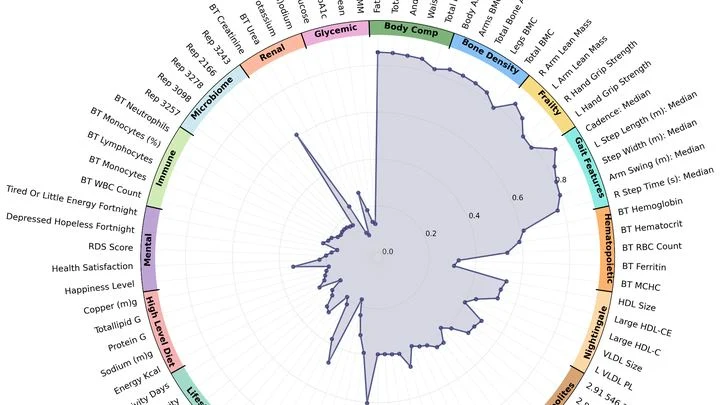
Gait is not just a way to get from point A to point B. Each step, arm swing, and torso tilt is like a signature the body leaves in space. Doctors have long noticed that disease alters gait, but they considered it merely a symptom of a specific problem: if you limp, your leg hurts. Now it turns out that gait is a whole book about health, and you can read it with an ordinary camera.
A piece of aluminum alloy is heated, and it quietly tells you about its strength. You just need to listen to that story in how the metal absorbs heat.
The usual way to find out how strong an alloy is — pull it until it breaks. That takes time and destroys the sample.
A seismometer is the planet's ear. It picks up the faintest tremors in the ground and turns them into an electrical signal. But this ear isn't perfect: its sensitivity depends on temperature. In the cold and in the heat, the instrument hears slightly differently, and that introduces error into measurements.
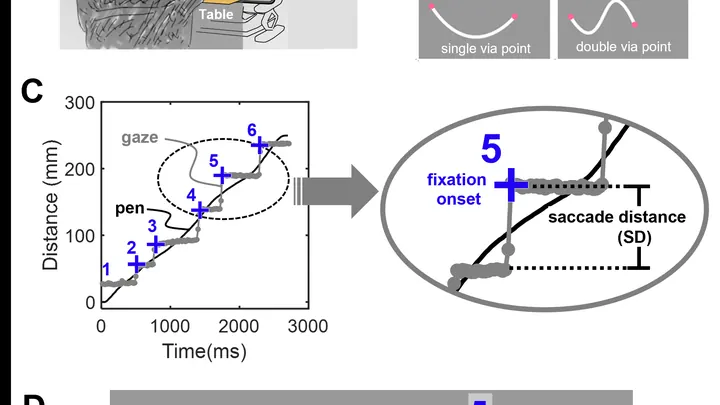
When the hand draws a line, the gaze almost always runs ahead, like a scout peeking around the corner before the column turns. But how far ahead? It turns out that each person has their own distance, and it does not change from attempt to attempt.
In the experiment, professional calligraphers and ordinary people traced a contour on a screen while instruments recorded eye and pen movements.
A drop of blood is a bustling city in miniature. Thousands of different molecules scurry through it, each leaving its own trace. But peering directly into this city is hard: the streets are tangled, and there are so many inhabitants that counting them all individually is out of the question.
Scientists have found a way to listen to the whole city at once, without singling out its residents.
Picture a translator at a meeting where everyone speaks an unfamiliar language. They don't know the words, but they notice: when one person raises their voice, another starts nodding a minute later. At first it seems like coincidence, but over time the translator learns to understand who influences whom.
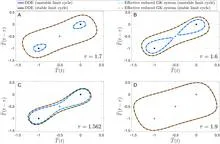
The Pacific Ocean remembers. Water warmed off the coast of Peru drifts slowly westward, and six months later its heat returns to South America. Scientists call this six-month journey the delay. It turns a simple climate model into a maze where the route depends not only on your current position but also on where you were half a year ago.
The ocean remembers its past. Heat given to the water off the coast of Norway does not vanish without a trace: it embarks on a long journey across the Atlantic, only to return decades later and alter the temperature at those same shores once again.
The Galaxy is a forest where birds don't start singing right away. First, trees must grow — stars, around which planets eventually appear. The Drake equation counts how many birds might be singing in this forest right now, but it implicitly assumes that their number doesn't change: as many as there are, that's how many there have always been.