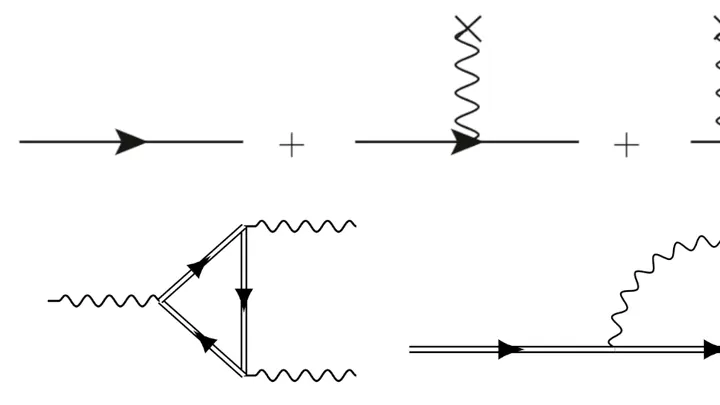
In 1954, Chen Ning Yang and Robert Mills asked: what if the laws of physics must remain unchanged not just under global, but also under local rotations of fields? From this idea of gauge symmetry (the requirement that the phase of a quantum field can freely change at each point) an equation was born describing fields that act not only on particles but also on themselves. Such fields are called non-abelian gauge fields—unlike the electromagnetic field, where photons (quanta of light) do not interact with each other.
History
Chen Ning Yang and Robert Mills published the equation in 1954, attempting to describe isotopic spin. Their work went unnoticed until the late 1960s, when physicists (Veltman, 't Hooft) proved the renormalizability of such theories, and Weinberg and Salam applied them to the electroweak interaction. Since then, the equation has underpinned quantum chromodynamics and the entire Standard Model.
How it works
It describes the dynamics of gauge fields: gluons in the strong interaction, W and Z bosons in the weak interaction. Its solutions yieldquark confinement and asymptotic freedom. The limits of applicability are energies below the Planck scale, where quantum gravity is not important.
In practice
This equation underpins the understanding of the strong interaction that holds protons and neutrons together, and describes all modern particles in colliders.
Fun fact
Initially, the Yang-Mills equation seemed like a mathematical toy because it predicted massless particles, and none were observed in nature. Only after the discovery of the mechanism of spontaneous symmetry breaking did it become clear how these fields could acquire mass and describe the weak force carriers W and Z.
Two dancers on the same stage mirror each other's moves even when a curtain separates them. In the quantum world, such pairs are called entangled, and physicists have spent half a century probing how far this connection reaches. Until now, all tests with massive particles concerned their internal properties, such as spin, but not their motion itself.
As planets orbit the Sun, they don't just follow their paths: they give each other a slight tug. It's like a dance where each partner feels the movements of the others. Scientists set out to determine how strongly this mutual attraction alters the planets' trajectories.
It turns out there are small corrections that were previously overlooked.
In the first instants after the Big Bang, the universe expanded faster than light could cross it. Like an inflating balloon, but instead of rubber, it was space itself. On this balloon, ripples inevitably formed — tiny compressions and rarefactions from which all galaxies and stars later grew.
A stone thrown at a wall bounces off. In the quantum world, a particle can pass right through, as if the wall were woven from mist. This is quantum tunneling: it lights up stars, works in microchips, and even operates in the cells of our bodies. But most particles have spin — an intrinsic rotation, like a spinning top.
Quantum field theory is the language physicists use to describe elementary particles and their interactions. The authors of the work decided to slightly "tweak" this language: they introduced deformations, that is, small changes to the rules of the game.
Two observers, Alice and Bob, sit at opposite ends of the same lab. Between them is a source that fires off two pulses in turn. Each pulse gives birth to a wave packet flying toward its own detector. So far, this looks like an ordinary experiment with quantum particles.
In some quantum theories, symmetries intertwine in an unusual way, as if a lock had two keys, but turning one slightly shifted the other. Such intertwined symmetries are called 2-groups. One is an ordinary symmetry acting on point particles (0-form), and the other is a 'linear' symmetry (1-form) governing extended objects like strings or lines.
The universe right after the Big Bang was like a boiling cauldron: bubbles of a new state of matter were bursting and growing everywhere. These were first-order phase transitions — exactly like water boiling, only at temperatures reaching trillions of degrees.
A quantum chain is like a string of lights, where the bulbs are the spins of particles. Ideally, all bulbs glow in sync, following a common rhythm: that's symmetry. But if you cut off a piece of the string, the rhythm can get out of step: within that segment, symmetry is broken.
Physicists study a chain of strongly interacting particles (the XYZ model).
At the center of attention is a monopole, a special clump of a non-Abelian field (a field where the order of operations changes the result), resembling a magnetic charge without a pair. In this work, it is placed in curved spacetime described by Einstein's equations with a Gauss-Bonnet addition (a correction important at small distances).
After a hit, a black hole rings like a bell. But instead of sound, it emits gravitational waves whose frequency rapidly decays: these are called quasinormal modes. From such a 'ring,' you can infer the hole's mass, spin, and other properties.
A pot of extremely thick and hot glue: that's roughly what the early Universe looked like. It wasn't ordinary glue, but a 'gluon soup': particles carrying the strong force (gluons) zipped freely through space. The temperature was so high that even quarks and gluons didn't stick together into protons and neutrons.
Over time, the Universe cooled.
A taut trampoline sheet dips under a heavy ball. If the ball spins quickly, the sheet begins to twist around it. Spacetime near a rotating black hole behaves similarly: it is not just curved, but also dragged along by the rotation, like water swirling around a whirlpool.
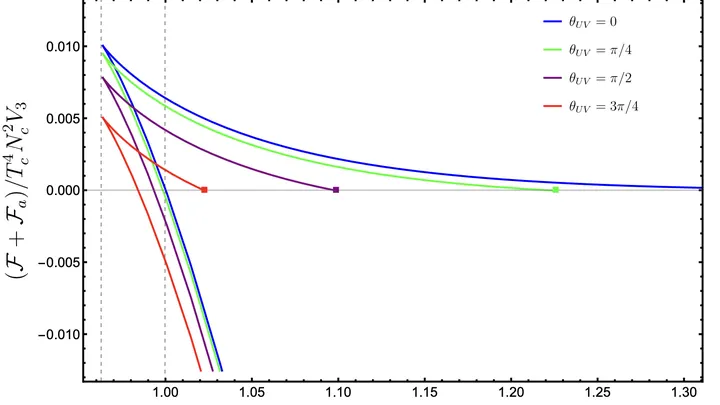
Water boils at one hundred degrees — everyone knows that. But why exactly one hundred? Why not smoothly, but abruptly: a second ago it was liquid, and suddenly — bubbles, steam, bubbling. Such sharp changes are called phase transitions, and they have a rigorous mathematical foundation.
A translator who translates not words but the very structure of a conversation runs into trouble when the chat moves beyond a quiet room. In a familiar simulation on a spatial lattice, everything follows a strict script. But the moment the interlocutors find themselves in a noisy square, where sound is distorted by echoes and the crowd keeps changing direction, the script falls apart.
In the center of almost every large galaxy lurks a supermassive black hole, whose gravitational abyss was first mathematically described by Karl Schwarzschild. When it swallows gas, a dazzling active nucleus is born — a quasar.
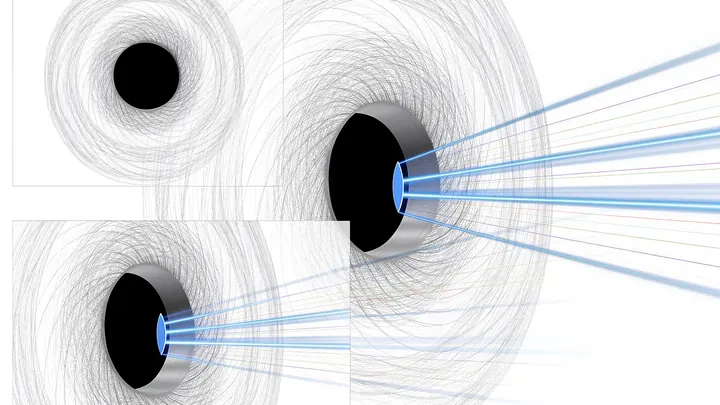
A black hole is not a dead object. After a disturbance, such as merging with another hole, it rings like a bell. This ring is not just a sound but a complex set of damped oscillations called quasinormal modes. Their frequency and damping rate depend on the hole itself: its mass, charge, and spin.
A quantum spin chain is like a string of beads, where each bead is a microscopic magnet pointing up or down. In the XXZ model, these little magnets interact differently along the three axes, and at special parameter values, roots of unity, the system awakens with a hidden memory.
Twins enter a room from different doors. Each gets a box with a button, and each time they press it, either a red or a green light flashes. If the twins are perfectly identical, you'd expect their lights to follow the same internal rules. But what if the rules differ even though the twins are exact copies?
That's precisely the scenario the authors explored.
If you squeeze water between two glass plates so that only two layers of molecules fit, it becomes something between a liquid and ice. At room temperature, molecules in such a trap still move but arrange themselves into a semblance of a crystal lattice.
Imagine a slide with three dips: the deepest one is a stable position for a ball, the middle one is precarious. A slight push and the ball rolls down. Yet, constant vibration of the right strength can hold it in the middle hollow for a long time.
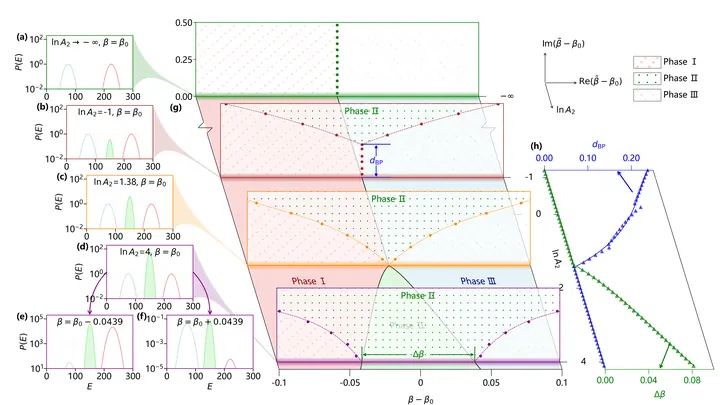
In the 1950s, physicists Lee and Yang discovered that all states of matter are separated by invisible points in the world of imaginary numbers.
Two electrically charged spheres attract each other with a certain force. If you replace their charges with magnetic poles, a spring scale shows exactly the same force. Black holes, it turns out, behave the same way — except instead of springs, the fabric of spacetime itself does the work.
Sunlight hits a silicon wafer, and a current flows in the circuit. That's the familiar work of a solar cell: light knocks out electrons, and a p–n junction (the boundary between two layers with different conductivities) forces them to move in one direction. But in some crystals, current arises differently — without any junctions, purely from the material's internal structure.
Throw a stone into a pond — ripples spread out, changing the scale of the wave. The new theory works much the same way: it gives each particle its own "scale ripple," and it's this curvature of an invisible space that turns out to be the source of mass.
In particle physics, it has long been taken for granted that the forces of nature (electromagnetism, the weak and strong interactions) obey a strict symmetry called gauge symmetry. It's like a set of rules by which particles exchange force carriers. But where do the rules themselves come from?
A tailor cuts a suit, but the seams pucker and the buttons won't align. In quantum field theory, similar glitches are called anomalies: they appear when a symmetry of the equations breaks down in the transition to a quantum description. Usually, they are fixed by sewing in extra patches, the so-called Bardeen–Wess–Zumino counterterms.
Gas falls onto a neutron star — the ultra-dense remnant of an exploded star. This gas accumulates at the magnetic poles and forms a mountain. But a mountain on a neutron star is not like one on Earth: it is held not by rock but by magnetic field lines, like iron filings on a magnet.
When there is too much gas, the mountain begins to break apart.
A magnetar is a neutron star with a magnetic field hundreds of millions of times stronger than Earth's. If you brought an ordinary magnet near such a field, it would instantly lose its magnetism, and atoms would stretch into thin filaments.
A quantum computer made of trapped ions played the role of a tiny universe. In it, particles didn't just move; they wove into knots that change their properties when swapped. Such knots are called Fibonacci anyons: they aren't ordinary particles but rather vortices in the fabric of space.
A guitar string after being plucked produces not only the fundamental note, but also quiet overtones. A similar phenomenon appeared in the gravitational waves from the merger of two black holes (event GW250114).
A tiny tungsten tip with a radius of less than a hundred nanometers is the perfect stage for watching a quantum performance. Apply an electric field of a few volts per nanometer, and electrons start flying out of the metal: that’s field emission.