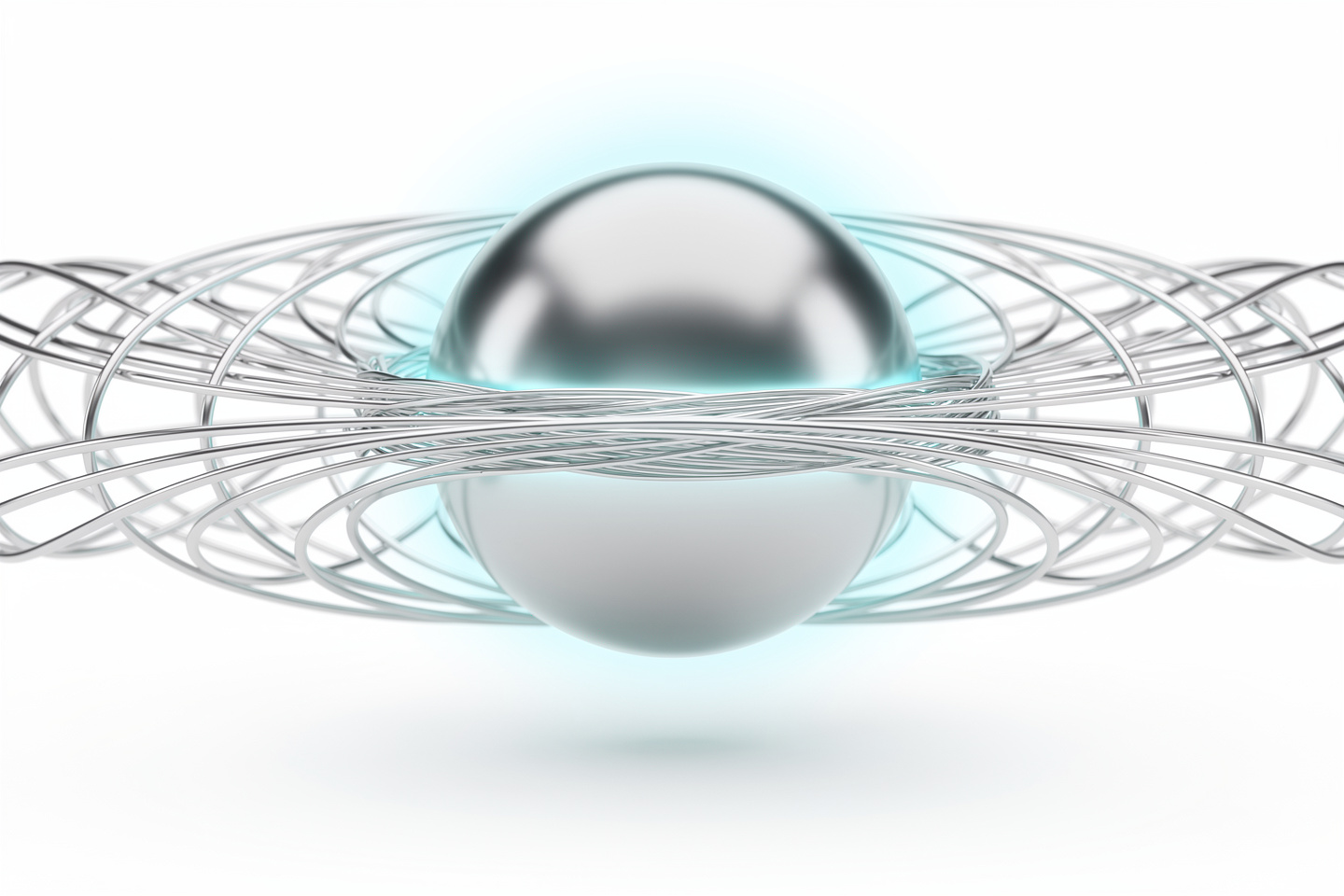
A superconductor expels a magnetic field, just as a float is pushed out of water — remaining perfectly empty inside.
In practice: Magnetic levitation of trains using superconducting magnets and precise magnetic field measurements without interference.
Discovered in 1933 by Walther Meissner and Robert Ochsenfeld. Before this, it was thought that a superconductor is simply an ideal conductor with zero resistance, but the experiment revealed a deeper property: regardless of whether the magnetic field was applied before or after cooling, the magnetic induction inside the superconductor is always zero. This is like an elastic ball in carbon dioxide: the gas is displaced, and the ball maintains the field shape around it.
How it works
Thanks to this effect, magnetic levitation becomes possible: a superconductor hovers above a magnet without requiring energy input, which is used in high-speed train suspension and frictionless bearings.
💡 Based on the Meissner effect, ultra-sensitive magnetometers (SQUIDs) have been created, capable of detecting the magnetic field of a human heart from several centimeters away.
When a material becomes superconducting (conducts current without resistance) at a very low temperature, it completely expels the magnetic field (flux of magnetic lines) from its volume. This is similar to how water does not penetrate a sealed float: there is external pressure, but it does not get inside.
How it works
Thanks to this effect, magnetic levitation becomes possible: a superconductor hovers above a magnet without requiring energy input, which is used in high-speed train suspension and frictionless bearings.
💡 Tin, used in the first experiment, becomes superconducting at 3.72 K — just slightly warmer than the temperature of the cosmic microwave background radiation (2.73 K).
Upon transitioning to the superconducting state, the material becomes an ideal diamagnet: the magnetic induction B inside the volume decays exponentially from the surface with a characteristic length λ (London penetration depth) and becomes zero in the bulk. This means the superconductor not only completely shields the external field but also expels any pre-existing field upon cooling — a property absent in an ideal conductor.
Discovery
The effect was discovered in 1933 by German physicists Walther Meissner and Robert Ochsenfeld. They cooled tin and lead in a magnetic field and measured the field distribution, finding that the field is completely expelled upon transition to the superconducting state. This demonstrated that superconductivity is not merely the disappearance of resistance but a thermodynamic phase. Later, the London brothers (Fritz and Heinz) developed a phenomenological theory, and the microscopic explanation was provided by the BCS theory (Bardeen, Cooper, Schrieffer) in 1957.
How it works
The effect is used to create powerful magnets for MRI, particle accelerators, and levitating transport systems. Limits of applicability: the superconducting state is typically destroyed upon exceeding critical temperature, current density, or magnetic field. In type-II superconductors, the field partially penetrates in the form of vortices (mixed state), limiting ideal screening.
Caveats
The nature of high-temperature superconductivity remains not fully explained; Some materials exhibit unusual magnetic states that do not fit the standard model; The need for extreme cooling limits practical application
B is the magnetic induction vector, λ is the London penetration depth (the characteristic distance over which the field decays by a factor of e), ∇² is the Laplace operator (second derivative with respect to coordinates).
A hybrid quantum system has been proposed, combining long-lived spin memory, a fast superconducting processor, and a topologically protected mediator — a magnetic skyrmion. Its oscillations bridge the atomic world of defects with macroscopic circuits, overcoming the scale chasm. Calculations promise
Armed with a quantum magnetometer that reads nuclear spins with incredible precision, scientists hunted for exotic forces that break mirror symmetry. A tandem of rotating lead masses and a cloud of neon atoms improved previous constraints by a thousandfold. The setup works like a miniature gravitati
Superconducting quantum computers hit a cooling wall: a single cryostat can't hold millions of qubits. The solution is optical channels, but they need microwave-to-optical converters, which are still far from perfect. The authors showed that with feedback protocols, parallel attempts, and quantum di
Quantum tunneling is not just a trick that lets electrons seep through impassable barriers. It’s a window into the deepest mysteries of reality. It turns out that an electron behaves not as a point, but as a distributed entity—something like an octopus squeezing its tentacles through a crack. This v
Contrary to the entrenched view of spontaneous emission as an incoherent process that destroys quantum entanglement, a team of physicists has theoretically demonstrated the possibility of generating near-perfect bipartite entanglement between two bright light fields. The scheme is based on a four-le
Physicists made a superconducting qubit forget its past—and saw how three types of temporal correlations (non-macrorealism, temporal steering, temporal non-separability) arrange themselves into a logical ladder. These echoes die at different noise levels and can resurrect when the environment briefl
Quantum sensors based on Rydberg atoms can detect minuscule electromagnetic fields, but optical readout usually destroys almost all signal photons. Physicists from Warsaw went against the grain and deliberately enhanced nonlinear losses through dipole-dipole collisions of excitations. This paradoxic
The work shows how chirality—the property of a molecule not coinciding with its mirror image—turns a weak magnetic signal into a reliable compass. Chirality does not merely create quantum coherence, but induces spin polarization, forcing the system to endlessly 'freeze' in one state. This amplificat
Researchers from Ephos and the Polytechnic University of Milan inscribed a 24-mode universal photonic processor into glass, using femtosecond lasers like a sewing machine needle. Operating at 925 nm—ideal for quantum-dot single-photon sources—the device is controlled by microheaters and uses less po
By combining lithium niobate and gallium arsenide, scientists created a chip. In it, quantum dots interact with microresonator modes, and electro-optic tuning of the feedback phase drives the system to an exceptional point. At this singularity, two modes coalesce, and the spectral density of states
Superconducting qubits and optical photons are separated by a five-order-of-magnitude frequency gap. Direct qubit translation is an engineering dead end, but an architectural trick inspired by packet switching turns weak transducers into entanglement generators. Thus the quantum internet transforms
The study unites two poles of quantum cosmology: tunneling from existing space and the no-boundary Hartle–Hawking state. Numerical solutions of Einstein's equations with an axion (or magnetic) charge and a scalar field revealed a family of Euclidean wormholes—their scale-factor profile shaped like a
The cosmic microwave background not only brings a map of the early universe but also a subtle twist in polarization—just a few thousandths of a radian. For a long time, it was attributed to ultralight axions, but they clash with experiments. A new explanation is more elegant: the rotation arises whe
A new theoretical study demonstrates how analog black-white holes created in superconducting SNAIL chains respond to perturbations: they don’t explode, but quietly fade, emitting a pure dissipative tone. Supersymmetric quantum mechanics proves the absence of growing modes, and quasinormal frequencie
The weak equivalence principle has been tested with fantastic precision, but always with grounded samples — as if one string of the gravitational violin is deliberately muted. The κ parameter quantifies whether acceleration depends on electric charge: it is the ratio of the difference in acceleratio
The main obstacle for a graviton laser is that gravitational waves cannot be reflected: they pass through any substance. The solution lies in the Gertsenshtein effect. Under a powerful magnetic field, gravity particles temporarily become photons, which are easily reflected by ordinary mirrors. The r