Betelgeuse no está sola: hallada una compañera estelar exprés
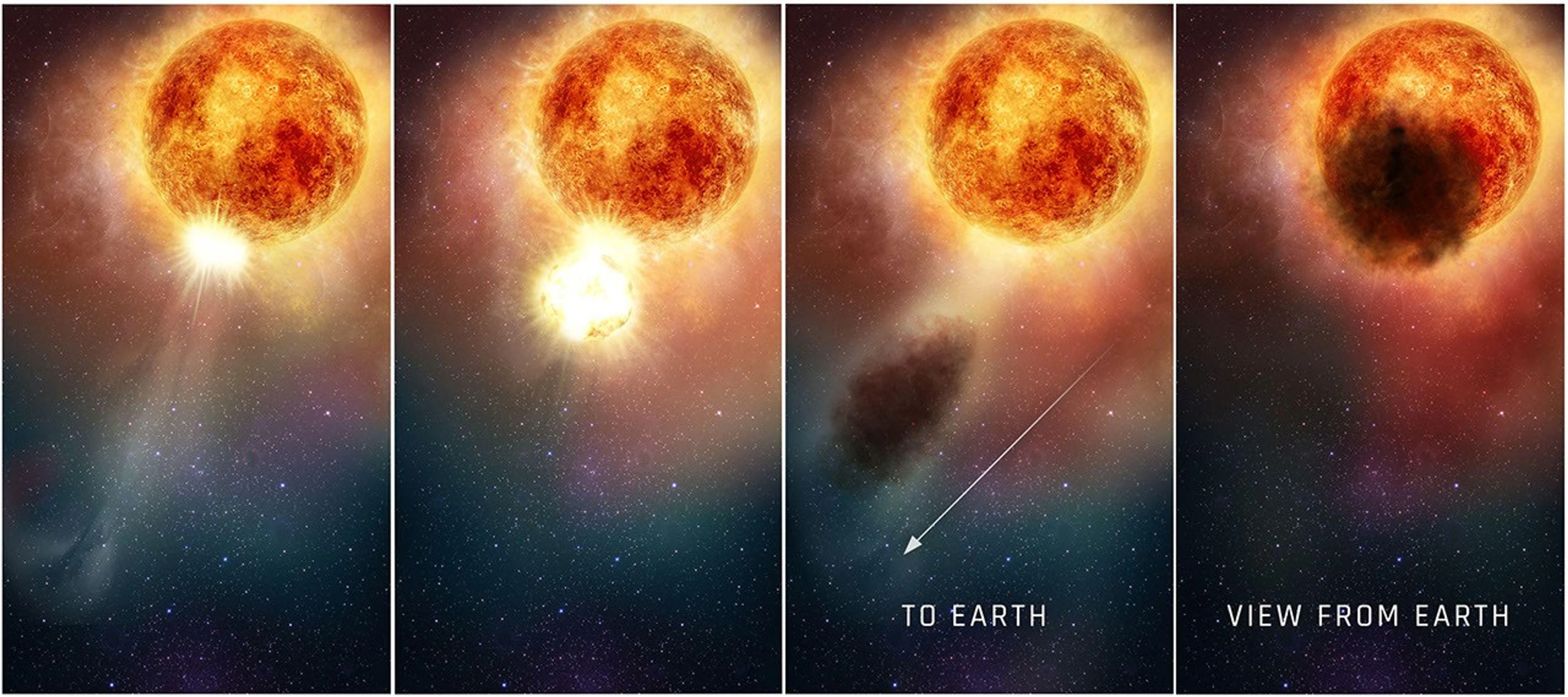
En 2019, Betelgeuse se atenuó repentinamente, generando rumores de una inminente explosión. Pero la culpa fue de nubes de polvo cósmico. Ahora, el telescopio Gemini North ha distinguido en su deslumbrante brillo una diminuta estrella compañera, predicha por cálculos.
Betelgeuse es como un reflector de estadio, y su compañero, una luciérnaga que destella justo en el haz. Es 250 veces más débil, pero los astrónomos lograron medir su posición y la diferencia de brillo. La coincidencia con la teoría resultó impresionante.
La vecindad explica las antiguas rarezas del gigante. Y lo principal: el compañero orbita alrededor de Betelgeuse en solo unos pocos años. Este veloz baile no solo pospone la posible explosión de supernova, sino que también da la oportunidad de seguir observando a la pareja. Las próximas observaciones serán en noviembre de 2027.
Resumen original
tal como lo escribieron los autores, en inglés arXiv:2601.02012v2
In the past six years, Betelgeuse has been in the news and drawn significant public interest. Starting in October 2019, Betelgeuse underwent a striking dimming event, fading from magnitude 0.5 to 1.7 by mid February 2020 a threefold decrease in brightness This gave rise to a number of speculative debates that the star was on the verge of a supernova, a moment of eerie quiet before the cosmic outburst. In a previous article, the author discussed the most accepted explanation to the dimming caused by episodic mass loss that released large dust grains, which obscured Betelgeuse's light and made it appear fainter. This interpretation suggested that the dimming was not a precursor to a supernova, as Betelgeuse is likely still far from reaching that stage. On 21 July 2025, the existence of the companion star was confirmed with direct imaging, for the first time, by the alopeke instrument on the 8.1 m Gemini North telescope. The companion is 6 magnitudes fainter than Betelgeuse and orbits close to Betelgeuse itself, within the supergiant star's extended outer atmosphere. The stellar companion was detected at an angular separation of 52 mas and a position angle of 115 deg east of north. These measurements, along with its brightness, being roughly 6 magnitudes fainter than Betelgeuse at 466 nm, are in excellent agreement with dynamical predictions. Although this was only a 1.5 sigma detection, the agreement in the companion's appearance, separation, position angle, magnitude difference, and estimated mass is reasonable, making the result tentatively acceptable. The next optimum period for observations is November 2027, when we hope to get better observations. This article describes the interesting twists and turns of this study and what lies in the future for Betelgeuse and its companion, Betelbuddy or Siwarha.
Los nombres no oficiales del compañero son Betelbuddy o Siwarha. Su órbita completa alrededor de Betelgeuse dura solo unos pocos años: en términos cósmicos, es un baile muy rápido.