Cómo los planetas gigantes conservaron su giro veloz exprés
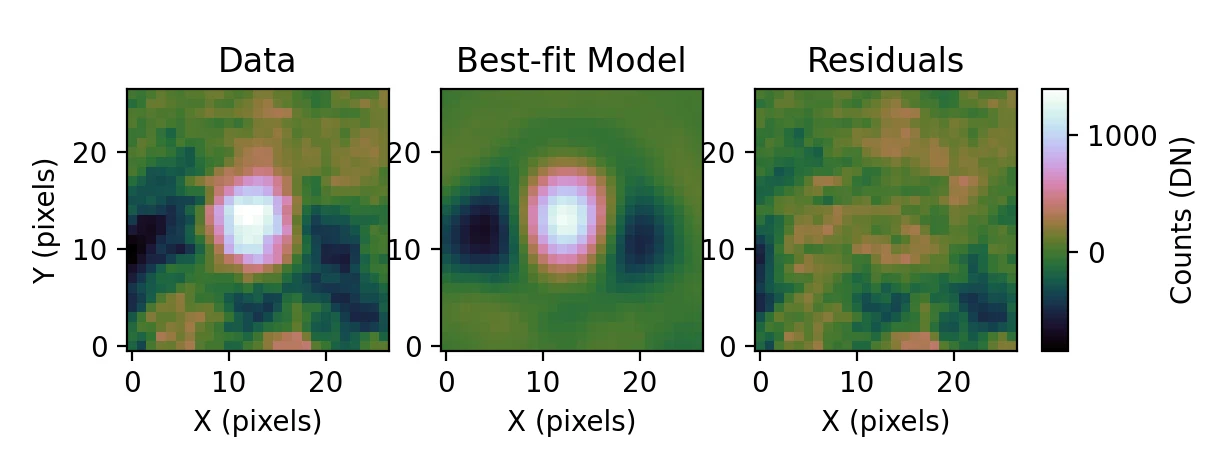
Usando el telescopio Keck y el método de espectroscopía (análisis de luz que revela la velocidad de rotación), los astrónomos midieron 32 objetos: desde planetas gigantes hasta enanas marrones, cuerpos más pesados que los planetas pero más ligeros que las estrellas y que no llegaron a encenderse.
Los planetas gigantes giran casi al límite de la ruptura: su capullo gaseoso al nacer apenas los frenó, como hielo bajo un trompo. Las enanas marrones perdieron rotación rápidamente: su disco actuó como arena. Es más, las enanas marrones ligadas a estrellas se frenaron más que las solitarias; los planetas, en cambio, giran igual sin importar la compañía.
Sorpresa: los objetos de 5 a 40 masas de Júpiter conservaron más rotación que los más masivos (40–100 masas de Júpiter). Al parecer, al formarse, cruzar cierto umbral activa un potente frenado. Júpiter, con sus días de 10 horas, es solo un modesto ejemplo: muchos planetas gigantes giran aún más rápido, equilibristas al borde de la autodestrucción.
Resumen original
tal como lo escribieron los autores, en inglés arXiv:2601.05976v3
We present a rotational velocity (vsini) survey of 32 stellar/substellar objects and giant planets using Keck/KPIC high-resolution spectroscopy, including 6 giant planets (2-7 M$$_\mathrm{Jup}$$) and 25 substellar/stellar companions (12-88 M$$_\mathrm{Jup}$$). Adding companions with spin measurements from the literature, we construct a curated spin sample for 43 benchmark stellar/substellar companions and giant planets and 54 free-floating brown dwarfs and planetary mass objects. We compare their spins, parameterized as fractional breakup velocities at 10 Myr, assuming constant angular momentum evolution. We find the first clear evidence that giant planets exhibit distinct spins versus low-mass brown dwarf companions (10 to 40 M$$_\mathrm{Jup}$$) at 4-4.5 $$\sigma$$ significance assuming inclinations aligned with their orbits, while under randomly oriented inclinations the significance is at 1.6-2.1 $$\sigma$$. Our findings hold when considering various assumptions about planets, and the mass ratio below 0.8% gives a clean cut for rotation between giant planets and brown dwarf companions. The higher fractional breakup velocities of planets can be interpreted as less angular momentum loss through circumplanetary disk braking during the planet formation phase. Brown dwarf companions exhibit evidence of slower rotation compared to isolated brown dwarfs, while planets and planetary mass objects show similar spins. Finally, our analysis of specific angular momentum versus age of 221 stellar/substellar objects below 0.1 M$$_{\odot}$$ with spin measurements in the literature indicates that the substellar objects of 5-40 M$$_\mathrm{Jup}$$ retain much higher angular momenta compared to stellar and substellar objects of 40-100 M$$_\mathrm{Jup}$$ after 10 Myr, when their initial angular momenta were set.
Un día en Júpiter dura solo 10 horas, más corto que en cualquier otro planeta del Sistema Solar.