Dimitri Mawet

11 articles · 30 co-authors · latest: 2026-07-28
1,071 citations · h-index 15 · 185 papersData: Semantic Scholar

We have retold 11 papers by this author. 2 of them with a full read. most often about: Sun, exoplanet, brown dwarf. 30 co-authors across our retellings.

Links in the knowledge graph
A Beacon Near Our Nearest Sun: First Glimpse of a Planet around Alpha Centauri A
In August 2024, the MIRI coronagraph on the James Webb Space Telescope stared at Alpha Centauri A, the nearest Sun-like star to our Sun. At 1.5 arcseconds from the star, a point source, S1, blinked into view. Flux: 3.5 mJy, contrast: 5.5×10⁻⁵. Four to six sigma. A lighthouse flashing in the fog.
Exoplanets2026-01-091 minarXiv:2601.05976express
Exoplanets2026-02-103 minarXiv:2602.09422express
Four Giants and Traces of Snow Lines
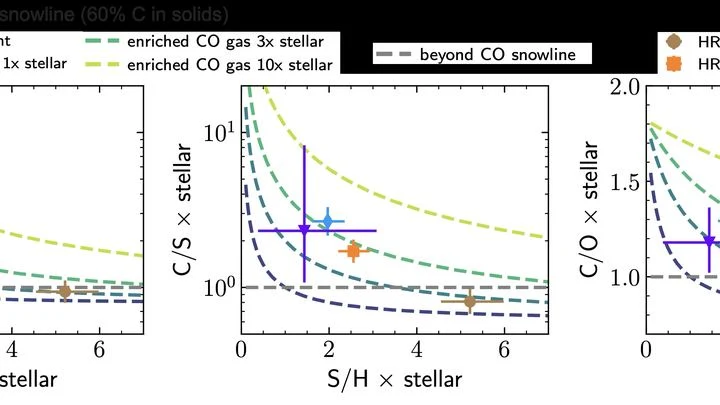
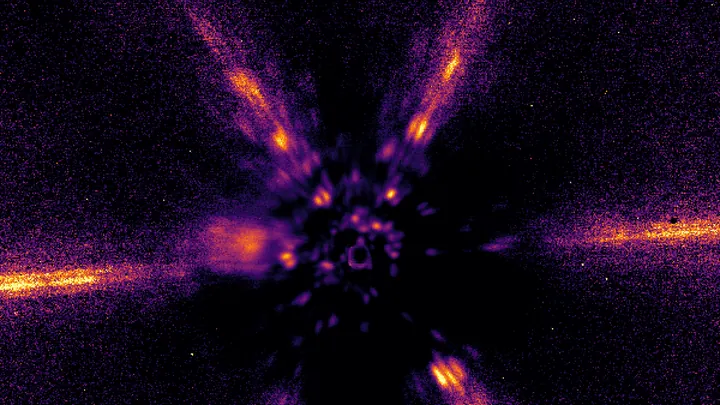
130 light-years away, four giant planets orbit the young star HR 8799—each 5 to 10 times more massive than Jupiter. They lie far from the star, at distances from 15 to 70 astronomical units (one astronomical unit is the distance from Earth to the Sun).
Exoplanets2026-02-101 minarXiv:2602.10198express
Two New Worlds Around Young Stars
In the dark clouds of gas and dust where new stars are just igniting, the Keck Telescope in Hawaii picked out two faint points of light next to young stellar objects. These aren't stars but their companions — too light to shine on their own.
Exoplanets2026-03-093 minarXiv:2603.08787express
A Warm Giant Next Door
Three and a half parsecs from the Sun, among the dim stars of the southern sky, hides a world that astronomers have been trying to see for thirty years. Epsilon Indi Ab is a gas giant, cold as a winter night: its temperature is about 275 kelvins, just above the freezing point of water.
Stellar2026-03-172 minarXiv:2603.17038express
A Brown Dwarf That Feeds Its Neighbor
Two faint embers circle each other in the dark so closely that one begins to tear glowing chunks off the other. That is the picture of the system ZTF J1239+8347, caught by the Zwicky Transient Facility telescope.
Stellar2026-03-172 minarXiv:2603.17040express
The Cosmic Waltz of Ultracool Dwarfs
Two dim stars whirl so close together that one siphons material off the other, like a spoon delicately skimming foam from broth. Astronomers have for the first time calculated the fate of such pairs — ultracool and brown dwarfs, the coldest and dimmest inhabitants of the galaxy. Previously, it was thought that mass exchange between them was impossible: they were too fragile.
Instrumentation2026-03-231 minarXiv:2603.22551express
Invisible Rings Snuff Out Starlight
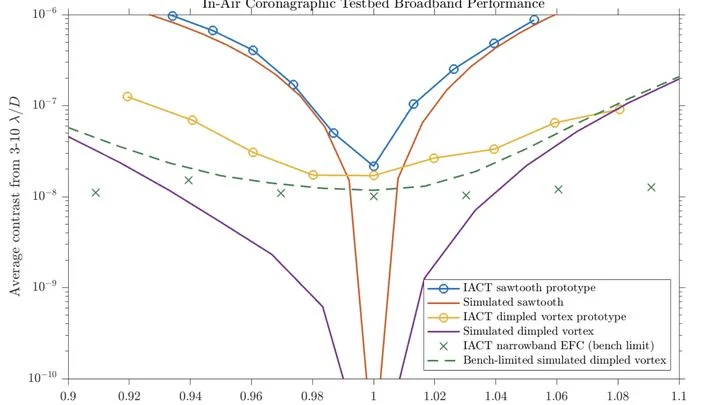
A star shines billions of times brighter than its planet. To see the planet, you need to quench the starlight, like shading your eyes with your hand to spot an airplane against the sun. Telescopes use a mask with a clever pattern that twists the star's light into a ring and cancels it out, while the planet's light passes through almost untouched.
Stellar2026-04-041 minarXiv:2604.03767express
A Star’s Companion Hides a Secret Twin
The companion of the star HIP 53005 has stumped astronomers. Its color and brightness and spectrum point to a mass of about 80 Jupiters — right at the hydrogen-burning limit, where an object is no longer a planet but not yet a star. Yet its orbital motion demands nearly twice that mass: 185 Jupiters.
Exoplanets2026-06-222 minarXiv:2606.23899express
The Glow of an Escaping Atmosphere
A world where a year lasts just one and a half Earth days, and the star in its sky is hundreds of times larger than our Sun. This is KELT-9 b — a gas giant heated to temperatures at which iron vaporizes. Its atmosphere is not just hot; it is literally boiling away into space, like steam rising from a giant cauldron.
Tricoupler on a Chip: The Knot That Cancels Starlight
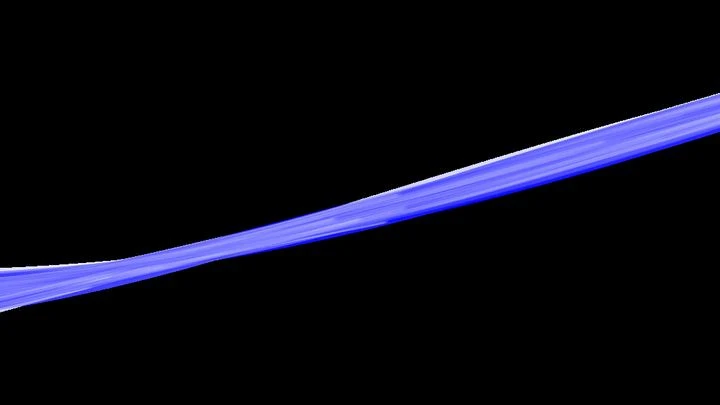
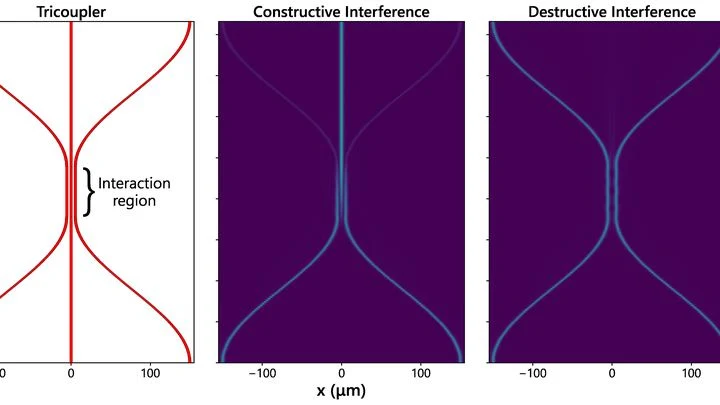
Every night, hundreds of observatories scan the sky, yet planets around other stars remain ghosts. Their light is billions of times fainter than the glare of their parent star — the task seems hopeless. But optics found a way: rather than block the star’s light, cancel it with a counter-wave of the same amplitude, shifted by half a period.