Jerry W. Xuan

9 articles · 30 co-authors · latest: 2026-08-30
767 citations · h-index 16 · 72 papersData: Semantic Scholar

We have retold 9 papers by this author. 1 of them with a full read. most often about: brown dwarf, white dwarf, angular momentum. 30 co-authors across our retellings.

Links in the knowledge graph
Exoplanets2026-01-091 minarXiv:2601.05976express
Exoplanets2026-02-103 minarXiv:2602.09422express
Four Giants and Traces of Snow Lines
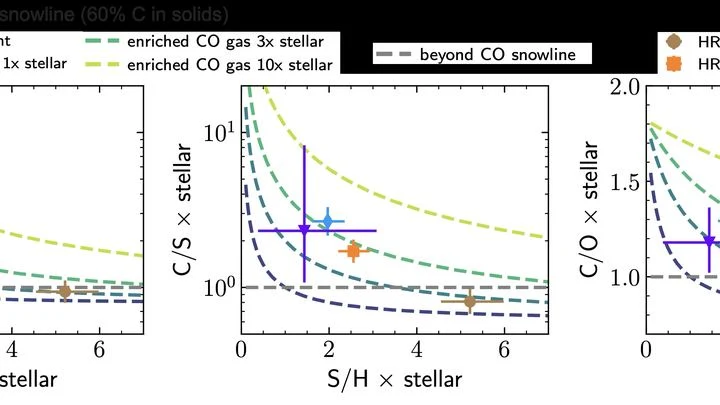
130 light-years away, four giant planets orbit the young star HR 8799—each 5 to 10 times more massive than Jupiter. They lie far from the star, at distances from 15 to 70 astronomical units (one astronomical unit is the distance from Earth to the Sun).
Stellar2026-03-172 minarXiv:2603.17038express
A Brown Dwarf That Feeds Its Neighbor
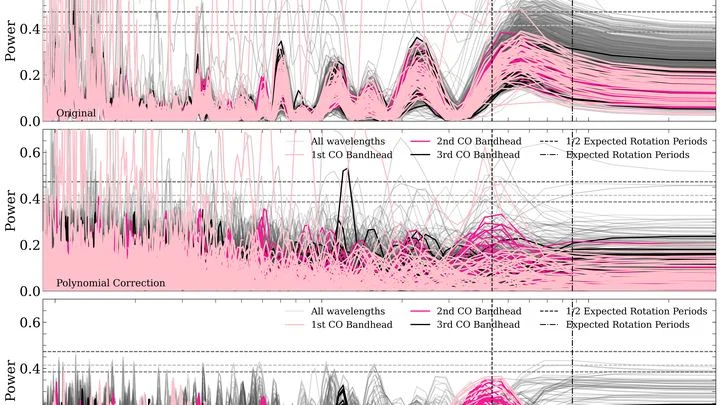
Two faint embers circle each other in the dark so closely that one begins to tear glowing chunks off the other. That is the picture of the system ZTF J1239+8347, caught by the Zwicky Transient Facility telescope.
Stellar2026-04-041 minarXiv:2604.03767express
A Star’s Companion Hides a Secret Twin
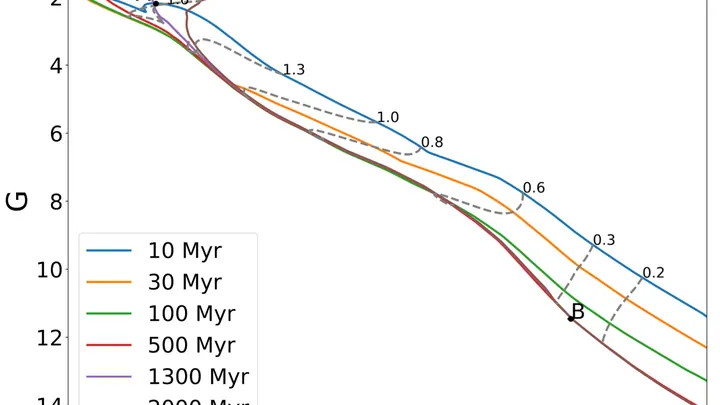
The companion of the star HIP 53005 has stumped astronomers. Its color and brightness and spectrum point to a mass of about 80 Jupiters — right at the hydrogen-burning limit, where an object is no longer a planet but not yet a star. Yet its orbital motion demands nearly twice that mass: 185 Jupiters.
Exoplanets2026-06-102 minarXiv:2606.11972express
Giant Planet Reveals Its Birth Secrets Through a Rare Molecule
In the attic, you find an old, worn suitcase. From the stickers and scratches, you can guess where it's been. Astronomers have long searched for a similar 'sticker' for planets, and thought they found it in carbon monoxide molecules. Ordinary carbon monoxide consists of a carbon-12 atom and an oxygen atom.
Exoplanets2026-06-221 minarXiv:2606.23789express
James Webb Fishes Out an Invisible Planet from a Dusty Disk
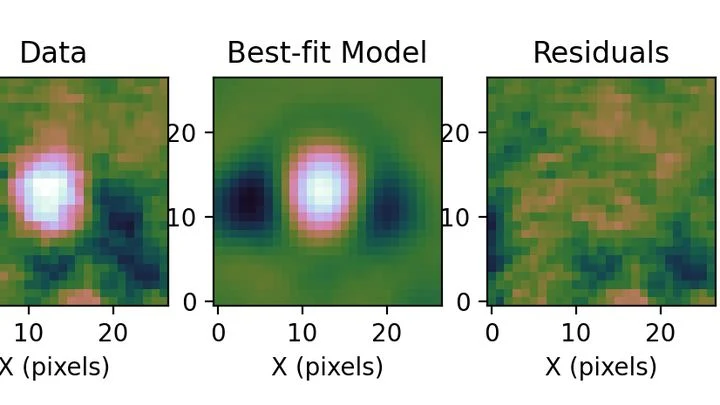
Using James Webb, astronomers 'fished out' a third giant planet from the murky dust disk of the star β Pictoris. Two others were already known, but this one was hiding in the bright light, like a fish in muddy water.
Exoplanets2026-06-222 minarXiv:2606.23899express
The Glow of an Escaping Atmosphere
A world where a year lasts just one and a half Earth days, and the star in its sky is hundreds of times larger than our Sun. This is KELT-9 b — a gas giant heated to temperatures at which iron vaporizes. Its atmosphere is not just hot; it is literally boiling away into space, like steam rising from a giant cauldron.
Exoplanets2026-08-161 minarXiv:2608.15912express
Stellar Recipes for Planets
Two stars, AF Lep A and ε Indi A, have become the focus of close attention. Using the GHOST spectrograph on the Gemini telescope, astronomers split their light into colors and, from absorption lines, determined how much carbon, oxygen, sulfur, and thirteen other elements are in the stars' atmospheres.
Gamma Cephei: How 45 Years of Observations Rewrote the Family Portrait of a Binary Star
The family album of this stellar pair has been filling up for 45 years, but the pictures were blurry and the captions contradictory. Now astronomers have pulled out the old photographs, taken new sharp shots, and put everyone back in their proper places. Gamma Cephei is a bright star visible to the naked eye, and it has an invisible companion that orbits it every 70 years.