Cómo enfriar la luz hasta el orden cuántico exprés
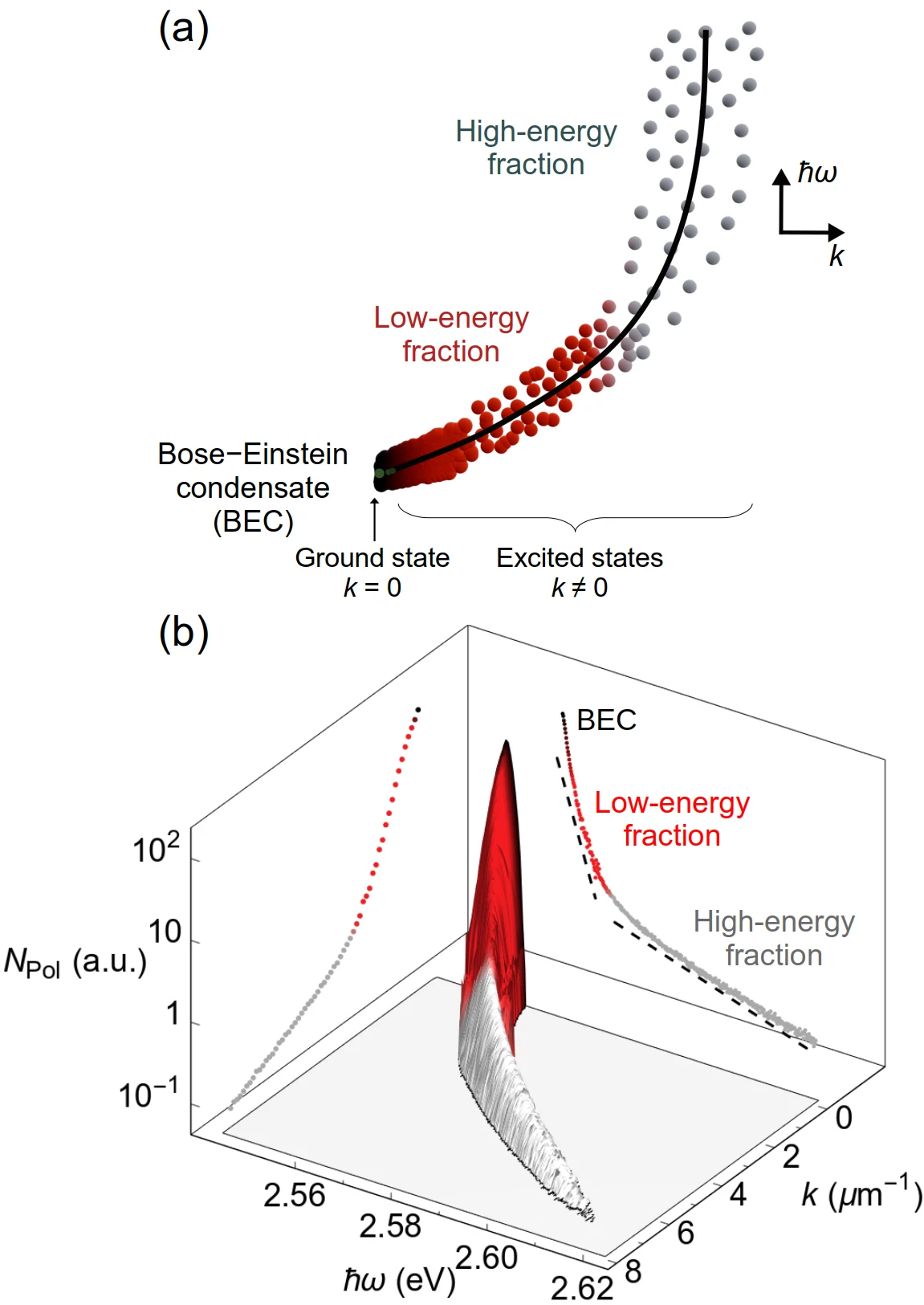
Enfriar suele imponer orden: el agua se congela en hielo. Pero en el mundo cuántico, el orden adopta formas inesperadas. Los experimentadores enfriaron polaritones —partículas que son a la vez luz y materia— casi hasta el cero absoluto. En lugar de congelarse simplemente, la nube comenzó a «bailar», sincronizando las oscilaciones de todas las partículas en un solo ritmo. Sin embargo, luego el baile se desdobló: la nube se dividió en dos «pistas de baile» con diferentes tempos, cada una obedeciendo las leyes descubiertas por Bose y Einstein. Lo más asombroso es que la temperatura de estas regiones no resultó del calentamiento, sino del número de partículas en cada grumo. Cuanto más apretada está la multitud, más caliente es el baile. Este principio inesperado es universal para sistemas cuánticos alejados del equilibrio y podría aplicarse en futuros dispositivos que funcionen al borde de los efectos cuánticos.
Resumen original
tal como lo escribieron los autores, en inglés arXiv:2601.15080
We report on the experimental observation of stimulated cooling in the non-equilibrium Bose-Einstein condensate (BEC) of weakly interacting exciton-polaritons from approximately room temperature down to 20K. By resolving the condensate in energy-momentum space and performing interferometric measurements, we distinguish the condensate from thermalized particles yet occupying excited states macroscopically. In contrast to the analytical quantum theories of non-equilibrium BEC [Shishkov et al., Phys. Rev. Lett. 128, 065301 (2022)], we observe segmentation of the particle density along the excited states into two fractions both following Bose-Einstein distribution, albeit with different effective temperatures and chemical potentials. Our results indicate that the temperature of the weakly interacting Bose gas is universally set by the density-dependent chemical potential, revealing a defining property of non-equilibrium BECs. Finally, we demonstrate that the stimulated nature of the cooling process directly governs the emergence of quantum coherence of the condensate and shapes the dissipative properties of the excited states.
Los polaritones son miles de millones de veces más ligeros que los átomos, por lo que su enfriamiento ocurre en un instante incluso a temperaturas relativamente «altas» para el mundo cuántico.