Donde nacen las estrellas: los filamentos del universo exprés
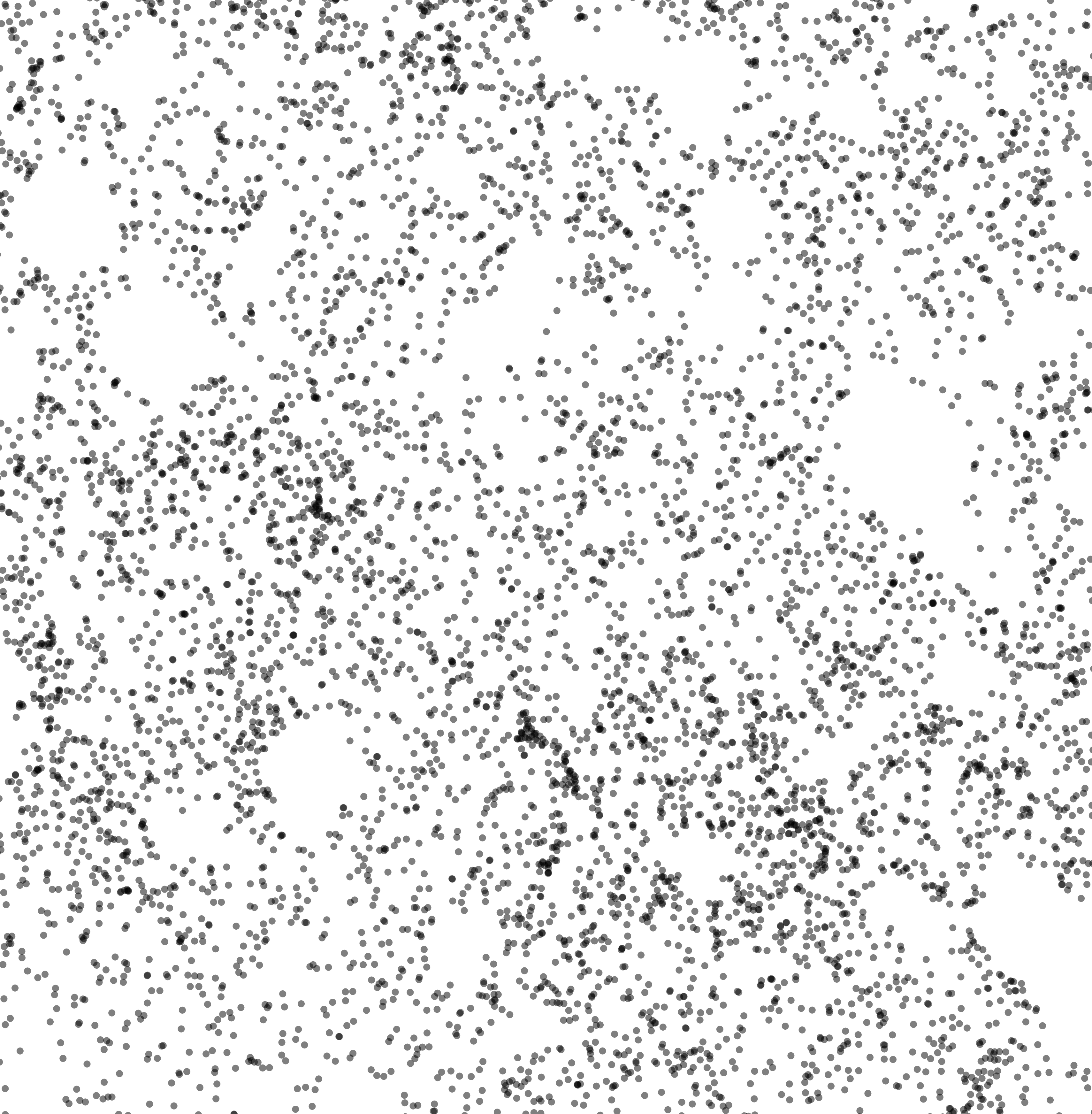
El universo se parece a una telaraña gigante: las galaxias no están dispersas al azar, sino que se agrupan en nodos y a lo largo de filamentos. Dentro de los filamentos hay mucho gas, y es allí donde con mayor frecuencia brotan estrellas nuevas. Pero, ¿cómo ha cambiado esto con el tiempo? Los científicos compararon datos de un modelo computacional con observaciones reales de miles de galaxias.
Resulta que en el universo joven, las galaxias con formación estelar intensa realmente se apiñaban cerca de los filamentos. En cambio, en épocas más recientes, se alejaron. Las galaxias tranquilas, donde apenas nacen estrellas, con el tiempo se acercaron cada vez más a los filamentos. Las galaxias con un ritmo normal de formación estelar se mantuvieron en un punto intermedio.
Esto no es solo un dato curioso. Significa que la estructura a gran escala del universo —los filamentos y los vacíos— controla directamente la vida de las galaxias. Y esto se observa incluso a distancias de miles de millones de años luz.
Resumen original
tal como lo escribieron los autores, en inglés arXiv:2602.21890
Cosmological simulations suggest that various galaxy properties depend on their location within the cosmic web. Yet direct observational evidence of the dependence of star formation activity on distance to filaments remains scarce and is missing at z>1. We investigate how starburst, main-sequence (MS), and quenched galaxies are distributed with respect to cosmic web filaments, and how this distribution evolves with redshift. We first use the SIMBA cosmological simulation to predict the redshift evolution of the mean distance to the closest filament from z=3 to z=0 for different galaxy populations after removing stellar-mass dependencies. We then measure the corresponding signal in the COSMOS field, using COSMOS2020 and COSMOS-Web data, where accurate photometric redshifts enable reconstruction of the projected cosmic web from z=2 to z=0.5, and starbursts are identified through far-infrared spectral energy distribution fitting. In agreement with the results from SIMBA, starburst galaxies are found closer to filaments at z>1 and at larger distances at z<1, MS galaxies occupy intermediate environments with little evolution, and quenched galaxies show progressively shorter distances to filaments toward low redshift, with a crossing between starburst and MS populations around z~1. In COSMOS-Web, the relative evolution in the average distance to filaments between starburst and MS galaxies is detected at a significance level of at least 5{\sigma}. We show that a minimal toy model in which the only environmental ingredient is the sSFR-filament distance modulation measured in simulations is sufficient to reproduce the observed differential evolution of the average filament distance between starburst and MS galaxies. These results show that the imprint of large-scale environmental effects on the star formation activity of galaxies, predicted by simulations, is detectable from z=2 down to z=0.5.
Los estallidos más brillantes de formación estelar en el universo joven ocurrían cerca de los filamentos cósmicos, y después de miles de millones de años el panorama se invirtió.