La memoria gravitacional hace más estables los agujeros de gusano exprés
Los agujeros de gusano son túneles a través del espacio curvo, permitidos por la teoría general de la relatividad. Para ser estables requieren energía repulsiva — aquella que no atrae, sino que repele. Una fuente puede ser el efecto Casimir, descubierto por Hendrik Casimir: dos placas en el vacío se acercan entre sí, como si el espacio entre ellas las empujara hacia afuera.
Una onda gravitacional, al pasar a través del agujero, deja tras de sí una tensión — memoria gravitacional: una huella que no desaparece. Dentro del túnel, esta huella añade energía ordinaria a la repulsiva, mezclándolas. En la garganta la fuerza expansiva es mayor, y a los lados el túnel se mantiene más suave — el agujero se vuelve estable.
Recalculando la forma, los autores mostraron: tal agujero proyecta una sombra como un agujero negro, replicando exactamente la silueta de M87*, medida por el Telescopio del Horizonte de Sucesos. Sorpresa: si varias ondas han pasado, las huellas se superponen y la sombra puede temblar. Quizás los telescopios ya ven estos objetos, sin distinguirlos aún de los agujeros.
Resumen original
tal como lo escribieron los autores, en inglés arXiv:2606.15552
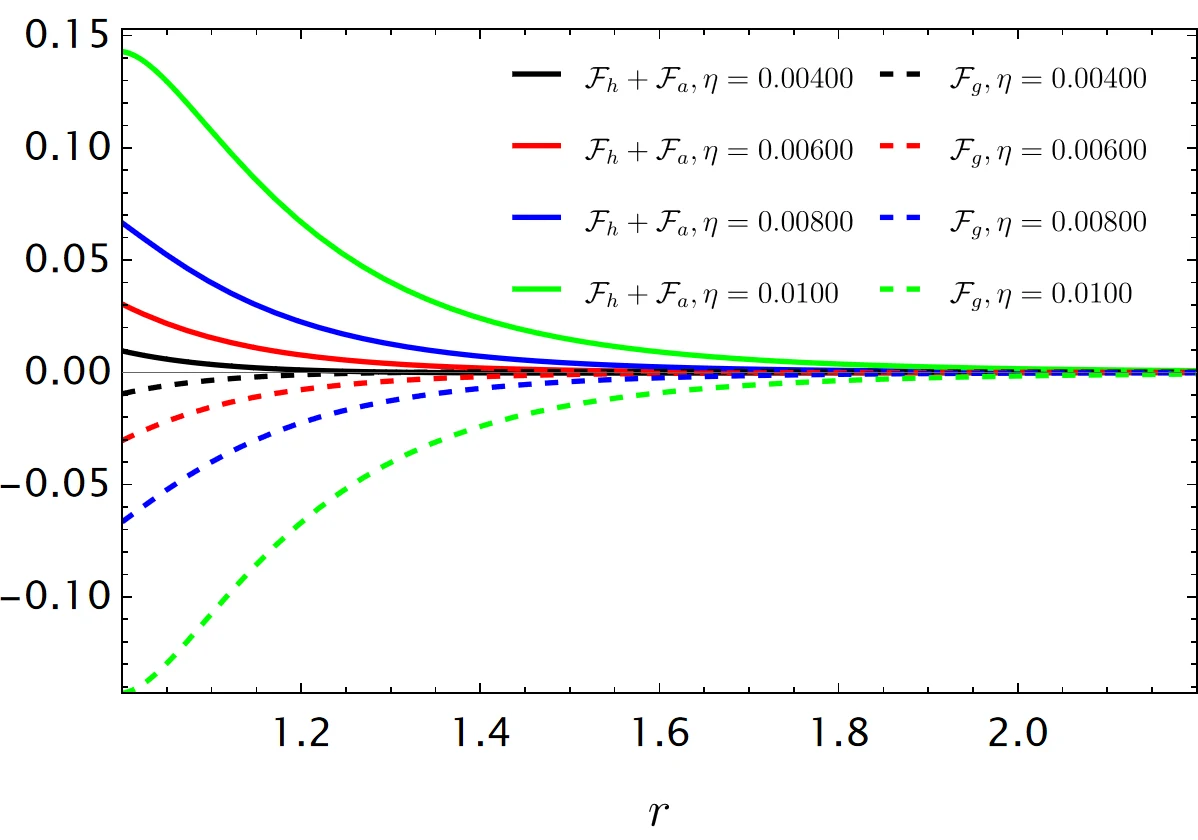
We investigate a class of traversable wormhole geometries supported by an effective Casimir source corrected by gravitational memory. The construction is motivated by the fact that a time-dependent gravitational background can leave a permanent positive shift in the vacuum polarization of a quantum field confined to a Casimir cavity. By promoting the plate separation to an effective radial scale in the Morris-Thorne spacetime, we obtain a density profile composed of the usual negative Casimir contribution, proportional to $$r^{-4}$$, and a positive memory-induced correction, proportional to $$r^{-7}$$. The corresponding shape function is derived directly from the Einstein equations and satisfies the throat condition by construction. We determine the redshift function from a constant barotropic equation of state together with the requirement of regularity at the throat, which fixes the barotropic parameter in terms of the Casimir and memory coefficients. The flare-out condition defines the admissible range of the memory parameter and separates a Casimir-dominated sector from a phantom-like sector, with the transition point associated with a singular limit of the constant-barotropic description. We analyze the curvature scalar, the embedding structure, the energy conditions, and the Tolman-Oppenheimer-Volkoff equilibrium of the anisotropic matter source. The radial null energy condition is necessarily violated at the throat, while the tangential sector depends sensitively on the redshift gradient. We also examine the shadow radius as a phenomenological diagnostic and show that admissible solutions can overlap the EHT range for M87*. The results indicate that gravitational memory can deform Casimir-supported wormholes by softening the ordinary Casimir contribution, modifying the near-throat geometry, and reshaping the internal stress balance required to sustain traversability.
El efecto Casimir fue predicho por Hendrik Casimir en 1948 durante una taza de café mientras discutía las propiedades del vacío.
El agujero de gusano como portal es conocido por la película 'Interstellar', donde la base científica fue aportada por Kip Thorne.