Bételgeuse n'est pas seule : une étoile compagne découverte express
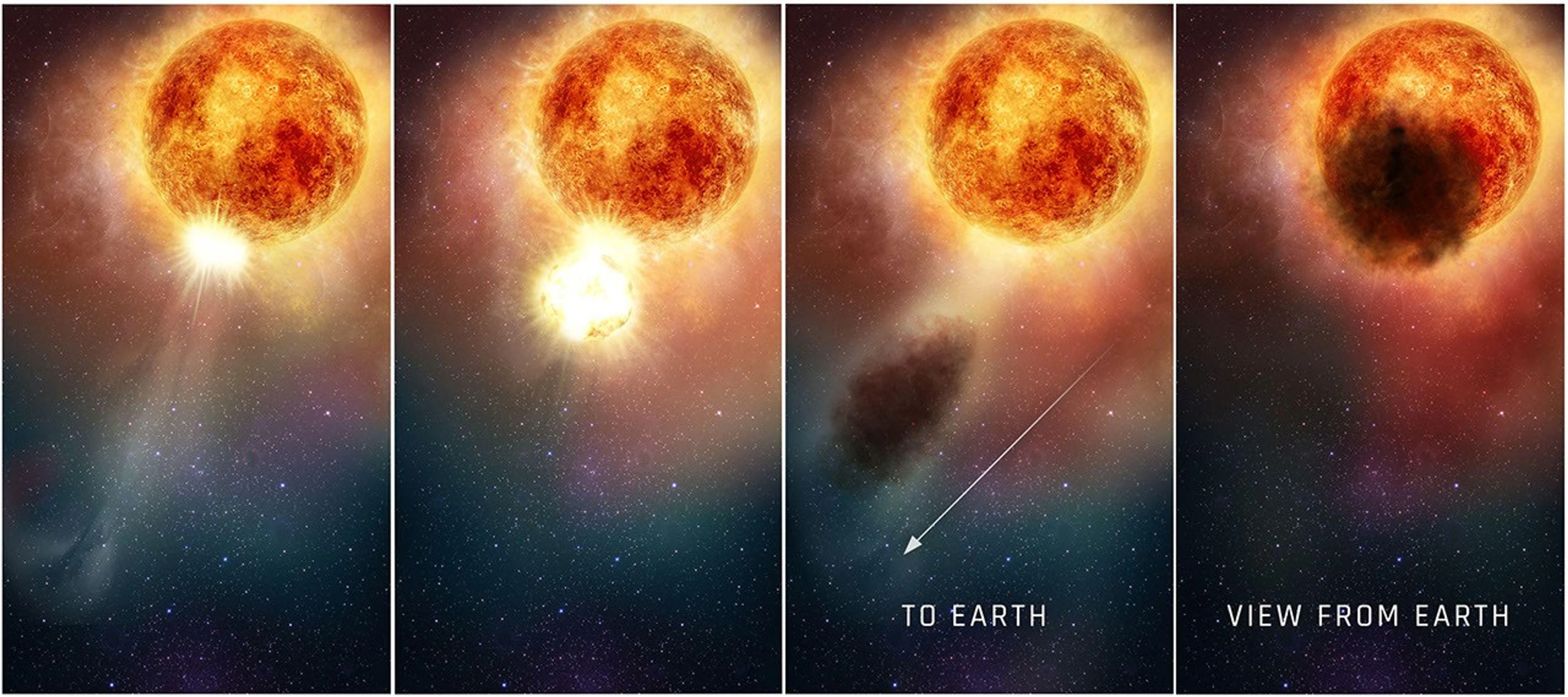
En 2019, Bételgeuse a soudainement pâli, alimentant les rumeurs d'une explosion imminente. Mais en réalité, des nuages de poussière cosmique en étaient responsables. Aujourd'hui, le télescope Gemini North a repéré, dans son éblouissante lumière, une minuscule étoile compagne, prédite par les calculs.
Bételgeuse est comme un projecteur de stade, et son compagnon, une luciole qui scintille juste dans le faisceau. Il est 250 fois plus faible, mais les astronomes ont réussi à mesurer sa position et la différence de luminosité. La concordance avec la théorie est impressionnante.
Ce voisinage explique d'anciennes bizarreries de la géante. Surtout, le compagnon tourne autour de Bételgeuse en seulement quelques années. Cette danse rapide non seulement repousse l'éventuelle explosion en supernova, mais offre aussi la possibilité de suivre le couple plus longtemps. Les prochaines observations sont prévues en novembre 2027.
Résumé original
tel que rédigé par les auteurs, en anglais arXiv:2601.02012v2
In the past six years, Betelgeuse has been in the news and drawn significant public interest. Starting in October 2019, Betelgeuse underwent a striking dimming event, fading from magnitude 0.5 to 1.7 by mid February 2020 a threefold decrease in brightness This gave rise to a number of speculative debates that the star was on the verge of a supernova, a moment of eerie quiet before the cosmic outburst. In a previous article, the author discussed the most accepted explanation to the dimming caused by episodic mass loss that released large dust grains, which obscured Betelgeuse's light and made it appear fainter. This interpretation suggested that the dimming was not a precursor to a supernova, as Betelgeuse is likely still far from reaching that stage. On 21 July 2025, the existence of the companion star was confirmed with direct imaging, for the first time, by the alopeke instrument on the 8.1 m Gemini North telescope. The companion is 6 magnitudes fainter than Betelgeuse and orbits close to Betelgeuse itself, within the supergiant star's extended outer atmosphere. The stellar companion was detected at an angular separation of 52 mas and a position angle of 115 deg east of north. These measurements, along with its brightness, being roughly 6 magnitudes fainter than Betelgeuse at 466 nm, are in excellent agreement with dynamical predictions. Although this was only a 1.5 sigma detection, the agreement in the companion's appearance, separation, position angle, magnitude difference, and estimated mass is reasonable, making the result tentatively acceptable. The next optimum period for observations is November 2027, when we hope to get better observations. This article describes the interesting twists and turns of this study and what lies in the future for Betelgeuse and its companion, Betelbuddy or Siwarha.
Les noms officieux du compagnon sont Betelbuddy ou Siwarha. Il fait le tour complet de Bételgeuse en quelques années seulement – une danse très rapide à l'échelle cosmique.