Кольцо тепла в колыбели звезды экспресс
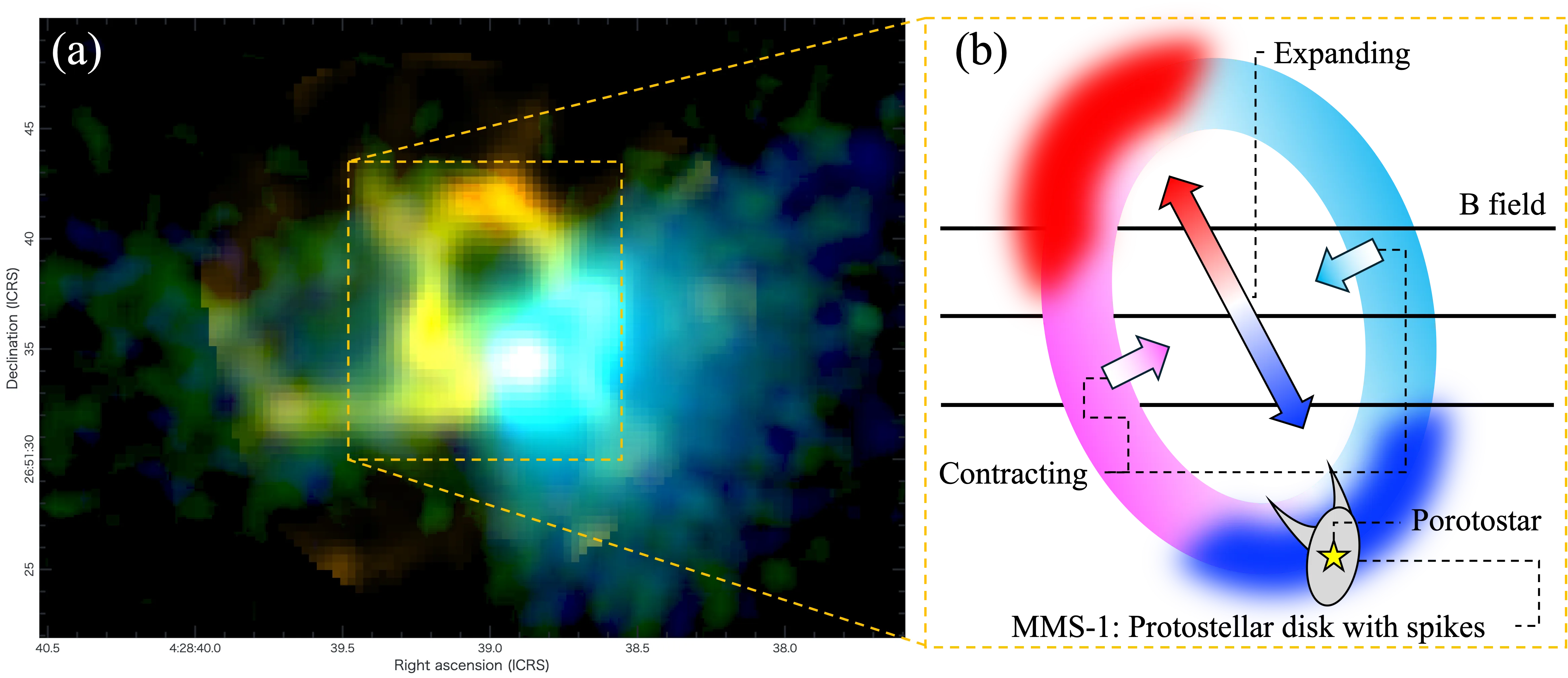
В холодном и тёмном облаке газа, где только начинает формироваться звезда, телескоп ALMA разглядел необычное кольцо. Оно состоит из газа, который теплее и плотнее окружающей среды. Раньше такие детали не удавалось увидеть, потому что газ в центре облака непрозрачен для обычных наблюдений.
Это кольцо, скорее всего, нагрето ударной волной. Когда вещество падает на формирующуюся звезду и одновременно выбрасывается от неё, потоки сталкиваются и сжимаются магнитным полем. В месте столкновения газ разогревается и начинает светиться в линиях угарного газа (CO). Наблюдения таких линий — новый способ заглянуть в самое начало жизни звезды.
Это открытие показывает, что даже в самых холодных и спокойных на вид облаках идут бурные процессы. Кольцо тепла — след первых движений, которые в итоге зажгут новую звезду.
Оригинальная аннотация
как её написали авторы, на английском arXiv:2602.12661
Infall and outflows, coupled with magnetic fields, rapidly structure the gas around newborn protostars. Shocks from interacting components encode the temperature and density distribution, offering a direct probe of the earliest evolution history. However, interferometric observations characterizing warm envelopes using high-excitation lines remain scarce. We present ALMA Band 9 observations of the Taurus dense core MC 27/L1521F, which hosts a Class 0 protostar, targeting the CO($$J$$=6-5) line at an angular resolution of $$\sim$$2\arcsec\ ($$\approx$$300 au). We detect an off-centered ring-like structure with a diameter of $$\sim$$1000 au that was not identifiable in previous low-$$J$$ CO data, where emission close to the systemic velocity is strongly affected by optical depth. The ring shows a typical peak brightness temperature of $$\sim$$3 K at our resolution. Excitation considerations indicate that the detected CO($$J$$=6-5) emission likely arises from relatively warm ($$T \gtrsim 20$$ K) and dense ($$n({\rm H_2}) \gtrsim 10^{5}$$ cm$$^{-3}$$) gas embedded within the surrounding cold, dense core. The morphology and kinematics suggest an energetic and localized shock-heating event, potentially linked to dynamical gas--magnetic-field interactions in the earliest protostellar phase. Our results demonstrate that high-$$J$$ CO observations provide a powerful new window on warm and dense gas components, enabling a more direct view of the physical processes operating at the onset of star formation.
Угарный газ (CO) — вторая по распространённости молекула во Вселенной после водорода. Он светится в радиодиапазоне, поэтому астрономы используют его как «краску», чтобы рисовать карты холодных облаков.