Почему у красных карликов меньше шансов на фотосинтез экспресс
Для фотосинтеза с выделением кислорода необходимо расщеплять воду. Это сродни водяному колесу: чтобы оно вращалось, нужен сильный поток. Свет выполняет роль потока, а частицы света — его струи. У красных карликов, самых распространённых звёзд, свет «холодный» и слабый — струи едва движут колесо.
Однако даже на Земле, с её ярким Солнцем, колесо использует лишь каплю доступной энергии. Теоретически возможный выход кислорода в тысячи раз выше реального. Поэтому сложная жизнь может прятаться незамеченной — а искать её стоит у звёзд, похожих на нашу.
Оригинальная аннотация
как её написали авторы, на английском arXiv:2602.20789
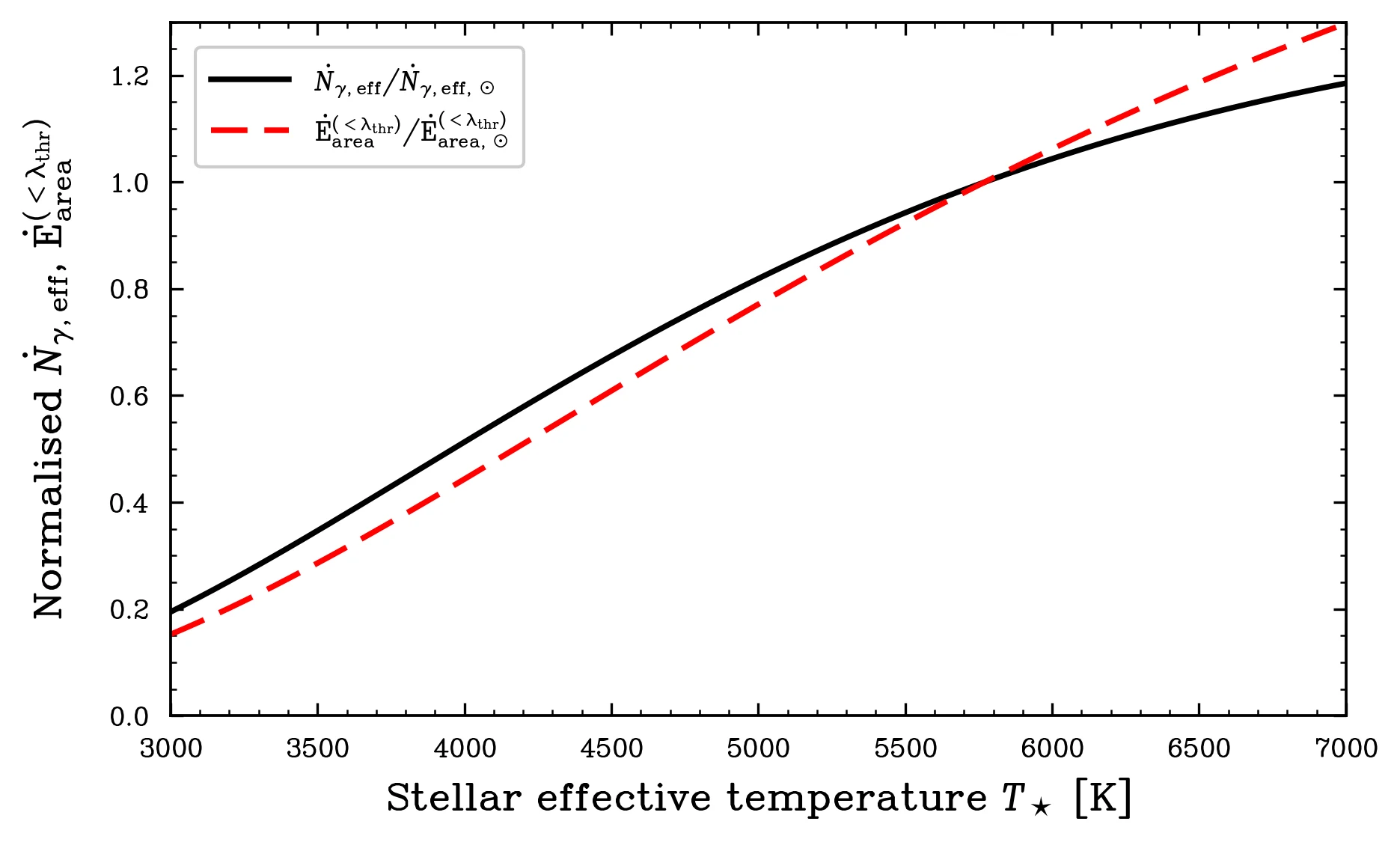
Photosynthesis is central to Earth's biosphere and a prime candidate for sustaining complex life on habitable exoplanets, yet a thermodynamically consistent treatment of the work potential of stellar radiation at planetary surfaces is still lacking. We develop a radiative-thermodynamic framework that quantifies the maximum useful work extractable for a given star-planet configuration and yields exergy-based bounds on photosynthetic power and long-wavelength absorption cutoffs. From these we derive kinetically constrained red limits for high-$$\Delta G$$ photochemistry and apply them to Earth-like planets receiving the same bolometric flux from FGK and M blackbody hosts, computing thresholded photon supplies and truncated exergy fluxes below a photosystem II red limit. For such planets the constraints confine single-photon oxygenic photosynthesis to near-infrared bands around Solar-type stars and to somewhat bluer wavelengths around late M dwarfs. Integrated over the stellar spectrum, the thresholded photon supply and truncated exergy available to drive a photosystem water-oxidation step are larger by factors $$\sim 5$$ around FGK hosts than around $$T_\star\approx 3000$$~K M dwarfs. For the Solar-Earth system, the exergy-based upper bound on O$$_2$$ production exceeds the observed O$$_2$$ throughput by several orders of magnitude, consistent with Earth's photosynthetic efficiencies. Cool M dwarfs suffer a double penalty: fewer photons above threshold and a lower shortwave exergy fraction, yielding systematically tighter ceilings on high-$$\Delta G$$ photosynthesis than around FGK stars. Our framework provides upper limits on photosynthetically harvestable power on habitable-zone planets and enables comparisons of photosynthetic potential across exoplanetary systems, and can be extended to multi-band photosystems.
Верхний теоретический предел получения кислорода на Земле в тысячи раз превышает то, что реально производят растения.